Sanjayovacha | New Delhi Needs To Reject Trump’s Donroe Doctrine | Sanjaya Baru
Given this history, it is not at all surprising that the United States is out to grab yet another oil-rich republic
Five hundred years ago Europeans set out conquering countries of what is now called the “Global South”, and discovered a world full of natural wealth. They conquered to extract silver.
They conquered to extract gold. They conquered to mine diamonds. They came for pepper, for nutmeg, for cardamom, for bananas. They conquered islands and populated them with slaves from other parts of the Global South to cultivate sugar for their cakes and tea. They deforested our lands to cultivate tea, coffee and rubber. And then they discovered oil and gas.
For five hundred years the Global West — defined today by membership of the North Atlantic Treaty Organisation (Nato) — comprising mainly Western Europe and North America, went around the world conquering territories, enslaving people, establishing colonial regimes and extracting resources.
At the turn of the last century electricity and the automobile were invented. Oil became the new gold. While oil reserves were found in the United States, much larger reserves were found in West Asia. Britain had secured control over the region. Hitler set out in search of it and was defeated. The United States stepped in and took control of the resources. Britain and France had already played a helpful role creating Arab potentates and calling them independent nations. Lines were drawn on the sand to create Saudi Arabia and the United Arab Emirates.
Britain and the United States then created a puppet regime, citing stray passages from the Old Testament, and called it Israel. A policeman for the region. Israel’s job was to make sure that it would guarantee the supply of oil to the West by keeping the sheikhs on a short leash. When the government in Tehran refused to play by the rules of the Western game, it was toppled. A puppet installed as a King.
Given this history, it is not at all surprising that the United States is out to grab yet another oil-rich republic. Today it’s not just oil but a variety of minerals, especially rare earths. The global demand for oil fed by a limited number of client countries ensured that the US dollar would become a global currency, irrespective of how badly it was managed at home.
The rise of China has for the first time in a century challenged American hegemony and geo-economic dominance. Unable to directly confront China and thwart its rise, even if it has not stopped trying, the United States has reissued a dated doctrine of regional hegemony.
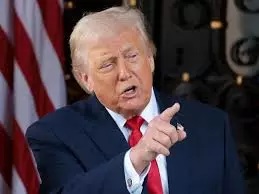
President Donald Trump calls it the “Donroe Doctrine”. The name recalls to geopolitical memory the 19th century Monroe Doctrine. This doctrine, enunciated by US President James Monroe in 1823, stated that the Western Hemisphere — spanning the continents of North and South America — was henceforth off limits to European imperialism. Spain, Portugal, France and Britain had all conquered various parts of these two continents. The US, a rising power of the 19th century, asserted its geopolitical dominance over the region.
During the Cold War, the Soviet Union challenged this doctrine, securing an alliance with Fidel Castro’s Cuba, and this brought the two superpowers to the brink of nuclear confrontation. The US tried hard to depose Castro but has thus far not succeeded in rolling back the Cuban revolution. Perhaps Mr Trump’s secretary of state, Marco Rubio, a Cuban American, hopes to achieve this objective now.
Before securing control over unfriendly countries like Cuba, Brazil and Colombia, Mr Trump has targeted a vulnerable Venezuela. Whatever be the credentials of a repressive Venezuelan regime, the abduction of a head of state and the imposition of regime change is highly condemnable.
It is regrettable, if not shocking, that the Government of India has responded to this act of Big Power gangsterism in a pusillanimous manner. It does not behove a nation that fancies itself as the protector of the interests of the Global South that it should merely regret what has happened, without condemning it.
Many have sought to draw a parallel with India’s silence over the Russian invasion of Ukraine. While Russia also breached another UN member country’s sovereignty, it invoked serious national security concerns, especially Ukraine’s attempt to seek Nato membership.
The eastward expansion of Nato in the post-Cold War period posed a serious challenge to Russian national security.
Nicolas Maduro’s regime in Venezuela posed no such threat to the United States.
The charge of narco-terrorism is overblown. In any case, Mr Trump has justified his action in terms of what he has himself termed as the “Donroe Doctrine”. In other words, that the US has a legitimate claim to impose its will on its neighbourhood. From bananas to rare earths, the American search has been for commodities. National security is an afterthought. Grabbing resources is the real motivation.
India must reject the Donroe Doctrine in its own national interest. Big Powers cannot be allowed the right to impose their will on their neighbourhood where no national security interest exists. In all the commentary that has appeared in India on the Trump administration’s National Security Strategy, few in India have directly challenged and rejected the Donroe Doctrine. As a self-proclaimed defender of the Global South, India must reject the doctrine. Prime Minister Narendra Modi has often claimed that India is a “Vishwa Guru” and a “Vishwa Mitra”.
In all these capacities, India ought to have the courage to at least say what Prime Minister Anwar Ibrahim of Malaysia has had the courage to say. Seek the immediate release of an illegally captured head of state, of a UN member country, and his wife.
The only redeeming aspect of this most reprehensible act on the part of the US is the extent of the domestic criticism of Mr Trump. Senior leaders of the Democratic Party, from Nancy Pelosi and Berny Sanders to Zohran Mamdani and Ro Khanna, have all condemned Mr Trump.
This gives us some hope. It should be remembered that Mr Trump’s popularity has taken a nosedive over the past few weeks. He has a very low approval rating now. Consequently, the Republicans are expected to lose their majority in the Senate, if not the House of Representatives, in the elections later this year.
All this must have weighed on a beleaguered President’s mind. It is quite common around the world for political leaders facing declining popularity at home to point to external challenges.
Sanjaya Baru is a writer and an economist and is Distinguished Senior Fellow, Takshashila Institution. His most recent book is Secession of the Successful: The Flight Out of New India.
