SANJAYOVACHA | Farewell To A Friend: A Hyd Environmentalist | Sanjaya Baru
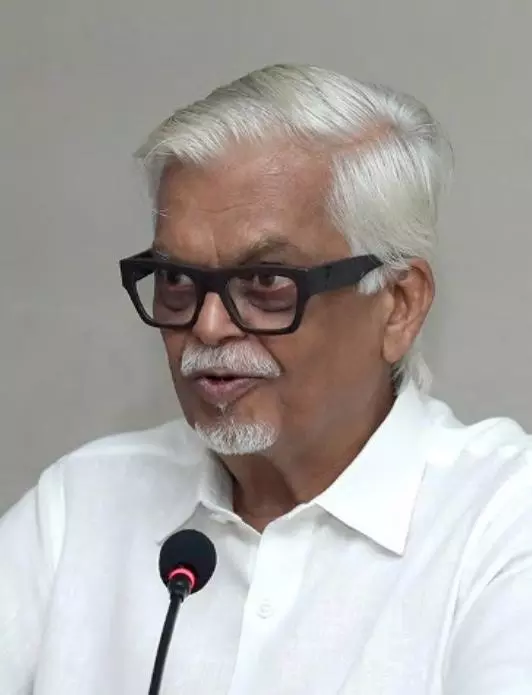
But the voice that dominated all conversation was of Komandur Santana Gopal. Some called him KS, others just Gopal. There was only one Gopal of any consequence in that city, at that time. He passed away on May 16, 2026, aged 74
It is a non-descript street. Not more than half a kilometre. From the Hyderabad YMCA to Barkatpura circle. Driving down that street a couple of months ago brought a flood of memories. I was going to meet a friend from my school and college days who was battling cancer. In a metropolis where so much has changed, little had on this street where I had spent many a youthful evening with him. Bliss was it in that “dusk”, with apologies to Wordsworth, to be alive, but to be young was very heaven.
An evening walk up and down that street was filled with conversations on neighbourhood girls, the Vietnam war, Karl Marx and the songs of Mohammad Rafi -- yeh duniya agar milbhi jaye to kya hai? There was Umakant and Pradeep and sometimes even Sitaram (who became famous as Yechury). But the voice that dominated all conversation was of Komandur Santana Gopal. Some called him KS, others just Gopal. There was only one Gopal of any consequence in that city, at that time. He passed away on May 16, 2026, aged 74.
We went to different schools and later different colleges, but in the late 1960s and early 1970s we came together as enthusiastic debaters. Members of a debating club. The Mock Parliament and Mock Assembly we organized and participated in witnessed impressive performances. Gopal always excelled as leader of an Opposition party, uncomfortable in the role of a chief minister. That summed up his personality.
Every evening we would meet at an Irani café in Narayanguda, and occasionally walk to the modest apartment of Communist ideologue Mohit Sen.
That is where I first met the late George Reddy, the slain student leader, who like Gaddar inspired many of my generation. We were as comfortable in that cosy flat, sitting on the floor, imbibing knowledge from Comrade Mohit, as we would be at the well-appointed home of Sen’s brother, N.P. “Potla” Sen, in one of the palaces of an erstwhile nawab that became the campus of the Administrative Staff College of India (ASCI).
As ASCI’s principal, N.P. Sen, once chairman of Air India, kept his doors open to visitors from around the world and invited young students from Osmania University to his soirees. We would meet Harry Magdoff, editor of The Monthly Review, and converse with a Joan Robinson, one of the tallest economists of her time, teacher of Manmohan Singh at Cambridge. We were mostly dishevelled youth, not awed by the elegance of the evening but inquisitive to question and learn.
When we interacted with Prime Minister Indira Gandhi at a Youth Congress convention in 1972, we would boldly question her on many issues, but would be mesmerized by her elegant response. There was no fear of authority. It was an era of questioning, the high noon before the Emergency. As youth gave way to young adulthood, we went in different directions.
Gopal did all manner of things but it is what he finally set out to do that deserved national recognition and honour. That, alas, did not come his way. I filled the online forms that the Narendra Modi government introduced for the Padma awards and uploaded his bio-data. Some lowly Intelligence Bureau functionary vetting the recommendation may have discovered and disapproved of Gopal’s political past and the leftist company he kept. That is how the State rewards civil society. It was then left to the French to recognize Gopal’s contribution to our shared future.
At the Paris International Agriculture Exposition, he was awarded the Global Champion Water Innovation Prize. Gopal’s interest in rural development and water conservation was stimulated during his time at the Deccan Development Society, an organisation that he became critical of in recent years, alleging lack of financial transparency. He then set up his own organisation, Centre for Environment Concerns and developed a water saving system that he called SWAR, for System of Water for Agriculture Rejuvenation.
He would take anyone interested for a demonstration, spending long hours explaining how the system works. It is an innovation that has taken drip irrigation to the next level of water conservation, ensuring moisture for plants. Rather than poke holes in the pipe and let the water drip on the ground, allowing for wastage due to evaporation and not ensuring that the roots received adequate moisture, Gopal’s SWAR linked pipes to mud pots embedded below the ground that would “sweat” and ensure adequate and sustained supply of water. The ground around the plant would appear dry, but dig a foot or two and the roots would all be embedded in nurturing moisture, yielding a bounty.
Beginning as a student of commerce and trade, Gopal became a self-educated agronomist. His knowledge of soils and plants was incredible. After the French award, he received an American award. His innovation began to attract attention around the country but it was in Telangana that he remained rooted. He was passionate about defending the reputation of a non-government organisation at a time when governments were harassing them for all manner of reasons. That, and the urge to help thousands of women in Zaheerabad taluk, pit Gopal against trustees of the Deccan Development Society, who he alleged had not delivered on their promise. The women he mobilised adored him for his commitment to their welfare.
My father, a member of the Indian Administrative Service, did not particularly approve or disapprove of the company I kept during my college days. However, years later, when I was in the Prime Minister’s Office, he would tell me that Gopal was spending his time in better ways. In his retirement my father devoted considerable time to support various NGOs. With Gopal he spent time not just talking about his work but about the world. “I find your father more interesting these days than I find you,” Gopal would tease me. I was an arm-chair columnist. He had mud on his hands.
When Sitaram Yechury passed away, Gopal organized an online memorial for him, gathering many of our school and college day friends from around the world.
Each one of us has lived a very different life, but the Hyderabad of the 1960s and 1970s had shaped all of us. We remained irreverent romantics, concerned citizens and good friends, like true Hyderabadis.
Sanjaya Baru, a journalist and a writer, is a graduate of Nizam College, Hyderabad, and was an adviser to Prime Minister Manmohan Singh
