REFLECTIONS | Trump’s Tariffs: Targeting Of India Has A Long History | Sunanda K. Datta-Ray

Not that India is a stranger to the blunt bullying practised by some North American politicians. Although Prime Minister Narendra Modi’s government issued a terse statement calling the targeting of India “unjustified and unreasonable”, as this column recalled, leaders like P.V. Narasimha Rao had demonstrated a certain finesse in dealing with American wrath, especially when they suspected the White House of applying double standards and indulging in dissimulation in pursuing national goals without obviously abandoning international ideals
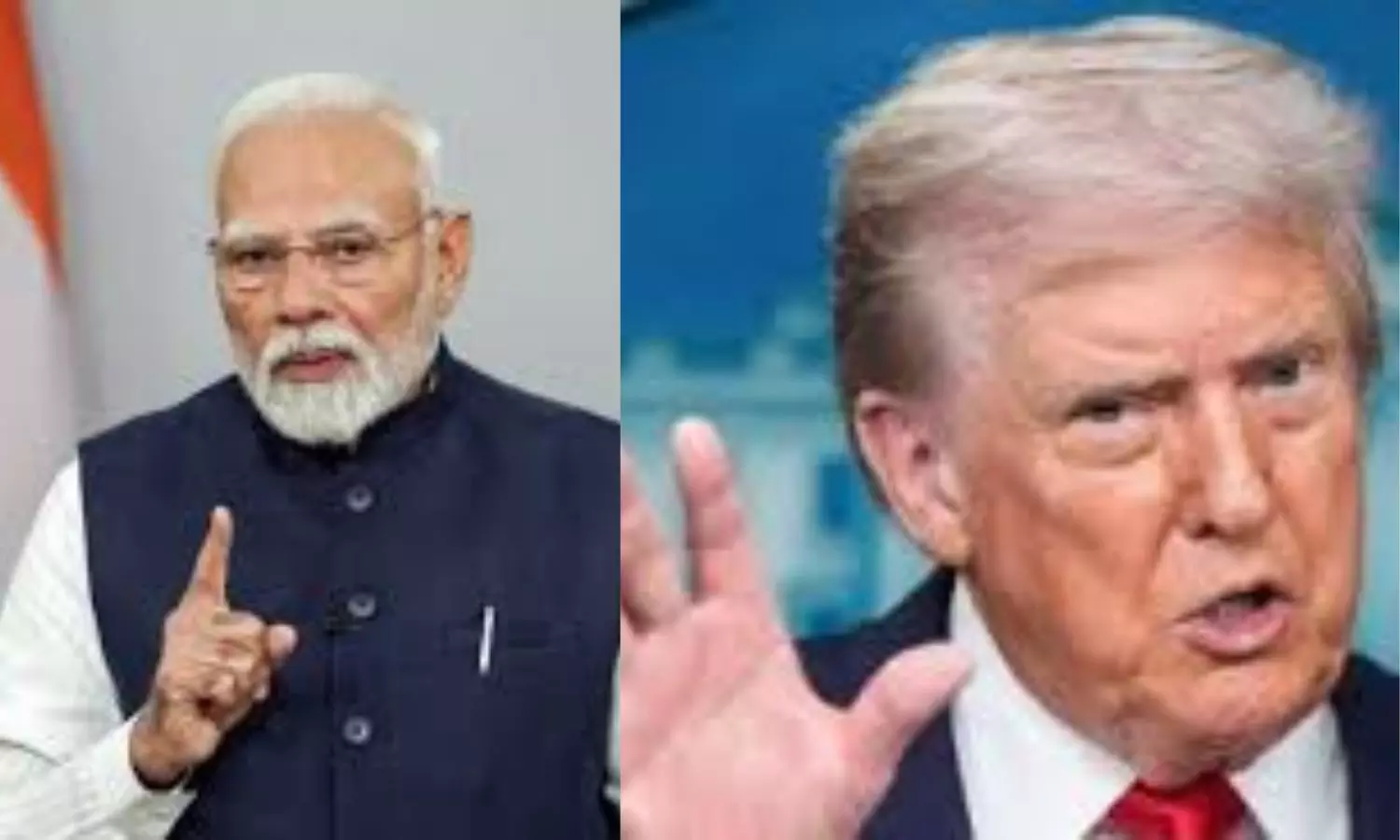
It is said that the grass suffers most when elephants fight. Faced with US President Donald Trump’s additional 50 per cent tariff for buying Russian oil, India’s rulers may repeat that the grass also suffers when elephants make love. It’s heads I win, and tails you lose, so long as leaders like the American President are calling the shots.
Not that India is a stranger to the blunt bullying practised by some North American politicians. Although Prime Minister Narendra Modi’s government issued a terse statement calling the targeting of India “unjustified and unreasonable”, as this column recalled, leaders like P.V. Narasimha Rao had demonstrated a certain finesse in dealing with American wrath, especially when they suspected the White House of applying double standards and indulging in dissimulation in pursuing national goals without obviously abandoning international ideals.
Harry S. Truman’s bombing of Hiroshima and Nagasaki 80 years ago, killing more than 210,000 Japanese and creating thousands of hibakusha (“irradiated people”), is a case in point. The “P-5” nations, permanent members of the United Nations Security Council and also the only five officially recognised nuclear powers, swear by the goal of a world free of nuclear weapons while refusing to surrender their own exclusive privileges under the Nuclear Non-Proliferation Treaty (NPT), which came into force in 1970. Western sceptics often accuse India of leading such ambivalence by developing the bomb while preaching disarmament. India is also charged with not only not passing on oil price cuts to domestic consumers but enabling crony capitalists to exploit discounts by manufacturing for third party exports. Not that ambidextrous statecraft can be compared with the contentious example of Britain’s Sylhet-born former minister for homelessness and rough sleeping, Rushanara Ali, who “ejected four tenants from her east London townhouse before re-listing the property for £700 a month more in rent”. Happily, she has since resigned.
P.V. Narasimha Rao could never be accused of similar dishonesty. But as Prime Minister, he did not disappoint Fidel Castro who sought Indian rice in 1992 to feed Cubans. Angry protesters against the Vietnam war were grinding Calcutta to a halt and Opposition stormy petrels like Indrajit Gupta and George Fernandes were addressing fiery meetings while Washington threatened trade sanctions and aid suspension. Ignoring all pressures, Narasimha Rao quietly told the State Trading Corporation to send 10,000 tonnes of rice to Cuba, ensuring that the Rs 10-crore bill was waived after the uproar had died down.
Things have changed. The United States is now India’s largest export destination -- buying goods worth $87 billion in 2024 and selling India goods worth $41 billion -- but the relationship is already reeling at the thought of Mr Trump’s earlier imposition of a 25 per cent tariff on Indian imports and the threatened second tranche of penalty tariffs. The £6-billion trade promised by Britain’s Sir Keir Starmer and the gains from an FTA with the European Union may not be sufficient compensation.
Worse, any US rebuff will be a slap in the face for a flamboyant Asian leader whose poses and postures -- witness his close cooperation with Israel’s Prime Minister Benjamin Netanyahu, who plans to reoccupy the Gaza Strip -- proclaim his affinity with the West. Blaming Israel for the deaths of over 62,700 people in the occupied territory, the Gaza authorities now live in fear of permanent servitude to the imperialist Israelis.
India’s defence is not without merit. Whether or not the US and the European Union (which takes a similar stand on Russia for obvious geopolitical reasons) admit it, they cannot deny the claim by the external affairs ministry spokesperson, Randhir Jaiswal, that the core of any government’s foreign policy must be the protection of its own fundamental interests. “Like any major economy, India will take all necessary measures to safeguard its national interests and economic security,” Mr Jaiswal succinctly justified the underlying rationale of any foreign policy.
As for the Russia-Ukraine war, George Kennan, the most astute of American Kremlinologists, would have blamed it on what he called Washington’s endless series of distortions of Russia, the dehumanisation of its leaders, the “reckless application of the double standards to the judgment of Soviet conduct and ours”, and the underlying implication that the conflict was ultimately an “irreconcilable one”. Blaming the historical blunder of dumping Sudeten Germans in Czechoslovakia as a principal cause of the Second World War, he predicted that the American media’s need for an enemy and US militarism, especially the North Atlantic Treaty Organisation’s eastward expansion, would be triggers that could destroy liberal trends in Russia, fuel a new Cold War and encourage escalation into nuclear conflict.
Shortly after Mr Trump’s latest announcement, New Delhi accused the US and European Union of double standards and of, in fact, encouraging India to buy Russian crude. “The United States at that time actively encouraged such imports by India for strengthening global energy markets’ stability.”
Whatever the truth of the allegation, there is no disputing the claim that ever since 1947 India has had to look for alternatives to Western support. Given the runaround to which the Americans subjected Jawaharlal Nehru’s envoys when he sought a military alliance, one is surprised that India did not swallow the Soviet bait hook, line and sinker. The state department even smugly boasted of having cleverly solved “the problem” (of Indian importuning) by classifying India “upwards to the category of countries receiving ‘restricted’ US military information”, and making “a deliberate effort to furnish the Indian military attaché in Washington with relatively harmless but somewhat impressive military information”.
Such deceit was practised because India was of “negligible positive strategic importance” to the United States while Pakistan occupied “one of the most strategic areas in the world”.
Yes, Russian President Vladimir Putin erred grievously in invading Ukraine. Yes, Ukraine’s beleaguered President Volodymyr Zelenskyy deserves wholehearted sympathy and support. But so does Aung San Suu Kyi in Myanmar. So does the institution of the Dalai Lama, in which are enshrined the rights and hopes of the Tibetan people. But all these are not India’s battles. They will not feed India’s hungry millions, provide them with education, jobs and houses. Instead, they will divert resources, energy, manpower and money from the neglected challenge of building a vigorous modern India.
