REFLECTIONS | Can Delhi, Beijing Avoid The Mistakes Of The Past? | Sunanda K. Datta-Ray

That tale seems apposite as members of the Quadrilateral Security Dialogue, a strategic forum of four democracies --India, Australia, Japan and the United States -- prepare to meet after the curtain-raiser of a three-day high-powered defence conference aimed at promoting a free, open and inclusive Indo-Pacific region through cooperation on maritime security, economic cooperation, and critical minerals
An old story with which many readers must be familiar has it that at the valedictory dinner in London following an international conference, an Indian delegate turned to a Chinese sitting silently next to him and, pointing to the soup, asked somewhat condescendingly: “Likee soupee?” The Chinese merely smiled and nodded, thereby confirming the Indian’s opinion of his social and linguistic inadequacy.
A little later, it was “Likee fishee?” and then, “Likee meatee?” Finally, “Likee fruitee?” The Chinese response was always an affable nod.
At the end of the dinner the conference chairman introduced the evening’s guest speaker -- and the Indian saw to his amazement the same Chinese gentleman invited up to the podium, from where he delivered a penetrating and witty discourse in impeccable Oxbridge English. Speech over, the speaker turned to the Indian with a mischievous twinkle in his eye, and asked amidst the deafening applause: “Likee speechee?”
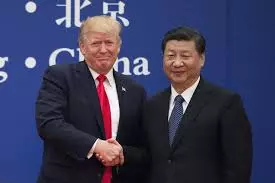
That tale seems apposite as members of the Quadrilateral Security Dialogue, a strategic forum of four democracies --India, Australia, Japan and the United States -- prepare to meet after the curtain-raiser of a three-day high-powered defence conference aimed at promoting a free, open and inclusive Indo-Pacific region through cooperation on maritime security, economic cooperation, and critical minerals. No doubt apocryphal, that tale encapsuling a highly simplified version of race attitudes and instant responses is relevant now as India and China seek a new dialect to resume their interrupted dialogue in a world in which Donald Trump’s punitive tariffs and Xi Jinping’s Global Governance Initiative have made the discourse of diplomacy almost technical in its complexity.
One possible reason why the “Likee speechee?” story has not aged with repeated telling is that an element of verisimilitude still clings to the attitude it apparently mocks. Perhaps some Indian diplomats do still take the unknown Chinese gentleman’s innocence for granted. After all, the late Zhou Enlai, for instance, thought India’s first Prime Minister, Jawaharlal Nehru, one of the most arrogant national leaders he had ever met.
Arrogance often mingles with ignorance in society’s lower reaches to create stereotype images. An English newsreader at Doordarshan would not otherwise have been so embarrassed when China’s President, Xi Jinping, arrived in New Delhi for highly-publicised talks with Prime Minister Narendra Modi many years ago. The Doordarshan announcer thought that the visitor’s family name, Xi, stood for the Roman numeral XI, and read it out as “Eleven Jinping”. Prasar Bharti’s then CEO Jawhar Sircar was quick to sack the errant broadcaster, but given Chinese sensitivity, the damage may have been done.
Such blunders can’t be allowed to hold the future to ransom as India and China set out to rediscover each other after a period of coolness interspersed with violence. It was a mystery for the redoubtable Henry Kissinger, the German-born nuclear expert who dominated American politics for several decades, how India could be best friends with the relatively nearby Soviet Union while treating the distant United States as a potential adversary. Foreign policy must be forged using whatever assets are available, and India has undoubtedly noted the Chinese ambassador’s recent robust defence of “the multilateral trading system” as countering Mr Trump’s reported comment, “Looks like we’ve lost India and Russia”. Innovative engineering might still permit India to exploit the price differential of Russian oil to counter Mr Trump’s punitive tariffs.
The original Concert of Europe was a diplomatic system that was established by the victorious powers after the Napoleonic Wars in 1815 to maintain a balance of power, preserve peace, and prevent any single nation from dominating Europe again. It involved regular consultations and congresses among the major governments -- initially Britain, Austria, Prussia and Russia, later joined by France -- to resolve disputes through diplomacy and maintain the political status quo. While successful in preventing major conflicts for much of the 19th century, the system faced challenges from nationalism and shifting power dynamics, ultimately collapsing when the Sarajevo assassination plunged Europe into the horrors of the First World War.
Himself primarily a 19th century man deeply immersed in the European history of the period, Jawaharlal Nehru, whose signature is still discernible in many aspects of India’s foreign policy, recognised that the core principle was to maintain a stable distribution of power among contending states to prevent any one of them from becoming too powerful and threatening the peace. Regular meetings and consultations were also essential.
It failed in Asia for a number of reasons, chief among which Nehru would have blamed an imbalance that owed much to external intervention, exacerbated by the increasing competition among contemporary governments for raw materials, trade monopolies, preferential pacts and, after colonial dispensations ended, a whole gamut of commercial privileges clubbed together as “neo-colonial”.
If so, nothing could be more obviously “neo-colonial” than China’s $120.46 billion worth of exports to India during 2024, especially when compared to imports worth a mere $14.25 billion, representing about 3.85 per cent of India’s total merchandise sold abroad. This alone may not have rankled so much if it had not been for a host of perceived grievances compounded by border and territorial clashes. To make matters worse, this is presented as a part of a bigger picture depicting China as protector and benefactor of India’s local arch-rival,
Pakistan, whose parity pretensions are sustained by Chinese arms, intelligence, technological skills and strategic guidance.
The scenario may be changing. The 10-member Shanghai Cooperation Organisation’s wholehearted condemnation of terrorism in all its forms and manifestations, including the April 22 Pahalgam attack, and Russian President Vladimir Putin’s acceptance of Prime Minister Narendra Modi’s invitation to visit New Delhi in December, might suggest a new dawn in multilateral diplomacy. While important as an end in itself, the SCO trip was significant because coming after a gap of seven years, it must have conveyed an additional sense of purpose if not mission and an opportunity to build for future growth and prosperity.
As that edifice rises from the flooded Gurgaon plain, India cannot afford to forget two things. First, foreign policy, like charity, begins at home. Second, diplomacy is making the best of advantages already possessed. The pressure tactics of Donald Trump’s tariffs must be countered through adjustments in India’s own trading pattern. As diplomacy is diversified and India reaches out to new beginnings, observers might miss the exhilaration of the quest for new targets that marked foreign policy in the post-Independence era. But with seasoned practitioners holding the cards, there is less likelihood of the Hindi-Chini bhai-bhai mantra of those early years yielding so quickly to the bye-bye caricature of 1962.
