Profits Up, Wages Down: India Inc. Faces Mirror
Mr Modi reminded his corporate audience that almost a decade back his government had reduced the corporate tax rate and brought about tax reforms which together contributed to an increase in corporate profits. Yet, a ‘greedy’ business class pocketed these earnings without passing them on to their salaried employees and wage-earning workers, thereby not enabling an increase in domestic demand
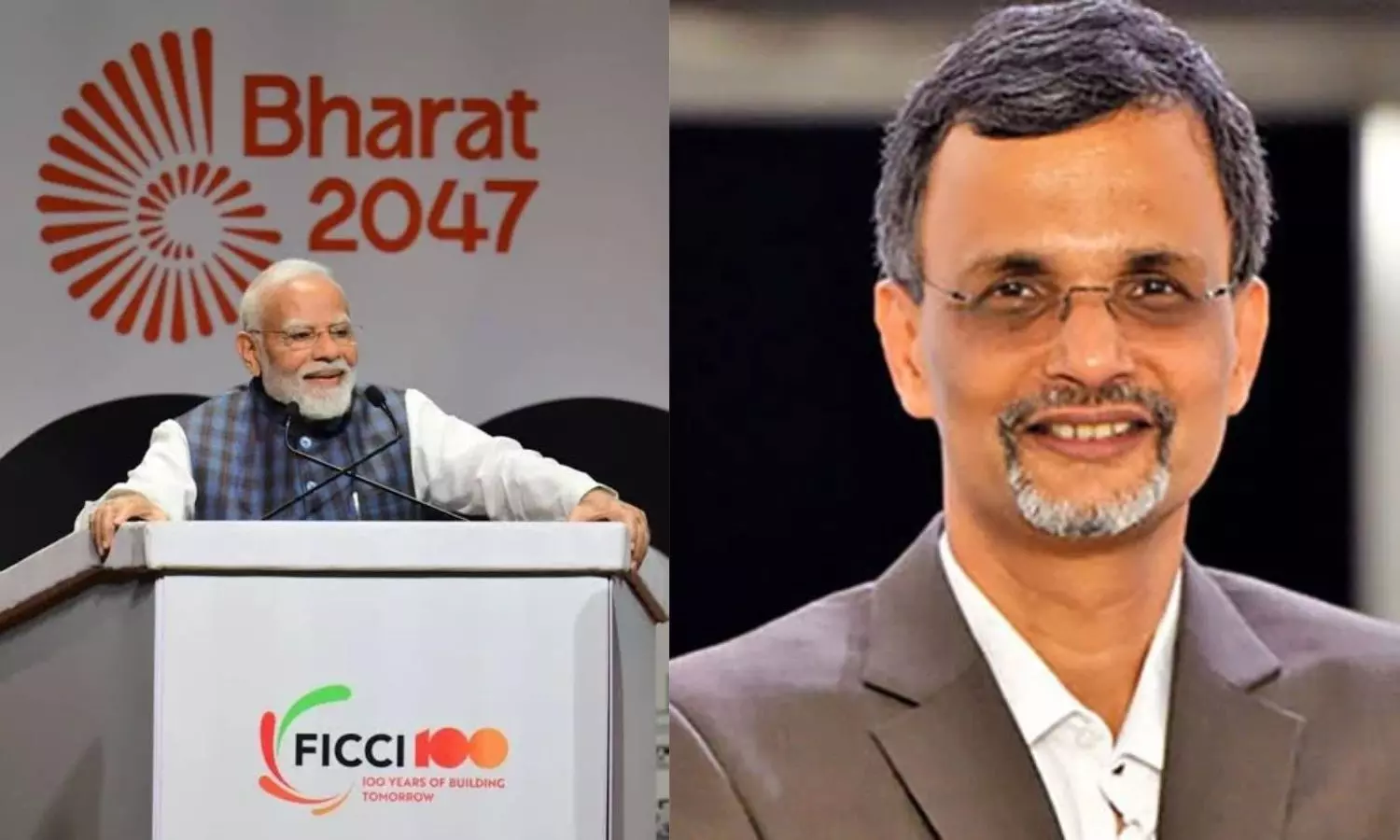
In what was clearly his most consequential speech in recent months Prime Minister Narendra Modi has put the Indian corporate sector on notice. Addressing the annual general meeting of the Federation of Indian Chambers of Commerce and Industry (Ficci) last week, Prime Minister Modi challenged Indian business with a very John Kennedy-like poser — ask not what the government can do for you, ask what you can do for the country.
Recalling Mahatma Gandhi’s call to Ficci in the 1920s to be a partner in the freedom struggle, Mr Modi reminded his audience that two decades later India won her freedom from colonialism. If ours has to become a developed economy by 2047 we have two decades ahead of us to become ‘Viksit Bharat’. The government will play its part, said the PM, asking for suggestions on how to enhance the ‘ease of doing business’. But what about the private sector? What would its contribution be towards Viksit Bharat?
Mr Modi reminded his corporate audience that almost a decade back his government had reduced the corporate tax rate and brought about tax reforms which together contributed to an increase in corporate profits. Yet, a ‘greedy’ business class pocketed these earnings without passing them on to their salaried employees and wage-earning workers, thereby not enabling an increase in domestic demand.
The Union government’s chief economic advisor, V. Ananta Nageswaran, has been saying as much recently. The facts stare us in the face. Corporate profits as a share of national income have been estimated to be 4.8%, an all-time high, with profits of about 4,000 listed companies rising 22.3% in the financial year 2023-24. However, employment in the corporate sector grew by a mere 1.5%. Average monthly earnings of regular salaried workers, adjusted for inflation, in fact fell between 2017-18 and 2023-24, dropping 6.4% for male workers and 12.5% for female workers.
Prime Minister Modi recently claimed that his policies had helped reduce poverty to an all-time low. This may have happened both on account of overall growth and targeted income and welfare schemes. However, last week he was conceding that even as poverty has declined, inequalities have increased. The wage-profit differential clearly demonstrates that.
It was the Polish economist Michal Kalecki who first demonstrated, in the 1940s, the relationship between changes in wage-profit balance and national income growth. A stagnation or decline in the share of wages in national income contributes to a decline in the rate of growth of consumption thereby creating a demand constraint that in turn hurts profitability. However, if capitalists create structures, increasing what Kalecki termed as ‘the degree of monopoly’, protecting their profits, there would be a further decline in aggregate demand, limiting the incentive to invest. Extending Kalecki’s argument one could suggest that in an open economy an increase in the share of profits in national income would contribute to an increase in imports of goods consumed by the profit-earning classes. That has been happening.
Neither Prime Minister Modi nor his chief economic adviser may have read Kalecki but they were essentially offering a Kaleckian explanation for the stagnation of private corporate investment over the past decade. Mr Modi’s criticism of Indian business went far beyond upbraiding them for their greediness. He warned them of the consequences of not becoming globally competitive. The latter warning comes on the eve of India entering into a series of trade agreements with developed economies — Britain, European Union and, perhaps, the United States.
In 1991 when Prime Minister Narasimha Rao opened up the economy to greater competition, at home and externally, the so-called ‘captains of Indian industry’, led by the late Rahul Bajaj, cried foul and sought a level playing field that would enable them to compete with global firms. The same argument is trotted out even today. While some businesses have become globally competitive, most still seek protection. In fact, the Modi government has increased the level of protection offered between 2014 and 2020. It is only now that the PM has realised that this has neither helped Make in India, nor has it made many firms globally competitive.
One can only hope that the PM does not stop with his wake-up call but will proceed to take concrete steps aimed at improving the ‘ease of doing business’, encourage greater employment generation and skill building and push Indian firms into becoming globally competitive. The corporate sector needs a few like Rahul Bajaj who never shied away from speaking truth to power. Recall the event in Pune when Mr Bajaj told the Union Home minister Amit Shah how businesspersons ‘lived in fear’. Many continue to do so except that they do not have Mr Bajaj’s courage to speak up.
The most important consequence of 1991 was that it unleashed what the economist John Maynard Keynes termed as ‘the animal spirits of enterprise’. Recently Union finance minister Nirmala Sitharaman asked a business audience of domesticated beings as to whatever happened to those ‘animal spirits’. Many are either content enjoying the super profits made in a protected environment or are exporting their wealth and investing overseas.
There has been, as I have often written, a ‘flight of capital’. This has happened ostensibly in the name of going global but without building global scale and capability at home. The media celebrates business ‘leaders’ and ‘entrepreneurs’ every year without asking the simple question whether their companies have become globally competitive or if they are merely one-eyed in a land of the blind. Only three sectors have produced global leaders — information technology, petroleum refining and pharmaceuticals. The rest are riding on imported technology and in protected markets.
The trend in corporate incomes and super profits generated in real estate and through cronyism at various levels, over the past couple of decades, has created a parasitical, wealthy upper crust that feeds on itself. Till now they have been content in their devotion to Prime Minister Modi. It remains to be seen how they would have reacted to his message last week. Publicly they would praise the PM, privately they will grumble.
Sanjaya Baru is a former newspaper editor. His most recent book is Secession of the Successful: The Flight Out of New India.
