PM, Shah Rush To Discredit INDIA Vote-theft Campaign

Modi posted: “MLC elections in 28 seats across four big states — Uttar Pradesh, Maharashtra, Bihar and Karnataka. Elections held using ballot papers. Guess how many seats Congress won?” A monocled emoji at the end of the post emphasised his sarcasm suggesting that this was the obvious conclusion after a close examination of the results. The Congress, however, did win one seat after all the ballots were counted
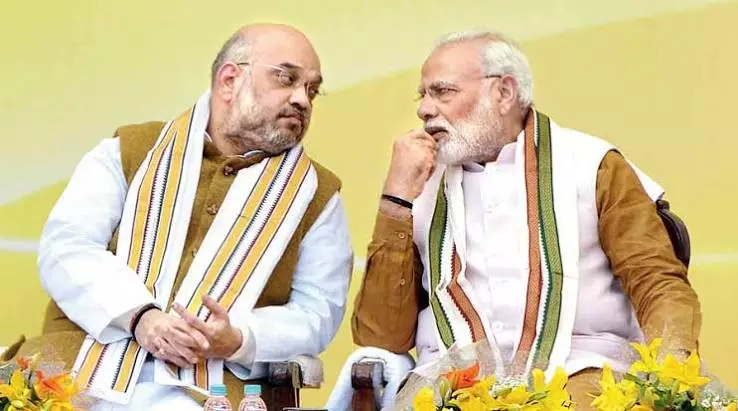
As the Opposition INDIA bloc’s campaign against electoral roll manipulation appears to be gathering momentum, Prime Minister Narendra Modi and Home minister Amit Shah have made public statements aimed at delegitimising the Opposition’s allegations of “vote-theft” under chief election commissioner (CEC) Gyanesh Kumar.
This is evident in Mr Modi’s post on X mocking the Congress even as the ballots for the legislative council elections were still being counted on October 28, prematurely suggesting that the Congress won zero seats despite ballot papers being used. He posted: “MLC elections in 28 seats across four big states — Uttar Pradesh, Maharashtra, Bihar and Karnataka. Elections held using ballot papers. Guess how many seats Congress won?” A monocled emoji at the end of the post emphasised his sarcasm suggesting that this was the obvious conclusion after a close examination of the results. The Congress, however, did win one seat after all the ballots were counted.
Although it emerged as the largest party with 16 of the 28 MLC seats up for election the BJP lost in several critical strongholds. It lost two MLC seats (Graduates’ and Teachers’ Constituencies) in Varanasi, Mr Modi’s own parliamentary constituency, to the Samajwadi Party.
It also lost the Graduates’ Constituency seat of Nagpur to the Congress. Nagpur is the headquarters of the RSS besides being the home of Maharashtra chief minister Devendra Phadnavis and the parliamentary pocket-borough of Union minister for road transport Nitin Gadkari. The Patna Teachers’ Constituency seat, a reliable bastion of the BJP in the past, was wrested by the Rashtriya Janata Dal.
So while there was little reason for Mr Modi to gloat, his intervention on social media could help to project the multi-party Opposition campaign on vote-theft as a bipolar contest between the Congress and the BJP. And it attempted to shift the Opposition’s allegations about the integrity of electoral rolls to its electoral performance in legislative council elections, despite ballot papers being used, especially by emphasising the Congress’ weak electoral performance.
Mr Modi’s argument conflates the question of whether the Congress (or the Opposition) has the public support to elections with the question that the Opposition and the public is raising about the lack of transparency and accountability of institutions responsible for conducting elections impartially. Political parties can perform badly and still raise legitimate questions about the alleged manipulation of voter rolls and electoral procedures.
These questions cannot be reduced to only the use of ballot papers in legislative council elections as they are not a referendum on the special intensive revision (SIR) of electoral rolls. These elections are different from normal elections with limited electoral colleges and held in different contexts.
Mr Shah’s intervention seeking to relocate the street protests to Parliament is an indication that the government is finding it difficult to handle the mass mobilisation that is playing out on the streets. The government, faced with mass protests, is pretending that Parliament is the appropriate forum to raise the vote-theft issue. There the ruling party largely controls the agenda, procedures and the terms of the debate, through its sheer strength in numbers and with presiding officers who are more likely to yield to the ruling party’s suggestions.
Mr Modi and Mr Shah are trying to reclaim the democracy narrative from the Opposition. The Opposition is saying that winning elections do not amount to a peoples’ mandate if in the electoral contest, the pitch is tampered and the umpire is partisan. They want the suspension of SIR, the resignation of CEC Gyanesh Kumar and restoration of names allegedly fraudulently deleted from the electoral rolls. This is not a demand of the Congress alone but of 20 opposition parties that have come together on this issue for a common mass campaign.
Neither Mr Modi nor Mr Shah want this argument to acquire the acceptance it is finding with ordinary citizens. They also do not want the Opposition to find a common political language against their ruling dispensation. Up to now, the biggest problem of the INDIA bloc has been maintaining unity among its constituents who have competing regional interests. Electoral integrity has given them a common cause as it impacts all of them if their voters are unfairly excluded by a partisan Central Election Commission.
Mr Shah’s challenge of offering to call a special session of parliament to debate vote-theft is particularly interesting.
In fact, during the Monsoon Session of Parliament, the House was adjourned repeatedly as the government refused to debate SIR in Bihar. When Leader of the Opposition Rahul Gandhi challenged Mr Shah to debate his three “vote-theft” press conferences, Mr Shah refused saying he would decide the order of his own speeches, leading to an Opposition walk out. In April this year, Lok Sabha Speaker Om Birla and Rajya Sabha Chairman C.P. Radhakrishnan rejected the Opposition’s notices to move a motion for Gyanesh Kumar’s removal.
The Opposition political parties only opted for mass mobilisation when the parliamentary approach failed due to the ruling party’s resistance.
Mr Modi and Mr Shah realise that the Opposition’s strategy is not only about an immediate election. If the Opposition succeeds in making electoral transparency and accountability a continuing national issue, it could impact every future election, raising questions about the credibility of the electoral process.
If it turns out that voter rolls are manipulated and genuine voters, unlikely to vote for the BJP or Mr Modi, were systematically excluded, or fraudulent voters were added, it would fundamentally challenge the mandate that Mr Modi claims. After all, the sole basis of Mr Modi’s legitimacy is that he has led the BJP in winning one electoral mandate after another. He never tires of claiming that he speaks for his “140 crore countrymen” — framing his mandate around the collective will and aspirations of the entire Indian population.
Mr Modi’s jibes and Mr Shah’s challenge are, therefore, not really addressing the questions about electoral manipulation raised by the Opposition. They are trying to flood the public debate with red herrings about whether the Congress under Rahul Gandhi can win elections and whether the Opposition is willing to follow parliamentary norms. They hope that any questioning of the BJP’s electoral mandates, past or future, will be drowned out by their jeering and selective invocation of parliamentary norms versus the supposed ‘anarchy’ of Opposition mobilisation.
Ironically, the more they mock Mr Gandhi and label the Opposition as unruly, the greater visibility Mr Modi and Mr Shah risk providing to the INDIA bloc’s campaign.
