Pavan K. Varma | Students: Be Non-partisan; Stop Protests, Drive Policy

The Cockroach Janta Party (CJP) and the larger Gen Z protest has set political parties at war with each other. The Congress blames the BJP for atrocities on the protesters in Delhi. The BJP is attacking the Congress for the violence against protesters in Jharkhand. Amidst this vociferous acrimony, Parliament was a washout
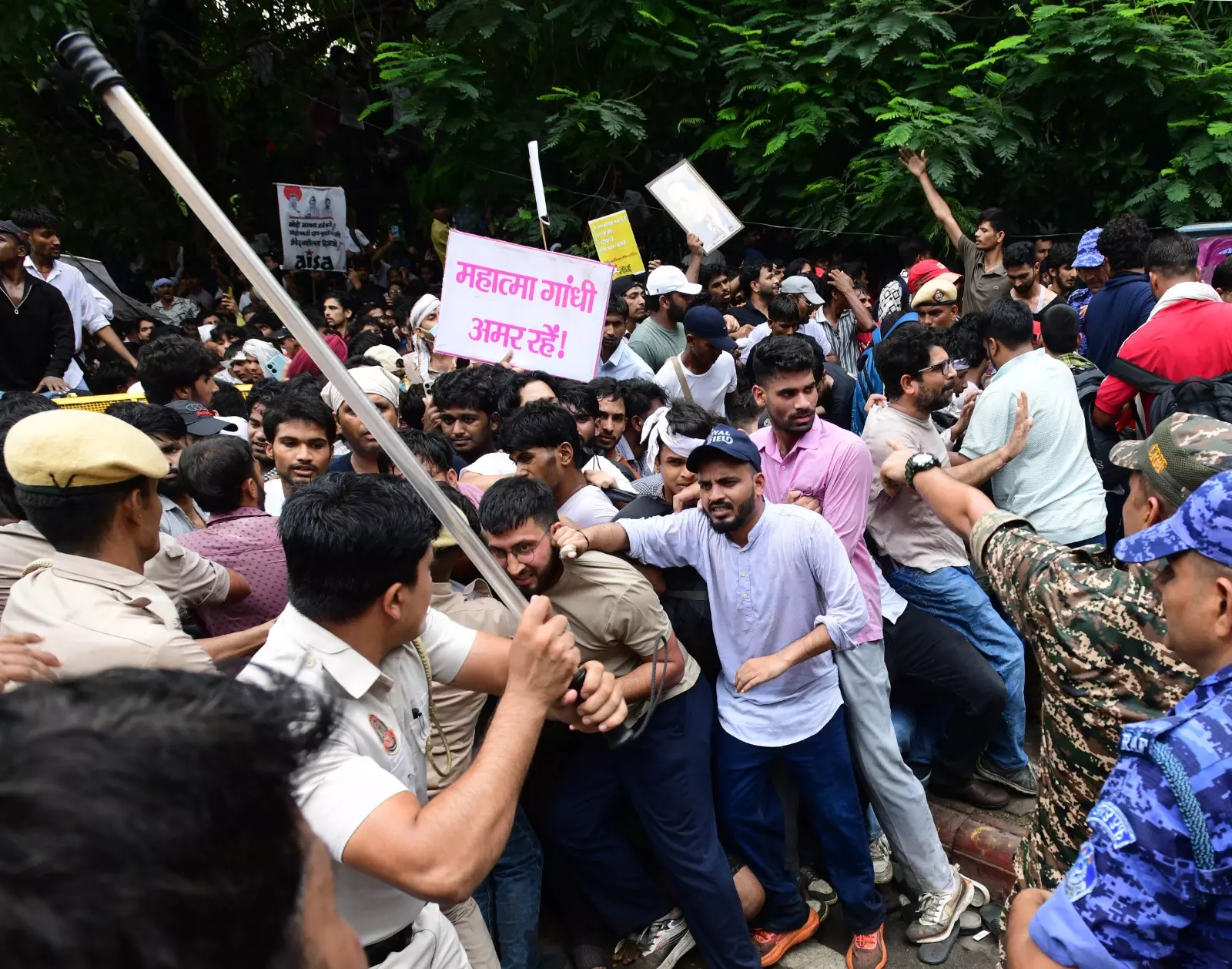
On August 6 in Mumbai, RSS chief Mohan Bhagwat made a significant comment: “If Gen Z is protesting, they're not anti-national. They're our own people. They're our next generation.” He also said that, the grievances of Gen Z are genuine, and if asked whom he would trust, he would place his faith in Gen Z. At a time when student dissent can easily be classified as subversion, conspiracy or anti-nationalism, the RSS supremo has chosen to give the protests a remarkably generous vote of confidence.
This assumes greater significance because only days earlier a senior RSS functionary, Atul Limaye, the organisation's joint general secretary, had apparently taken a markedly more suspicious view of the movement. Speaking to ABVP activists at Chhatrapati Sambhajinagar on July 30, he alleged that anti-national slogans were raised from the CJP stage and described the wider movement as an attempted “subversion of democracy through democratic means”. The distinction between the two approaches is important. Essentially, Limaye was asking who is behind the protest, while Bhagwat was asking the more fundamental question: why are the young protesting?
The Cockroach Janta Party (CJP) and the larger Gen Z protest has set political parties at war with each other. The Congress blames the BJP for atrocities on the protesters in Delhi. The BJP is attacking the Congress for the violence against protesters in Jharkhand. Amidst this vociferous acrimony, Parliament was a washout.
Objectively, it seems quite apparent that all political parties are trying to appropriate the youth unrest for their own political benefit. The critical question is whether this generation can escape the older mechanisms of political co-option. This would depend, of course, on how these protests develop and sustain themselves in the future. If the present unrest remains confined to individual examinations, recruitment scandals and campus grievances, it may gradually dissipate. But if disparate grievances begin to converge around a larger demand about governance and accountability of the entire political establishment, it could pose a new and real threat.
The student movement did not emerge from a vacuum. The Neet examination controversy was the immediate detonator. For young Indians, competitive examinations are not merely examinations. They are often the principal gateway to a respectable career, social mobility and the fulfilment of family expectations. Years of preparation, enormous financial expenditure and intense emotional pressure are invested in them. If the sanctity of such examinations is compromised, the young do not merely lose marks. They lose faith in the promise that effort will be rewarded.
That is why the agitation has acquired a significance far beyond Neet. The deeper grievances are about corruption, unemployment, police action, bureaucratic arrogance, authoritarian tendencies, and the perceived erosion of institutions. What began as a demand for fairness in an examination has become by now equally about whether the system delivers.
Concerns like this cannot be lathi-charged out of existence. The students want examinations they can trust. Jobs they can compete for fairly. Institutions that are impartial. Police forces that exercise restraint. Universities where questioning is not treated as disloyalty. Governments that are accountable. And elections that are fair.
For decades, the political system has known how to mobilise the young through caste, religion, region and ideology. Mandal mobilised one set of identities; Mandir another. Political parties have become adept at converting social distinctions into electoral arithmetic. But what happens when a young person begins to see another student — not as a Hindu or Muslim, Brahmin or Dalit, North Indian or South Indian — but as someone confronting the same examination, the same unemployment, the same uncertainty and the same institutional failures?
The really transformative possibility then is not that Gen Z will become another political party but a new political constituency. Such a constituency would be uncomfortable for everyone. It would trouble the BJP because it could not be easily absorbed into the politics of religious divides. It would trouble the Congress because the Opposition's attempt to piggyback on youth anger cannot conceal its own dynastic baggage and organisational infirmities. It would trouble regional parties because a pan-Indian youth identity could cut across carefully cultivated caste and regional loyalties.
The Opposition will inevitably attempt to use the movement. That is the nature of politics. But the young should be wary of becoming the foot soldiers of parties whose own record they have every right to question. A movement that demands accountability from the government must demand it from the Opposition as well.
The challenge for the young is, thus, not to exchange one form of political manipulation for another, but to see themselves first as students, citizens and aspirants for a better future rather than as members of inherited political blocs. The moment a movement becomes a political party, it acquires leaders, factions, financiers, electoral calculations and ambitions. The spontaneity that created it begins to disappear. A movement born to challenge the political establishment can very quickly become another component of it.
We have seen examples of this co-option in the past. The Anna Hazare movement demonstrated genuine public anger against corruption. But the danger was always there that the system would eventually digest the protest, absorb its vocabulary and continue much as before. The Gen Z agitation demanding accountability for paper leaks has legitimacy. But here too, the fear is that protesters will become politicians and slogans manifestos, and eventually begin operating according to the very distortions they once denounced.
If the students want to be taken seriously, they must rise above rage. They must remain peaceful. They must resist provocation. They must distinguish between legitimate dissent and reckless vandalism. They must reject the politics of hatred even when political parties attempt to recruit them into it. A pan-Indian youth constituency that cuts across caste and religious divisions would be a formidable development.
Perhaps, this is what RSS chief Mohan Bhagwat has realised. In my view his is a statesman-like response. However, this, and other endorsements, would be valid at this stage only if Gen Z moves from political ambition to accountability, from anger to organisation, from protest to policy, and from resentment to citizenship.
