Pavan K. Varma | PM’s Ghuspetiya Outrage: Isn’t It Too Little, Too Late?

The Election Commission of India (EC) made a general statement that there are “large numbers of people from Nepal, Bangladesh and Myanmar in Bihar”
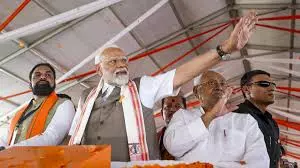
As Bihar stands on the cusp of another Assembly election, Prime Minister (PM) Narendra Modi, in a speech in Gaya on August 22, has suddenly trained his rhetorical guns on the issue of “illegal intruders and migrants”. According to him, such ghuspetiyas are taking jobs meant for Biharis, and seizing lands of locals. This raises a fundamental question: Is this an expression of genuine national concern, or a calculated attempt to polarise, distract, and divide?
At one level it is a genuine issue. No nation can allow illegal migrants to proliferate. But what is curious is the timing of the PM’s new found concern, and the motivation behind it. If, indeed, ghuspetiyas have become a serious problem, it is logical to ask what the Central government of which he is the leader has done about it for the last 11 years, especially when an NDA government is also part of a “double engine” in Bihar for the past eight years? Where are the detailed policy proposals, the data-driven assessments, the sustained administrative actions?
The security and supervision of the border, and the duty to prevent illegal migration, are the responsibility of the Central government. Surely, the PM was not publicly confessing to his own failure. Further, for most of the government’s tenure, this issue lay dormant in Bihar’s political discourse, barely meriting mention in parliamentary debates or policy initiatives. Yet, as the electoral clock ticks louder, it has erupted into fiery speeches and headlines. The PM has only now announced the creation of a “Demography Mission” to tackle this problem. But no details have been provided of its structure, modus operandi, timeline, and objectives. One wonders how a government that has not yet carried out the much-delayed National Census, which should have been held in 2021, is now going to implement a separate Demography Mission.
The question also arises where is the evidence regarding this new menace? The Election Commission of India (EC) made a general statement that there are “large numbers of people from Nepal, Bangladesh and Myanmar in Bihar”. But in the Special Intensive Revision (SIR) exercise in which it has deleted 65 lakh voters, the overwhelming number are those who, as per its claims, are either deceased, or have possibly shifted permanently elsewhere, are voters at multiple places, or are “untraceable”. How many voters has the ECI, or any other state authority, specifically categorised as Rohingyas or Bangladeshis? This figure needs to be made public.
Bihar, unlike Assam, does not share a long, porous international border with Bangladesh, nor has it historically been the epicentre of mass illegal migration. Its struggles are inward-looking: endemic poverty, outmigration, woeful infrastructure, rampant unemployment, agrarian distress, and a crumbling public health and education system. It is intriguing that when issues of such magnitude are begging for attention, why is the spectre of illegal migrants suddenly being given priority.
The argument that illegal immigrants will usurp jobs in Bihar begs the question: Where are the jobs to be taken? Bihar has the country’s highest rate of unemployment. That is why lakhs of Biharis leave the state to find jobs in far flung corners of India, working on unacceptably low wages and living in miserable conditions. The state government’s claims to have provided jobs needs a serious audit. It should make public what jobs in how many numbers have actually been implemented. What is known is that a mere 6837 appointment letters were distributed by chief minister Nitish Kumar in February 2025. How many of these actually fructified into actual employment also needs to be put in the public domain. According to the 2022 Bihar Caste-Based Survey, only 1.5 per cent of the state’s population are employed in government jobs — equivalent to about 20-21 lakh individuals. In the absence of any other successful employment scheme, this helps to benchmark the scale of current efforts. Of course, as elections approach, there is a shower of promises. The Bihar cabinet on July 15 approved the creation of one crore jobs by 2030. If the track record of the last five years is taken as a touchstone, this is hardly a viable or convincing promise.
The truth is that using the ploy of illegal migrants, the government is pursuing the art of political distraction. When governments face scrutiny for their governance record, and are found lacking, they often seek to redirect the electorate’s attention to an external “other”. By invoking this threat, the attempt is to transform the election from a referendum on the government’s performance into a moral crusade to “save” the nation. It is a tried and tested formula, not unique to India. Moreover, the language employed in such speeches often goes beyond policy concerns into the realm of identity politics. The illegal intruder is often implicitly linked to a specific community. This deliberate conflation stokes fear, resentment, and ultimately, communal division. It turns neighbour against neighbour, converting what should be a contest of ideas into a contest of identities.
For too long the interests of the people of Bihar has been sacrificed on the altar of religion or caste. The cost of such politics is not merely electoral gamesmanship; it is the slow poisoning of India’s social fabric. Bihar, for centuries, has been a land of cultural synthesis, where Hindu and Muslim, upper caste and lower caste, have shared not only space but heritage. It was the crucible of Buddhism, the land of Gandhi’s Champaran satyagraha, a region that once epitomised resilience in diversity. To inject into this milieu a divisive narrative is highly unfortunate.
The larger danger is to Indian democracy itself. Elections should be an opportunity for citizens to evaluate governance, to debate competing visions for the future, to hold leaders accountable. When they are reduced to referendums on who is ‘us’ and who is “them”, democracy is hollowed out from within.
Bihar deserves better. It deserves an election fought on the real issues that shape its people’s lives — jobs, education, health, infrastructure, corruption, social justice. It deserves leaders who trust its electorate enough to engage them on substance rather than seduce them with fear. It deserves, above all, honesty.
