Parsa Venkateshwar Rao Jr | India Needs Reality Check: Double-digit Growth Vital

There is a divide between the economic experts in the political establishment in the government and the Reserve Bank of India (RBI). The financial institutions are sure to be cautious, and in the eyes of those who want to go forward, even timid
There is legitimate concern that India’s economic growth rate of around seven per cent, which has been the fastest among the big economies of the world in the past decade, is not sufficient. The necessity of a double-digit growth rate to push India into the next stage of economic vibrancy is now quite evident. Speaking at the Kautilya Economic Conclave in New Delhi earlier this month, finance minister Nirmala Sitharaman has struck a surprisingly cautionary note. She said: “Just as eternal vigilance is the price of liberty, eternal performance is the price of strategic independence. There is no room for complacency or self-congratulation beyond a quiet confidence in our abilities to take the right decisions and execute them.” This is the first time that someone high in the governmental hierarchy expressed the view that the current rate of economic growth, which is high and good enough in the global economic context -- should not lead us to complacency and self-congratulation. It is a self-critical assessment of the government’s own attitude.
The minister was quite emphatic in saying that there would be no escape from engaging with changes like the emergence of stablecoins -- crypto currency -- and this did not depend on our likes and dislikes. In the same speech, she said: “Such developments underscore the scale of the transformation underway. They also remind us that no nation can insulate itself from systemic change. Whether we welcome these shifts or not, we must prepare to engage with them.” This is candid talk indeed.
There is a divide between the economic experts in the political establishment in the government and the Reserve Bank of India (RBI). The financial institutions are sure to be cautious, and in the eyes of those who want to go forward, even timid. The tussle between the financial institutions and their cautionary approach and the political establishment’s desire that it has to take bold and risky decisions to survive politically, is a much needed one. Unbridled adventurism is needless.
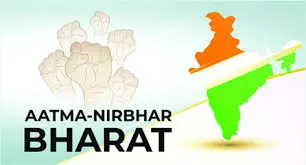
Is there also a contradiction between the political messaging of Prime Minister Narendra Modi with its emphasis on “Atma Nirbhar” and “Swadeshi” and what Ms Sitharaman had to say. Both Mr Modi and Ms Sitharaman would deny there is any conflict between the two viewpoints. However much they may reject the apparent differences in their pronouncements, the public perception will detect the difference.
For the people at large, “Atma Nirbhar” and “Swadeshi” mean that there should not be any dependency or attraction for foreign goods, and that India should make at home all that it needs, and that the people should take pride in the fact that they use home-made stuff. The assumption underlying the “Atma Nirbhar” and “Swadeshi” argument is that India’s billion-plus population provides a large enough domestic market for Indian manufacturers and services. This, however, leads to some kind of isolation. There is the internal problem of whether the Indian domestic market can consume all that it produces because the purchasing power and the economic profile of the India consumer is not the same across the social and economic spectrum.
Prime Minister Modi is also keen that India should be the hub of exports in as many fields as possible, and that the world should be knocking at India’s doors for its products and services. He is also of the view that India should extend technological and economic help to less developed countries, and free them from the discriminatory trade regime of Western economies. The Prime Minister wants India to be the leader of the “Global South”. There are enough hurdles on the way towards that goal because China is in that race too, and the less developed countries may not like to accept the leadership of either India or China.
There have been two important indications of the linkages of the domestic economy with the external. First, Ms Sitharaman’s own view that the shift to stablecoin or crypto currency is needed because of the changing “landscape of money and capital flows”. She was emphatic that “binary choices” have to be made, and failure to adapt would lead to exclusion. The reference to capital flows is an indirect acknowledgement that India would need to absorb foreign capital, either because India needs foreign direct investment or India becomes an attractive investment destination for global fund managers. The other indication was that of the Reserve Bank of India raising the limit of external commercial borrowing (ECB) from $750 million to $1 billion. The RBI’s decision is a sign that the domestic financial markets cannot meet the needs of manufacturers and traders fully. Raising the limit of borrowing would ease the burden on the Indian money market.
The dilemmas faced at the governmental level are expressed in the views of Mr Modi and Ms Sitharaman. They may or may not spell differences as much as reflecting the difficult policy choices facing the country. The finance minister has done well in breaking the spell of self-satisfaction that India is doing well and better than many large economies. It is unclear as to what is left to be done. The lack of clarity is no shortcoming. There is need for deliberation, and more people from all sides should contribute to the much-needed debate on the economic future.
The debate has to rise above the criticism hurled by the political Opposition at the government of the day that there has been little or no economic progress. There has been change and progress with all the caveats thrown in. Ms Sitharaman has articulated the view that the government cannot remain in the self-congratulatory mode. Mr Modi’s emphasis on “Atma Nirbhar” and “Swadeshi” is an attempt to chart the onward path. It may not be the best way forward. Now is the time to get as many views as possible on how to move forward. The imperatives of increasing exports and India’s share of global trade, and as it cannot be a one-way street, the need to absorb a fair amount of imports cannot be overlooked. The tariff tussles across countries and economic geographies will not go away.
Compromises must be made, gains and losses will have to be worked out. Ms Sitharaman’s candour at the Kautilya Conclave has to become the norm of public discourse.
