Parsa Venkateshwar Rao Jr | Delhi Fire Tragedy Exposes Lawlessness, Urban Decay

The big problem lies in this: No one of them would complain against rule-breakers endangering lives like the owner of the home stay because almost all of them are breaking rules, big and small, to manage their dwellings
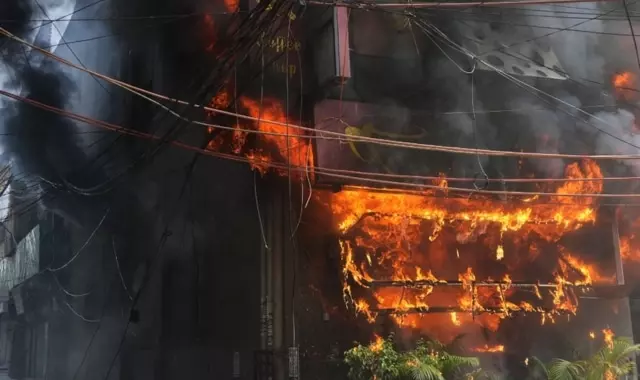
Accidents happen, and many of them can be traced to human error. But the fire that broke through the Flourish Stay Bed and Breakfast in Malviya Nagar in south Delhi reveals a brutal truth of another kind. The fire seems to have started in the basement where the commercial LPG cylinders were stored, and climbed up to the ground floor restaurant, and then to the five floors with the guestrooms, accommodating 25 as against the legally allowed six. Everything was unsafe in the building. The single entrance/exit, the stairs, the absence of a fire escape, the electronically-locked doors, the locked windows which shut out ventilation, all made it a first-rate death trap. The fire safety officials at the local level did not bother, the owner of the flourishing ramshackle establishment — with no safety arrangements it cannot be anything other than one — did not feel the need to get the no objections certificate (NOC) for fire safety. The cynicism is inbuilt, and it is based in the reckless attitude that nothing will go wrong. It is when things unravel that the whole arrangement collapses like a pack of cards.
The death of 21, 12 of them foreigners who are in the country for medical treatment, and the 20 injured, many of them critical which could take the death toll higher, becomes another statistic for the police and the courts. There is the redeeming story of the residents in the locality and neighbours rushing in to help the inmates of the home stay — the rules say that Bed and Breakfast joints are not commercial establishments like hotels and restaurants — with all the ingenuity at their command. For example, they brought out mattresses to cushion the fall of those jumping from the upper floors, and some of the youngsters bravely rushed into the smoke-filled interiors to get the trapped people out. The big problem lies in this: No one of them would complain against rule-breakers endangering lives like the owner of the home stay because almost all of them are breaking rules, big and small, to manage their dwellings. There are disasters, people feel chastened and sad. And they are back to their rule-breaking ways because that is how they manage their daily lives. The officials are not bothered. This is the most dangerous aspect of urban decay in India — the matter-of-fact attitude towards danger-laden living.
The phenomenon of dangerous living takes different shapes in Delhi. A few days ago, a multistory building collapsed, where students who have done their engineering and medical degrees abroad and were to take to the government-conducted qualifying exam were staying in crowded quarters in another part of south Delhi, not too far from the gutted Malviya Nagar home stay. Three people died and many more injured as those trapped in the debris of the collapsed structure had o be rescued.
There is a pattern to the emerging danger zones in Delhi. It is the crowded alleys in the middle of the apparently posh and genteel neighbourhoods in the heart of the city that have become disaster-prone spots. They are all economically-stressed lower-middle-class neighbourhoods tucked behind the spacious, and sometimes posh, frontages. South Delhi has earned the unenviable reputation of having desirable addresses — in the pecking-order conscious Delhi this plays an obsessive role — and this is the area where the disasters of the week have taken place. It shows that the city is accommodating its inflatable population within the narrow confines of its central districts. It is these crowded areas that have become fine-dining hubs, with fashion outlets vying for space with exotic cooking ingredient shops alongside ever-so-small tea and coffee places. The pathways are unpaved and much too disorderly, comparable to uncharted jungle trails.
The buzz is that business is happening, establishments are offering services and people are grabbing them with both hands as it were. Do not take notice of all the basic rules of spacing that should be followed in commercial and residential urban neighbourhoods and do not be a spoilsport by raising the alarm. The government does not want to be disturbed. All it wants is for business to go on so that it can collect taxes from one and all. This is a case of wild undergrowth of the city’s back-alleys. How else is one to explain the presence of a non-commercial bed and breakfast home stay grown beyond its non-commercial limits and an undeclared students’ hostel housed in an unsafe building in the hidden parts of the city centre?
Are the national urban planners with their dreams of a futuristic India bothered? Is the local government, whether it is the Government of the National Capital Territory of Delhi or the Delhi Municipal Corporation, moved to take action? The clerks and inspectors of the local administration tasked with fire safety measures in the city certainly seem inertia-bound to not move a finger. The owners who run the non-commercial homestays and hostels for migrant students — those petty business folk forever working their small plans to make big bucks — must be more than confident with dealing with the bureaucracy at the lower levels. And the people impelled by necessity must be cowering and cringing in what claustrophobic spaces they can find without complaining for they cannot afford to do so.
We are aware of the unsafe and squalid inner cities, where the poor live, that mark the world’s megalopolises across continents — from Rio de Janeiro to Lagos to Manila. In India’s big cities, there are no crowded inner cities. Perhaps Dharavi is an exception but there are attempts to re-develop it as well. In India’s big cities, it is the crowded and rule-breaking back-alleys that are spread across the urban sprawl that are the danger zones. And in Delhi, there are more of them, it appears, than most other Indian cities.
The horrific incidents that took place in south Delhi this week expose large mounds of urban decay. The state government and the urban local bodies cannot afford to continue in their undisturbed stupor. And the helpless of the city cannot afford to be passive, living with danger cheek-by-jowl, paying the price when things get out of hand. Governments have this dirty habit of believing that cleaning up the city means evicting people. That does not solve the problem. The response has to be one which re-arranges the alleys in an orderly fashion.
