Parsa Venkateshwar Rao Jr | A Vote For Change, But With Plenty Of Caveats

The BJP’s victory in West Bengal is sullied. Whether it is the case or not, the Special Intensive Revision (SIR) of the electoral rolls, and the 2.7 lakh deletions, and the presence of 70,000 Central paramilitary forces, with armoured vehicles to boot, has make the BJP’s victory quite distasteful
The Assembly elections in the East (West Bengal and Assam) and in the South (Kerala, Tamil Nadu, Puducherry) have shown a clear pattern. Some ruling parties have been displaced: the Trinamul Congress in West Bengal, the CPI(M)-led Left Democratic Front in Kerala, and the DMK in Tamil Nadu. Assam is the only state and Puducherry the only UT where the ruling BJP or its NDA allies retained power. Assam can be seen as an anomaly, but it is not.
The Congress failed to be an alternative. In West Bengal, Kerala and Tamil Nadu, there was a visible and assertive alternative: the BJP in West Bengal, the Congress-led United Democratic Front in Kerala, and matinee idol Vijay’s Tamilaga Vettri Kazhagam (TVK) in Tamil Nadu. If there had been no Vijay on the scene, the DMK would have returned to power because the AIADMK had reduced itself to an appendage of the right-wing BJP. The question remains open whether Vijay’s votes would have gone to the AIADMK or DMK? Where there was a visible and substantive option, people had unhesitatingly chosen the alternative. And this is what democratic politics is all about.
The BJP’s victory in West Bengal is sullied. Whether it is the case or not, the Special Intensive Revision (SIR) of the electoral rolls, and the 2.7 lakh deletions, and the presence of 70,000 Central paramilitary forces, with armoured vehicles to boot, has make the BJP’s victory quite distasteful. All that the BJP folk can say, echoing Maradona’s “Hand of God”, is that neither the large-scale deletions from the electoral rolls nor the presence of the Cenytral forces played any role in the party’s victory. They will have a hard time convincing themselves and convincing others too that this victory was entirely due to their own efforts. The BJP’s historic electoral triumph in West Bengal is not flawless, to say the least.
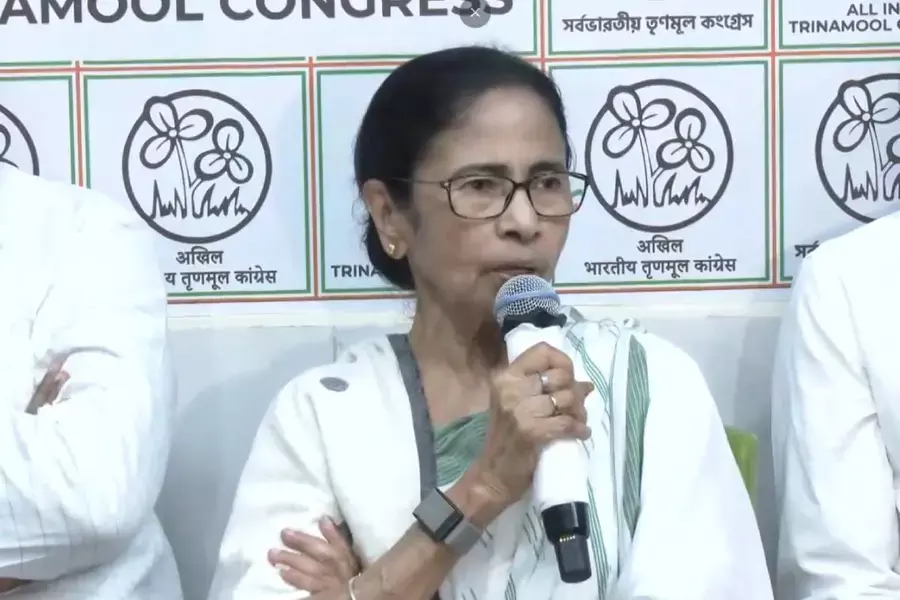
There is little doubt that Mamata Banerjee had to lose because she had a long enough innings at the helm. Even if there was no serious discontent, the people had every right to choose change. Apparently, the people of West Bengal had learnt that it is not good to have a party in power for too long. They did not want to commit the mistake they had made with the CPI(M)-led Left front government which had lasted for 34 years. Ms Banerjee made the mistake that most popular leaders do -- relying too heavily on her own charisma, and her virtues of a street-fighter. The TMC remained a brittle organisation because she was the sole anchor of the party. Everyone else in the party, whatever their abilities, chanted her name almost relentlessly. The incantation lost its spell due to sheer repetition.
The BJP’s triumph in West Bengal poses a major democratic challenge. The pattern appears to be that wherever the BJP comes to power, whether it is in Gujarat, Madhya Pradesh, Uttar Pradesh, and now in Assam, it has dodged defeat, and not always in a fair manner. Of course, Rajasthan is an exception. The BJP’s persistence to hold on to power once it gets to win an election is a disturbing phenomenon. It shows manipulative tactics on the BJP’s part to elude electoral defeat. The means it adopts aren’t above suspicion. The BJP’s totalitarian tactics often cast a long shadow over its democratic credentials.
The BJP can always argue that it is unreasonable to expect that it should lose an election once in a while to refurbish its democratic credentials. It can argue that similar objections were not brought up against the Left Front for its unusually long stay in office. Perhaps it would have been better both for West Bengal and for the Left Front if the coalition had lost an election or two. But it cannot be made a precondition for the credibility of the democratic system. It should not come as a surprise if the BJP were to stay on in power in West Bengal as it has done for a decade and more.
As a legitimate victor, the BJP would be justified in spreading its toxic ideology of intolerance, and the suppression of dissent, which forms part of its inherent ideology. Here too the counter-argument would be made that is indeed what the Left Front had done in the state during its 34 years in power. The saving grace of the Left, the TMC, and of the Congress in general is that they did not subvert the system in the manner that the BJP usually does. It is far too evident that the Election Commission’s SIR exercise is a nod to the BJP government at the Centre. The EC did not make any effort to make it appear fair and objective. The extensive use of Central forces was done as an intimidatory tactic by the Narendra Modi government rather than as a precautionary measure to ensure peaceful voting.
In Kerala, the CPI(M)’s chief minister Pinarayi Vijayan was always on unsteady ground. His victory in 2021, rare for any party in Kerala, was not a stamp of political immortality. Even though the Congress in the state was not as united as it should have been, its presence was enough for the people to have brought it in. There will be enough inner-party squabbles in the Congress in Kerala because that is what the Congress is. It is constantly displaying the symptoms of feuds, in power and out of power, as can be seen in Karnataka. Among the results of the four major states, the people’s verdict in Kerala is the most rational one.
The irrational element in Tamil Nadu is much too evident. The people have taken the risk of choosing an untested Vijay and his TVK. The choice may turn out well, but it remains an unknown factor as it was in the run-up to the elections. But Tamil Nadu’s voters are not as irrational as they appear to be. They trust their leaders, and what the TVK’s victory reveals is their trust in Vijay. It is not based on mere adulation, but is based on a clear assessment of Vijay’s character and his potential as a leader. They trusted MGR and Jayalalithaa in a similar manner.
And they did not hesitate to defeat Jayalalithaa when they felt the need to do so. So, Vijay cannot take his electoral victory and the people’s trust behind it at face value. He must prove himself in office. The electoral victory is an opportunity, not a reward for his popularity.
