Padma Rao Sundarji | Will India’s China Reset Lead To US, West Tweak?

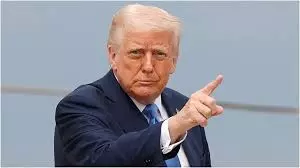
At the epicentre of those seismic disturbances were America’s unpredictable President Donald J. Trump, his tariffs and his loose cannon trade adviser, Peter Navarro
The onset of New Delhi’s searing summer usually sees officials scramble to attend useless conferences (example: the UN’s never-ending deliberations on climate change) in cooler lands. But a recent series of dramatic events saw departures in a different direction -- to the equally hot, coastal city of Tianjin in eastern China.
At the epicentre of those seismic disturbances were America’s unpredictable President Donald J. Trump, his tariffs and his loose cannon trade adviser, Peter Navarro. India was not only a “bad boy” for importing Russian oil, but was now seen as the root cause behind Russia’s invasion of Ukraine.
All that changed on Monday, September 1, when a single photograph of Prime Minister Narendra Modi in a gleeful huddle with Russian President Vladimir Putin and China’s Xi Jinping pierced through the soupy gloom hovering over newsrooms in Delhi and Noida like a ray of sunshine, and uplifted media spirits more than the Press Club of India’s bar on any given evening.
Just months after Beijing was suspected of providing Pakistan with intelligence on India’s retaliatory Operation Sindoor, Prime Minister Modi had done the unthinkable by travelling to China for the 25th summit of the Shanghai Cooperation Organisation (SCO), and meeting with China and Russia on its sidelines. Negotiations and bilateral talks to improve India’s frosty relations with China have been going on for at least a year, but this was Mr Modi’s first visit to that country in seven years.
Though no joint statement was signed after the well-publicised bilateral meeting, the usually reserved Xi Jinping, too, said he welcomed “good neighbourly and amicable ties” with India. Later, and as though to cock another snook at Washington DC, Mr Modi took a long, leisurely, one-on-one ride with President Putin in the latter’s limousine.
Nobody knows what was said at either of these interactions, of course. But there is no doubt that they were exquisite moves, and exactly the tonic that India’s battered self-image badly needed.
Meanwhile, the global media reacted very differently. Western analysis on India, which usually ranges from the sneeringly clueless to the studiously underplayed, exploded in horror. Here was Mr Modi, whom the West had “eating out its hands”, now cosying up to a gallery of the world’s biggest thieves!
Though it was difficult to say how much of this consternation, even in the European media, was genuine regret, and how much a smug “I-told-you-so” to point at Donald Trump as the cause behind the “loss” of India as a “valuable democratic ally” (read giant consumer market; world’s largest purchaser of weapons, and, if push came to shove with China, possibly a steady supplier of cannon fodder) in the Indo-Pacific region.
The SCO is, in the interim, the largest grouping in the Indo-Pacific region. India had hosted a meet of its foreign ministers in May 2023 in Goa and the line-up had included Pakistan’s then foreign minister Bilawal Bhutto. But as before, Pakistan has continued its pursuit of cross-border terrorism, most recently through the dastardly terror attack in Pahalgam.
Public distrust of China in India is almost at par with that of Pakistan, more so since that Pahalgam massacre -- over China's silence over the origin of the terrorists, and later, its tacit support to Pakistan when India struck back with Operation Sindoor.
To be publicly seen clasping Mr Putin’s hand couldn't be too beneficial either, given the Ukraine war and the punishing US sanctions for buying Moscow’s oil. All in all, New Delhi is known to skip global meets as per its own periodic perceptions.
So, why did India attend the SCO summit?
The SCO meeting would have taken place anyway,” points out Navtej Sarna, veteran diplomat and former ambassador to the US. “The only difference is, that because of this India-US issue, all routine bilateral meetings which would not have evoked that reaction, are now being seen as ‘teaming up’.”
Mr Sarna says that attending the summit was a “signalling by India that there are other options, other relationships and that India has been unjustly treated by the US”. But he also points out that mere participation at the SCO does not mean “India is giving up on the basic challenges with China”.
Leading China affairs analyst C. Raja Mohan is optimistic, but cautious. “India has been trying to reboot its relationship with China ever since the Galwan face-off in 2020. Remember -- we put a lot of brakes on Chinese investment thereafter. Now, we are lifting some restrictions, China is talking de-escalation at the border. Nothing dramatic, but both are giving something.”
As for Russia, both analysts see bonhomie and “reaffirmation”, rather than any dramatic new developments in India’s relations with Moscow. On the defence front, India has diversified its purchases and platforms, but will continue to rely on Russia for the supply of defence spare parts, and is even aiming to order more S-400 surface-to-air missile systems after their excellent performance during Operation Sindoor.
But what about the T-word? Which China has repeatedly refused to call out, despite the continuing support that Islamist terrorism receives in Pakistan? How much longer can China ignore Islamist terror on India out of Pakistan, while condemning Chinese Uyghurs of the Turkistan Islamic Party (TIP), who seek independence for China’s Uyghur province, now operate out of Syria and still enjoy close links to Al-Qaeda and the Taliban in Afghanistan?
A statement condemning terrorism “in all its forms and manifestations” was released at the end of the summit. To the naked eye, the declaration may not offer much solace. It does mention and condemn the attack in Pahalgam (something that an earlier SCO meeting had failed to do), and demands that the “sponsors” of such attacks be brought to justice. However, it carefully avoids all mention of Pakistan in any related context. Still, Indian diplomatic sources say that the statement was “at least something”, given that the SCO is the largest such body of the Global South and not some insignificant forum.
And what about India’s ties to the United States? Will the provocative photos at the SCO prompt an about-turn in Washington DC? If the US Supreme Court strikes down the tariffs, or, if President Trump himself has a change of his very unpredictable heart, can the clock be reversed?
“It can happen”, says Mr Sarna. “But that trust between India and the US was built over several years. The signalling from the Trump regime has now made things difficult. Building back that trust will take time. And possibly another personality.”
