OF CABBAGES AND KINGS | Straits Of God? Of A ‘Parsi Peg’ & Whisky Brand Called ‘Hormuz’! | Farrukh Dhondy

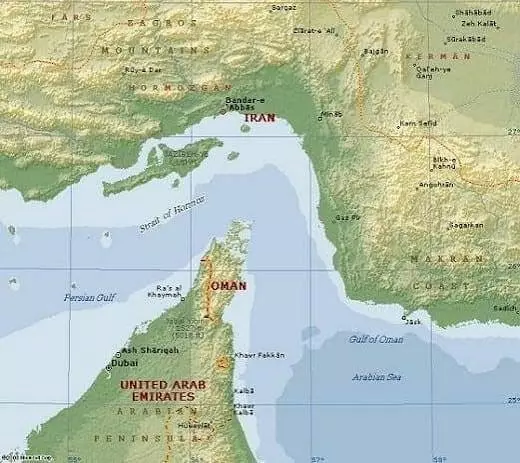
The world has been hit by financial crises owing to the closure of the waterway adjacent to Iran known as the Strait of Hormuz. Iran has mined this stretch of water to blow up any shipping and especially tankers carrying supplies of Middle Eastern oil to its buyers across the world
“The sun is sinking in the West,
Dinner dishes go down in the sink --
Sauvignon Blanc is undoubtedly best --
It’s time for a writer to drink!
Orange skies -- a radiant sunset
Which calm the emotions to see --
Those ones I saw and won’t forget
Looking at skies -- just her and me?”
From The Songs of Rose Leyti, by Bachchoo
Regime change looms ahead in the UK, and so, gentle reader, it’s reasonable to expect my speculation about the direction Andy Burnham’s premiership will take. But no. I’ll wait till he’s actually in 10 Downing Street and chooses a Cabinet. Instead, today, I will turn to a strange intrusion that’s come my way.
This column’s name, as you perhaps know, comes from Lewis Caroll’s rhyme in Alice in Wonderland:
“The time has come, the Walrus said…/ To talk of many things/Of shoes -- and ships -- and sealing wax/ Of cabbages and kings…”
I have very little to say about sealing wax, and, despite the fact that every commentator makes predictions about tomorrow’s UK, the time hasn’t come, for me, to talk about it.
Instead, here’s a strange, perhaps surrealistic and provocative offshoot of another international tangle of our times -- the US-Israeli war with Iran.
The world has been hit by financial crises owing to the closure of the waterway adjacent to Iran known as the Strait of Hormuz. Iran has mined this stretch of water to blow up any shipping and especially tankers carrying supplies of Middle Eastern oil to its buyers across the world.
Apart from a break in the bombing of Lebanon, and the surrender of nuclear capability by Iran, opening of the Strait of Hormuz to shipping has been one of the chief aims of the hesitant or non-existent “ceasefire negotiations” of this war.
It has, so far, come to nothing. Hormuz remains closed.
And this fact has inspired an AI-constructed joke on the Internet which has, I believe, “gone viral”. A friend sent it to me. It’s the picture of a bottle of whisky called “Hormuz”. The label says it’s a “single malt”, the category which is more expensive than “blended” whisky.
My friend’s caption to the photograph, or AI-generated picture (is it called a “meme”?) was something to the effect of “open up Hormuz”, presumably with a swig, to calm the anxiety caused by this murdering, destructive war.
If the actions of the United States had, as Orangeeboob originally intended, led to the rapid elimination of the cruel Iranian regime, it would have been welcomed by the civilised world. Donald Deranged Duck didn’t know what he was doing, or how to do what he wanted, and so it didn’t happen.
I respectfully assume, gentle reader, that none of this is news to you and that my comments are unnecessary! But what perhaps some of you don’t know is that Hormuz is the short form of “Ahura Mazda”, the “God of wisdom” or the supreme intelligence and light or energy of the universe -- the name for the monotheistic god of the Zoroastrian religion -- that of my family and my birth.
One of my ancestors and very many Parsis (Zoroastrians) are named “Hormuzd”, shortened in many instances to “Homi”.
I have, throughout my short and happy life, wondered why any community would call a boy child by the name of God. There are Christian boys in Portugal called Jesus, but there aren’t Jewish lads called Jehovah and calling a Muslim boy Muhammad is acceptable, but humans can’t be called Allah.
I suppose calling a stretch of the sea the Straits of God might be okay, but calling a mortal man Hormuzd -- Ahura Mazda -- is surely wrong? I came to the conclusion that over the years there had been an unconscious literal slip – that the original name was “Hormuzdyar”, which means the “friend of Ahura Mazda”, rather than God himself. That had slipped in usage to become Hormuz or Hormuzd and then “Homi”.
I am, as a born Zoroastrian, grateful to Ahura Mazda for keeping the religion devoid of ayatollahs. Yes, we’ve always had Dasturs, head priests and people who vainly regarded themselves as super-Dasturs, but nothing like the “supreme” ayatollahs, whose pronouncements become not “opinions”, as the translation of the word “fatwa” means, but commandments -- not perhaps carved in stone, but provocatively whispered into the steel of daggers and the barrels of guns?
There was never in Zoroastrianism, as there is in some other religions, an injunction against alcohol. Quite the contrary. The culture of, or indulgence in, a “chhaanto-pani” (“a splash with water”) is prevalent amongst us Parsis. And then there’s the joke of the two-fingered measure of a “Parsi peg” – involving the distance between the forefinger and little finger held against the glass -- the breadth of a hand? Full measure.
Freedom to consume alcohol may not make it permissible to name a single malt (or for that matter a blend) by the name of God. Stretches of ocean? Yes!
But brands of whisky???
My guess, gentle reader, is that even if there were Zoroastrian ayatollahs with severe dispositions, the natural tolerance within the tenets, traditions and culture of the religion would not lead to a “fatwa” to visit harm on the inventor of the Hormuz whisky meme. Cheers!
Or, as my grandfather would say when raising a glass, invoking service to God: “Sahebji!”
