Mohan Guruswamy | RSS Had Played No Role in Hyderabad Joining India
It is now 77 years since the largest princely state in British India was integrated into India on September 17, 1948
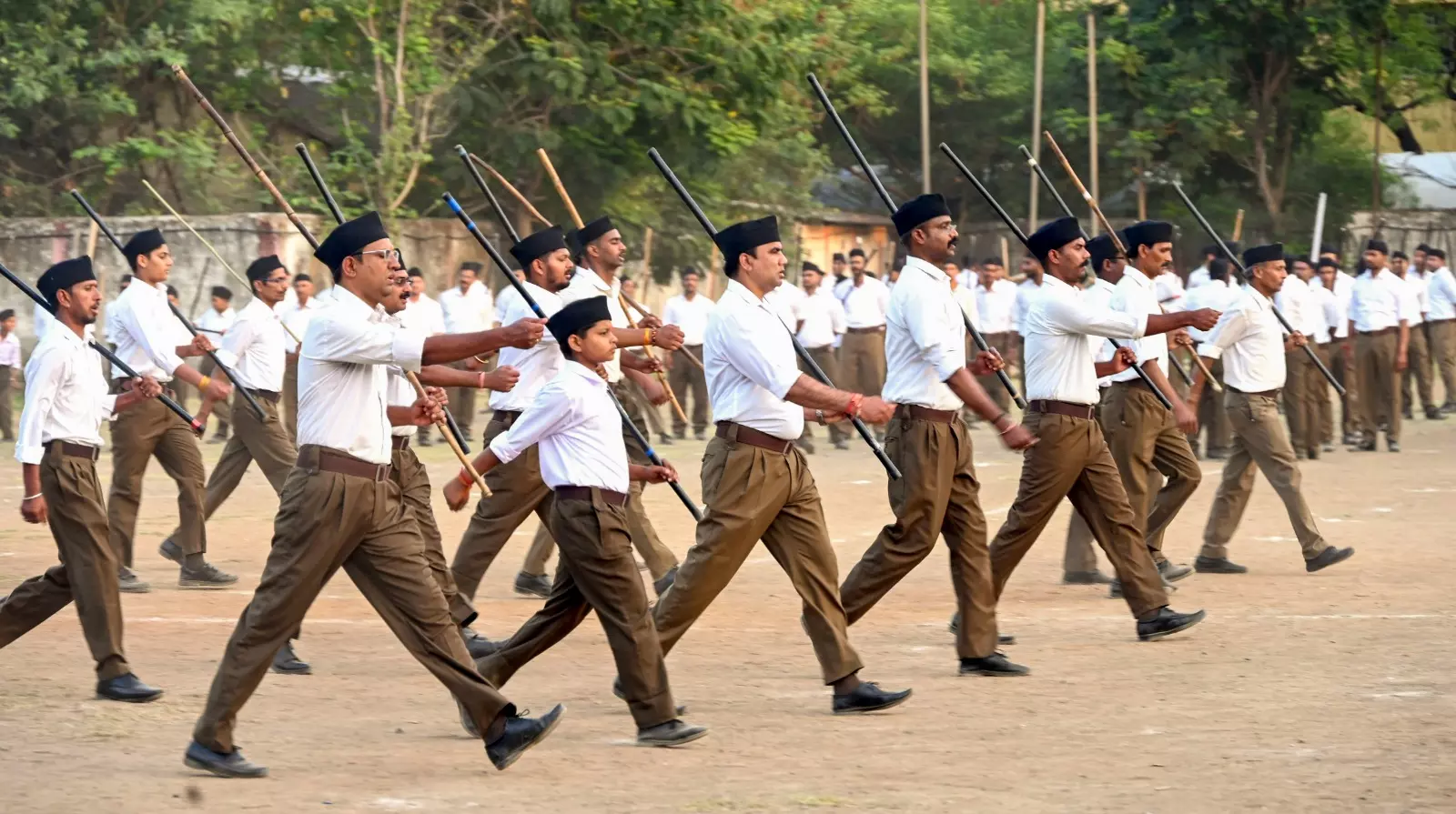
Prime Minister Narendra Modi and the Telangana BJP have once again demanded that the state government must celebrate the “liberation” of Hyderabad from the Nizam's yoke, something in which the RSS had no role to play. It’s like them wanting to celebrate August 8 as “Quit India” day, which the RSS had opposed.
It is now 77 years since the largest princely state in British India was integrated into India on September 17, 1948. Few now celebrate the hoisting of the tricolour here. We who were born in Hyderabad and have deep roots here take this day as another event in the passage of history. That Hyderabad which was “liberated” does not even exist. But what do these Johnnycomelately Sanghis know? They are prisoners of habit, habituated to fashioning lies into a selfserving history.
At the time of India’s Independence, Hyderabad was the largest Indian princely state in terms of population and GNP. Its territory of 82,698 sq miles was more than that of England and Scotland put together. The 1941 Census had estimated its population to be 16.34 million, over 85 per cent of whom were Hindus and with Muslims accounting for about 12 per cent. It was also a multilingual state, consisting of peoples speaking Telugu (48.2 per cent), Marathi (26.4 per cent), Kannada (12.3 per cent) and Urdu (10.3 per cent). It was a Muslimdominated state and its vast Hindu majority was generally excluded from government. It was a mirror image of J&K, which was a Hindudominated fiefdom.
Hyderabad had its Hindu nobility, and a couple of them even rose to become prime ministers. Maharaja Chandulal was prime minister from 1833 to 1844 during the rule of Sikandar Jah. Sir Kishen Pershad was the prime minister from 1902 till 1912. Nevertheless, it was a government of the Muslims and by the Muslims. The 1911 records show that 70 per cent of the police, 55 per cent of the army and 26 per cent of the public administration posts were held by Muslims. In 1941, a report on the civil service revealed that of 1765 officers, 1,268 were Muslims, 421 were Hindus, and 121 others, presumably British, Christians, Parsis and Sikhs. Of officials drawing pay between Rs 6001,200 per month, 59 were Muslims, 38 were “others”, and a mere five were Hindus. The Nizam and his nobles, who were mostly Muslims, owned 40 per cent of the total land in the kingdom.
The BJP’s only power base is in Hyderabad’s Old City, which is the political domain of the MIM, its mortal enemy. The nature of its power here is best symbolised by how it managed to inflict a temple on the southeast corner of the Charminar and where it still grows right under the nose of the Charminar police station.
The first stirrings of political activity in the Asaf Jah kingdom began in 1927 when the MIM was formed to unite various Islamic sects for “the solution of their problems within the principle of Islam”; and to protect the economic, social and educational interests of the Muslims. They presumably were affected by the happenings in Turkey and the direction the Khilafat movement took in India when it allied with the Congress and joined the nationalist movement 1920. The MIM soon became a movement to establish an Islamic state in Hyderabad.
In 1933, an association of “mulkis”, or localborn Hindus and Muslims, called the Nizam’s Subjects League was formed as a reaction to the continued domination of “gairmulkis”, mostly Muslim and Hindu Kayasthas from what is now UP, in the government. This was soon to be known as the Mulki League. It was the Mulki League that first mooted the idea of a “responsible” government in Hyderabad.
In 1937, the Mulki League split between the more radical elements, who were mostly Hindus, and the more status quo inclined. This led to the formation of the Hyderabad People’s Convention in 1937, a prelude to the establishment of the Hyderabad State Congress the following year. With this the movement for political and constitutional reform picked up momentum. The RSS did not exist in Hyderabad even on paper. The Hindu nationalist rump was of the Hindu Mahasabha, and mostly confined to Marathwada.
The Hyderabad State Congress agitation coincided with a parallel agitation led by the Arya Samaj and Hindu Mahasabha of V.D. Savarkar on Hindu civil rights. To a large extent the interests of the Congress and Hindu organisations coincided. This put them squarely against the Majlis, who were now led by Bahadur Yar Jung, who was also the founder of the AnjumaniTablighiIslam, a proselytising Muslim organisation whose prime activity was the conversion of Hindus.
Bahadur Yar Jung was a charismatic figure who became popular among Muslims and had the ear of the Nizam, Osman Ali Khan. Bahadur Yar Jung summed his goal very succinctly: “The Majlis policy is to keep the sovereignty of His Exalted Highness intact and to prevent Hindus from establishing supremacy over Muslims.”
The Congress leadership took more nationalist overtones after the arrival of Swami Ramanand Tirtha on the scene. Tirtha hailed from Gulbarga and as a young man became a sadhu. He became Hyderabad Congress president in 1946 and attracted around him several young men who rose to prominence in Independent India. Foremost among these was P.V. Narasimha Rao. Others were former chief ministers Shankar Rao Chavan, Veerendra Patil and Marri Channa Reddy.
While the Congress was gaining strength, the Communists were also active in Telugu-speaking areas. They captured the Andhra Mahasabha that was formed in 1921 to represent the interests of the Telugu-speaking people in 1942. Unlike the Hyderabad Congress, which launched a movement for democratic rights to run parallel to the Quit India movement, the Communists tacitly joined hands with the Majlis to support the Nizam, who was being a faithful ally of the British. The Communists will deny this, but the fact is that like the Muslim League and the RSS, they too had opposed the Quit India movement.
Accession brought in its wake the changes that were sought ever since political activity began in the state. The Muslim elite soon found themselves marginalised and many migrated to Pakistan. Others like Ali Yavar Jung made a smooth transition into the new order. A new bureaucratic elite was quickly installed even as the Communist insurrection was quelled. The Muslim feudal regime was replaced by a government that enjoyed the people's mandate. The RSS had nothing to do with it.
