Managing US, China In An Rising Bi-multipolar World
President Trump was forthright when he spoke of an idea that had first been proposed by an American scholar, Fred Bergsten in 2000, when he suggested that the US and China form a “Group of Two” (G2) to be able to jointly manage world affairs
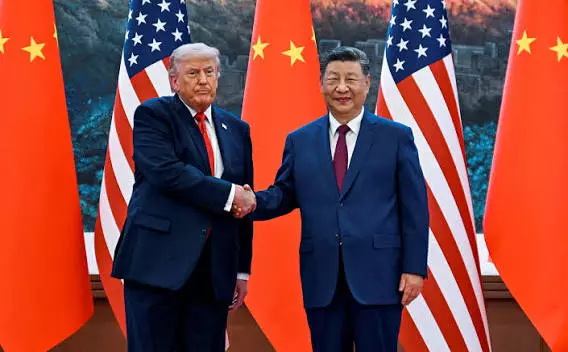
The world’s two biggest powers are seeking a new balance of power based on what has been termed as a “Constructive Strategic and Stable Relationship”. After meeting in Beijing in May this year and in Washington last week, the two plan to meet again in November, in China, and in December, in the US. This is historically unprecedented.
It should be clear to all strategic affairs analysts that a serious attempt is being made to arrive at some sort of condominium between the two big powers. This is not to suggest that their relationship would in fact be “strategic” or “stable” but their engagement could potentially be constructive if they are able to end the on-going wars in Europe and West Asia, revive multilateralism and manage the global power transition under way. But then, que sera sera! The future’s not ours to see.
President Trump was forthright when he spoke of an idea that had first been proposed by an American scholar, Fred Bergsten in 2000, when he suggested that the US and China form a “Group of Two” (G2) to be able to jointly manage world affairs. China has officially dismissed the idea of a G2 stating that it believes the global system is headed towards “multipolarity”, with dispersed centres of power. Russia, the third big power, has long advocated the idea of multipolarity suggesting that apart from the “big three”, the European Union, Brazil, India, Iran, Japan, South Africa and so on are also important players in the global system.
The debate about the structure of power among nation states and the global influence and capability of various states will continue. It is true that through centuries the power of states has been dispersed with no one power capable of asserting its interests over all others. The British Empire enjoyed that kind of power through the 19th century and lost it by the middle of the 20th. The United States has enjoyed a sort of monopoly over global power for less than a century now but it no longer does. There was a brief moment after the Soviet Union imploded when analysts suggested that the global system was ‘unipolar’ with no country in a position to challenge the US.
The Harvard historian Samuel Huntington, famous for his theory of the “clash of civilisations”, questioned the notion of “unipolarity” in a paper he published in 1999. The post-Cold War global system was in fact “Uni-multipolar”, suggested Huntington, because a group of “regional” powers would come together to prevent any single nation from becoming the hegemon of a unipolar power system. “The superpower’s efforts to create a unipolar system stimulate greater effort by the major powers to move toward a multipolar one.” Huntington suggested, adding: “Virtually all major regional powers are increasingly asserting themselves to promote their own distinct interests, which often conflict with those of the United States. Global politics has thus moved from the bipolar system of the Cold War through a unipolar moment — highlighted by the Gulf War — and is now passing through one or two uni-multipolar decades before it enters a truly multipolar 21st century.”
The question today is whether between uni-multipolarity and multipolarity there is going to be a phase of “bi-multipolarity”? Of course, one can reject all such theoretical constructs saying the reality is more complex than any attempt to fit it into intellectual straitjackets and paradigms. Yet, I persist. If indeed one were to accept Huntington’s formulation that what came after the brief “unipolar moment” of the 1990s was a long phase of “uni-multipolarity” then it stands to reason to define the current phase as one of “bi-multipolarity”.
Neither the US nor China have any peers in their respective hemispheres. Russia has weakened itself after its misadventure in Ukraine. China has so far played its cards well, especially in Asia. Both the US and China are facing resistance within their respective hemispheric spaces, yet they have been able to take unilateral actions that have not yet met with much resistance.
The US has toppled a regime in Venezuela. However, it is still not sure if it can topple the Cuban regime so easily. China has consolidated its position in West and South-east Asia, and in much of South Asia, but it will be a long time before it can claim victory across the Taiwan Straits. There are checks and balances at work and India has been at the forefront of strengthening these checks and balances.
Indian diplomacy has, in recent months, woken up to the challenge at hand after wasting years investing more than required in a relationship with the United States. It required some plain speaking by President Trump for those who have been sleepwalking through the corridors of power and think tanks in New Delhi to wake up and smell the coffee.
The challenge for India is in front of us in plain sight. Either we understand and deal with the world as it is or continue to remain in a world of our own making. It is India’s legitimate aspiration to be viewed both as one of the poles of a multipolar world and as a significant pole of a multipolar Asia. Many diplomats and analysts in India nurse the grievance that China is willing to view the global power balance as being multipolar but is not willing to concede multipolarity in Asia. This is a petty grievance.
Multi, uni or bi polarities are not there for the asking. Each of them is the reflection of real power balances shaped by economic, military, educational, scientific, technological, political and diplomatic capabilities. The Chinese termed this “comprehensive national power” (CNP). India has some distance to travel on each of these axes. That is our task at hand. At the end of the 20th century the CNP of China and India were more or less at par. Today China is far ahead of India in terms of CNP. India will get there but has to work at it.
Just as the unipolar moment for America gave way to a uni-multipolar era, the latter has now been replaced by a bi-multipolar phase. This phase will yield to multipolarity when India and other nations invest in strengthening their CNP and build coalitions of the like-minded.
Sanjaya Baru is a Distinguished Fellow, United Service Institution of India and Takshashila Institution
