Kamal Davar | Nuclear Threats By Pak’s Munir Can’t Be Ignored By India, West

Field Marshal Asim Munir appears to have gone haywire in his utterances, especially after President Trump’s unprecedented invitation to him for lunch at the White House
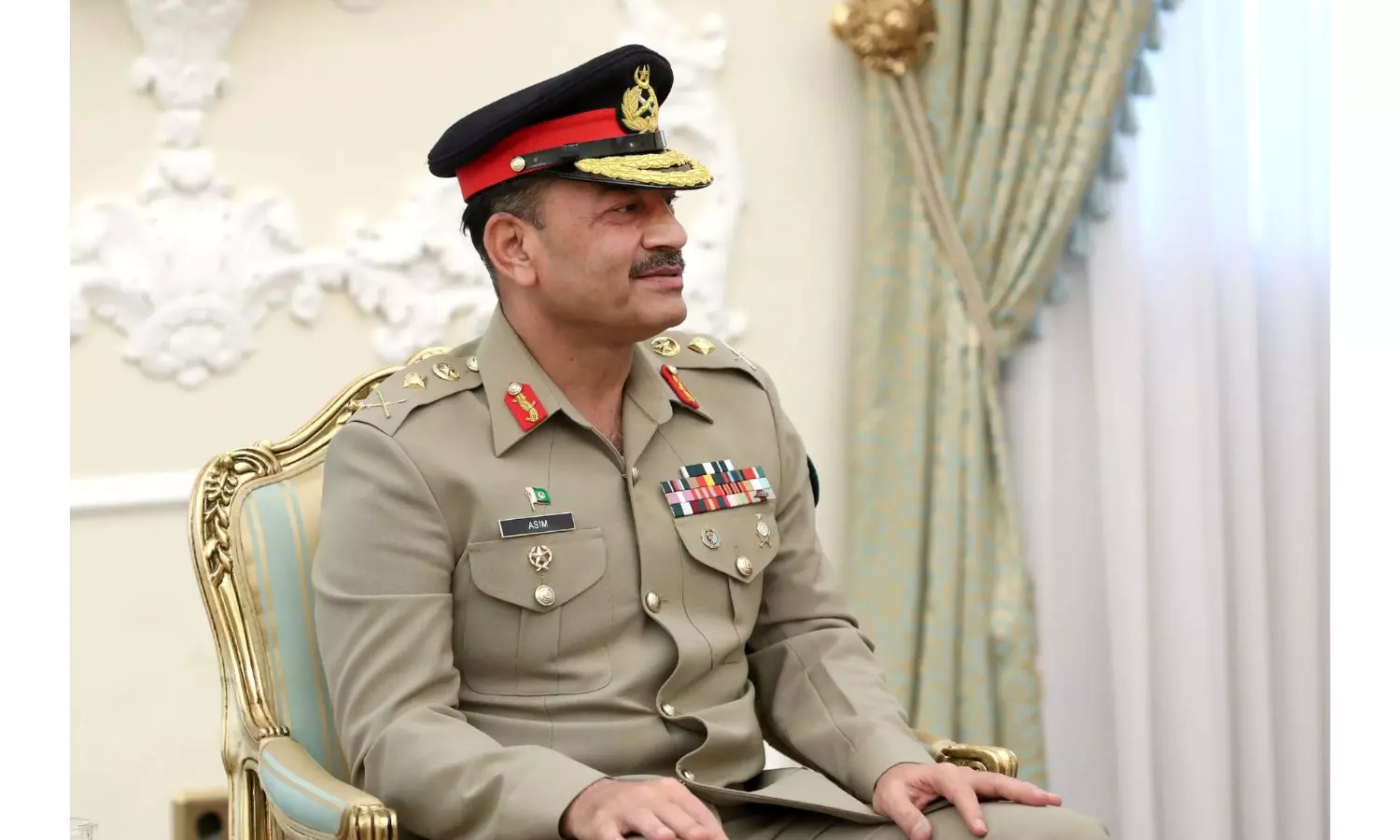
It’s indeed a historical truism that power, especially in the veins of undeserving or self-appointed worthies, makes most such individuals go berserk, which gets reflected in their actions that could turn out to be dangerous beyond comprehension. One glaring example is Pakistan’s current Army chief, recently self-promoted Field Marshal Asim Munir, whose utterances before some members of the Pakistani community in Tampa, Florida, have raised alarming red flags.
Asim Munir’s second visit to the US in two months appears to have rocked him off balance. It is fairly unprecedented in the history of US-Pakistan relations for a serving Army chief to be invited twice in a couple of months, especially after his rather surprising visit to the White House for lunch with America’s unpredictable President Donald Trump.
Though virtually a vassal state of the US since the early 1950s, Pakistan’s relations with the US have been a roller-coaster ride over the past few decades. Is the current level of warming in ties between the two nations an example of the citadel of democracy succumbing to the citadel of terror? We will know for sure soon enough.
Gen. Asim Munir had become Pakistan’s Army chief on November 29, 2022, with the approval of Shehbaz Sharif’s elected civilian government. He promoted himself to Field Marshal after the recent conflict with India in May this year. But since his first day in office, Asim Munir has kept up his nation’s practice of its Army wielding power inside Pakistan far beyond its constitutional mandate, whether in matters of internal security or external policies. Prime Minister Shehbaz Sharif is well aware of his government’s limitations in his nation’s governance and, like the rest of the government, has been content playing second fiddle to the over-ambitious and congenitally anti-India Army chief. That Asim Munir calls the shots in Pakistan is more than amply clear with him ensuring that the vastly popular former PM, Imran Khan, continues to languish in jail and no political space is accorded to Imran’s supporters in Pakistan.
Field Marshal Asim Munir appears to have gone haywire in his utterances, especially after President Trump’s unprecedented invitation to him for lunch at the White House. It appears that Mr Trump has undertaken a complete volte face over Pakistan after having earlier described it as one of the chief architects of global terrorism for the past 50 years or so. Perhaps the US now feels that in its dealings with Iran and Afghanistan, Islamabad could be a useful behind-the-scenes actor and also do America’s dirty jobs in the region, as required from time to time.
Meanwhile, in the US, speaking in Tampa, Florida, Asim Munir has made some extremely irresponsible and provocative statements, which cannot be taken lightly either by India or by the US or any other country. Brandishing the nuclear card, he stated that “we are a nuclear nation, and if ever Pakistan goes down, it will take down half the world”. Commenting adversely on India holding in abeyance the 1960 Indus Waters Treaty after the recent four-day conflict with Pakistan, Asim Munir reportedly said: “We will wait for India to build a dam, and when it does so, we will destroy it with 10 missiles.” His tirade continued with him further saying that “the Indus river is not the Indians’ family property”.
An interesting out-of-the-way statement was also attributed to Field Marshal Munir on the role of the Army in politics in his country. At the same event in Tampa, Asim Munir emphasised the importance of the role of the military in Pakistan’s politics and governance, and reportedly expounded that “they say that war is too serious to be left to the generals, but politics is also too serious to be left to the politicians”.
There were, meanwhile, protests by many members of the Pakistani diaspora and supporters of other Pakistani political parties in the US against Asim Munir’s visit, accusing him of human rights violations and trampling with democracy inside Pakistan.
India, fresh and exuberant after its resounding success in the recent Operation Sindoor, which lasted just 88 hours, has to be wary and doubly careful with Field Marshal Asim Munir being in the driver’s seat in Pakistan. The major damage to its 11 airbases and command and control centres inside Pakistan caused by India’s retaliatory strikes will prompt them to take equal or appropriate counter-measures against India. Thus, our Intelligence, Surveillance and Reconnaissance (ISR) measures have to be of the highest order. Asim Munir will be waiting in the wings to take adequate revenge against us after the serious losses suffered by Pakistan.
It goes without saying that the quality of timely intelligence that is available for the troops and higher HQs will have to be of the highest order. I am sanguine that all the three service headquarters, under the Chief of Defence Staff, would have undertaken, in camera, a complete study of the operations and our deployments prior to the launch of Operation Sindoor and afterwards. The three chiefs may wish to advise the government to make up our deficiencies in our arms, equipment, platforms and ammunition holdings at the earliest with additional financial commitments for capital purchases. The defence budget must be augmented up to at least 2.5 per cent of GDP while ensuring improvements in our drive for high-tech weaponry and self-reliance, for which additional funds will be required also for our R&D.
India’s geopolitical challenges have only multiplied in the last one year. With a not so friendly strategic ally in our presence, India will have to be further self-reliant, watchful and pragmatic in its approach to its security.
The writer, a retired lieutenant-general, was the first head of India’s Defence Intelligence Agency, and is a strategic analyst
