John J. Kennedy | Protecting NEET Papers: The Real Leak Is in Integrity of All Institutions

Secure transport alone cannot fix systemic weaknesses in India's examination system.
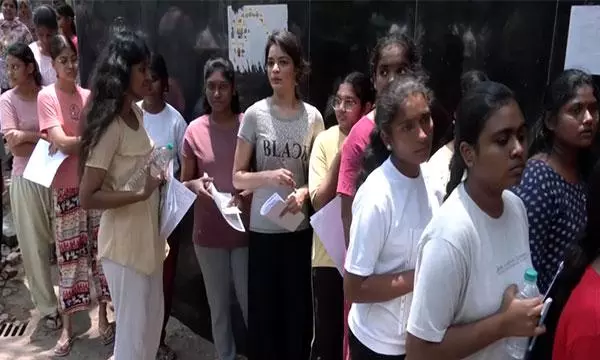
The Government of India is reportedly considering using the Indian Air Force to transport NEET examination papers. A civilian examination system is now looking to military logistics to secure the pan-India movement of question papers. This is not merely a security problem but a sign that something much more serious has gone wrong inside our trusted institutions.
The proposal has already triggered criticism from a variety of quarters, with opponents questioning whether military resources should be deployed to compensate for failures in the civilian examination management system. If civilian institutions cannot guarantee the integrity of a national examination, the problem then lies far deeper than simply transportation.
The recent NEET controversy exposed what many had already suspected -- that India’s high-stakes examination system is vulnerable from within. Students protested. Parents demanded answers.
The courts intervened. Investigations then followed. Arrests were made. More troublingly, investigators pointed to the involvement of individuals linked to the examination ecosystem itself. This is the part that matters most. The threat did not come solely from outsiders attempting to break into the system. It also came from insiders who had privileged access to the processes that were supposed to remain secure.
Many major examination scandals in India have showed a similar pattern. Public outrage is followed by a familiar set of fixes -- more cameras, biometric systems, stricter laws, encrypted transmissions and now, perhaps, military transport. The assumption behind these responses is that the system is fundamentally sound but operationally weak and that better logistics will solve the problem. This assumption is only partly correct. A paper does not leak merely because transportation is insecure. It leaks because someone, somewhere in the chain -- a paper setter, moderator, printing official, coordinator, or even administrator -- misuses the access entrusted to them. Technology and tighter logistics can reduce risk, but they cannot totally eliminate the failures of integrity.
Indian society has traditionally held teachers and educational institutions in deep respect. Exams were not just tests. They were the mechanism through which a child from a poor family could compete with one from a wealthy background. Exams carried a promise -- that merit would be rewarded regardless of where one came from. That promise is now under serious strain. The problem is not simply criminal infiltration from outside. Investigations repeatedly suggest that insiders sometimes become part of the problem. When individuals entrusted with safeguarding examinations compromise them, the issue ceases to be merely administrative and becomes ethical. This is not happening in isolation. Across Indian public life, there is a growing tendency to treat duty as a transaction. Private gain often overrides public responsibility. In education specifically, the pressure on students to secure admission at any cost has created an ecosystem where shortcuts can appear normal and even rational. The coaching industry thrives on this anxiety and, in some cases, helps intensify it. As the stakes rise, so does the temptation to cheat.
A system operating under such pressure, staffed by individuals shaped by the same social environment, is unlikely to be repaired simply by placing question papers on an Air Force aircraft.
What India needs is structural reform, and it must begin with how paper setters and examination personnel are selected and managed. For high-stakes examinations such as NEET, JEE, and CUET, those handling sensitive material should be treated as members of a specialised and carefully screened pool. Rigorous background checks, conflict-of-interest declarations, and periodic recertification should become standard practice. Examination work must be regarded as a serious public responsibility rather than a routine academic assignment distributed without adequate scrutiny.
The deep and largely unacknowledged overlap between examination bodies and the private coaching industry also deserves closer attention. Rules against conflicts of interest already exist in various forms, but enforcement remains uneven. Mandatory disclosure of ties to coaching institutes, test-preparation companies, and related commercial ventures should become standard practice. Concealing such relationships should attract serious penalties, including permanent exclusion from examination-related responsibilities.
Beyond personnel reforms, the examination process itself requires stronger compartmentalisation. Paper setting, moderation, printing, and distribution should be kept strictly separate, with no individual enjoying access across multiple stages. Large international examination systems, including organisations such as Cambridge Assessment, employ various forms of role separation, restricted access, and layered oversight to reduce insider risk. India should adopt similar safeguards while ensuring frequent personnel rotation to prevent the emergence of long-standing informal networks that could facilitate collusion. The problem in India is not a shortage of regulators but a shortage of independent oversight. Examination agencies should not be left to assess their own security failures. Regular external audits, integrity reviews, and insider-risk assessments by an autonomous panel of experts would strengthen accountability without creating another layer of bureaucracy.
None of these reforms, however, will succeed if the broader ethical culture surrounding education continues to deteriorate. When students stop trusting examinations, they stop believing that hard work will be fairly rewarded. The coaching industry grows on that fear, and merit loses credibility. For a country where examinations determine access to education, employment and social mobility, this is not a minor administrative lapse. Meritocracy cannot survive if those entrusted with protecting fairness fail to uphold it. The damage extends beyond a single examination cycle. It erodes public trust in institutions themselves.
Surely, India does not need a militarised examination system. It needs an examination system that works. One that is secure not merely because papers are transported under tighter guard, but because the people entrusted with the process take their responsibilities seriously. The real leak in this crisis is not simply in the question paper. It is in institutional integrity. And unlike a paper, that cannot simply be reprinted.
The writer is retired professor and former dean of the School of Arts and Humanities at Christ University in Bengaluru
