Indranil Banerjie | America@250: Could It Still Inspire The World?

While the fortunes of India and America followed very divergent trajectories, an incipient link connected the two. This was political ideology. The United States was destined to serve as the political inspiration for India
During the second half of the 18th century, when India was coming under the inexorable stranglehold of British colonialism, halfway across the world, the opposite process was underway. In America, citizens were fighting to oust their British colonial overlords. The independence of the American colonies, which came at the end of a bitter eight-year-long war, ushered in a period of unprecedented prosperity and eventually transformed the country into the world’s richest and most powerful nation. India, on the other hand, slipped from being one of the most affluent and awe-inspiring empires into one of the world’s poorest and inconsequential countries.
While the fortunes of India and America followed very divergent trajectories, an incipient link connected the two. This was political ideology. The United States was destined to serve as the political inspiration for India.
The process started early. In 1831, an unknown American publisher sent a thousand copies of Tom Paine’s famous tracts Age of Reason and The Rights of Man by ship to Calcutta, where booksellers hawked them at one rupee a piece, not an inconsiderable sum in those days. The book proved to be such a bestseller that the booksellers quickly raised the price to Rs 5 a copy! Young Indians who had learnt English and were beginning to devour Western philosophical and political works were electrified by Tom Paine’s writings on liberty and the rights of all men. More of his books were ordered from America.
The colonial masters in India were furious at this development. The Scottish missionary, Dr Alexander Duff, was among the many who condemned the book’s publisher, calling him a “wretched bookseller in America” who had “no God but his silver dollars”. Like most colonials, Duff considered Indian self-governance or political independence unthinkable, and believed it was their divine duty to rule India and eventually transform it into a Christian nation!
But the damage was already done. The idea of liberty and a government of free people was so intoxicating that it would eventually spark off a revolution in Indian political thought and sow the seeds of the country’s freedom movement.
The United States, even in later years, continued to champion the independence of India. During the Second World War, when US President Franklin D. Roosevelt demanded the end of British rule in India as one of the preconditions for US support for the British war effort, a furious Winston Churchill declared: “I have not become the King’s First Minister in order to preside over the liquidation of the British Empire”. But Churchill could not hold out. and in the end lamented: “The empire I believed in has gone”.
Though the United States played a significant role in India's struggle to achieve Independence, the two countries drifted apart shortly after 1947. This was primarily because after World War II, America emerged as a global hegemon and took on the imperial mantle from Great Britain. Over the years, the nation that had once championed liberty and democracy grew into a ruthless superpower bent upon imposing its will on the rest of the world.
Its imperialistic war machine rampaged across the globe, killing millions in countries as varied as Vietnam, Afghanistan, Iraq, Syria, Yemen, Libya, and most recently Iran. In the post-9/11 period alone, the US is estimated to have killed over 4.5 million people.
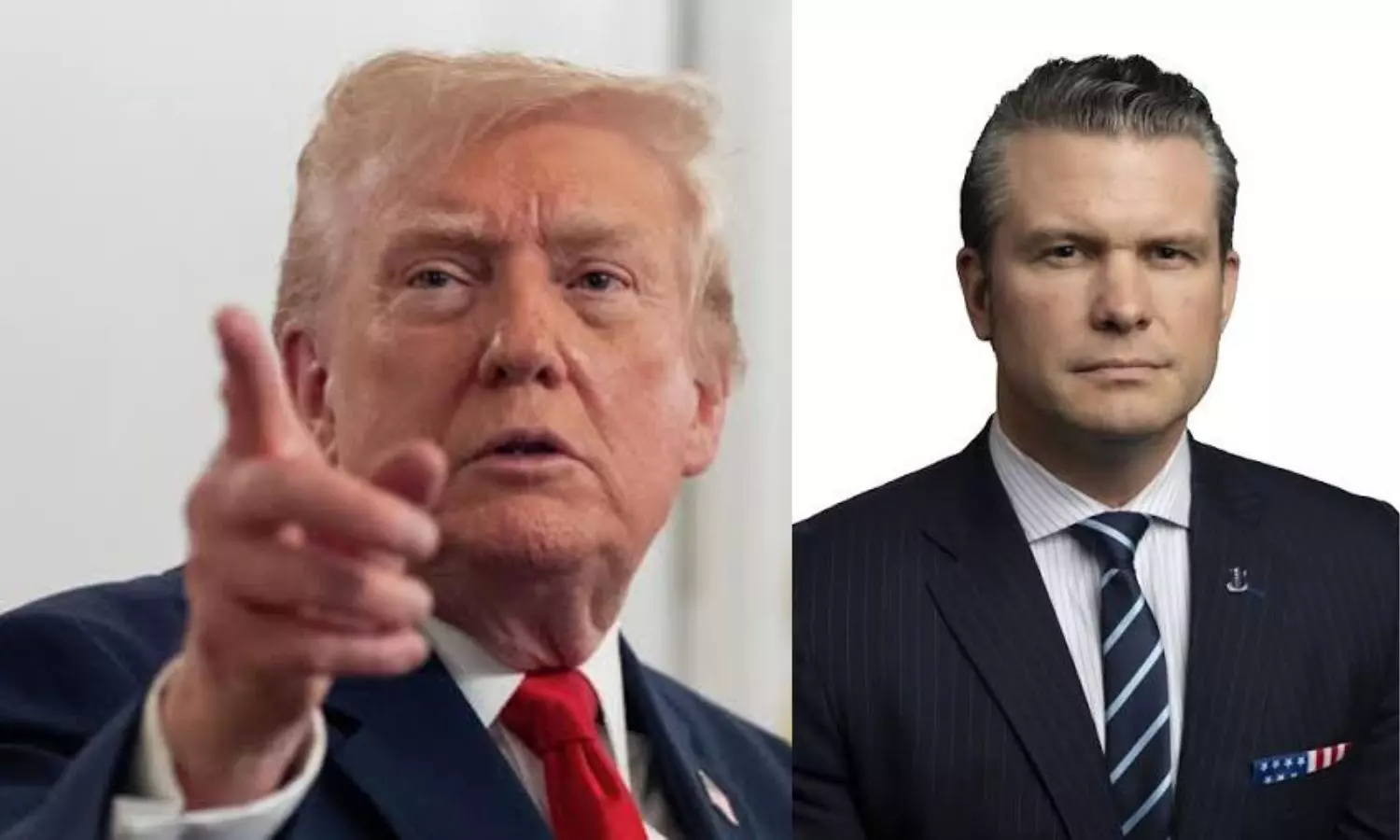
As the United States marks its 250th anniversary, there is little to suggest that it could once again revert to being the beacon of democracy, justice and liberty that it once was. US President Donald Trump's threat to “wipe out an entire civilisation” (Iran) from the face of the earth is a deeply disturbing echo of the kind of amoral thinking that grips the country’s elite. His defence secretary, Pete Hegseth, hosting his first monthly Christian worship service at the Pentagon (on March 25, 2026), quoted from the Psalms: “I pursued my enemies and overtook them, and did not turn back till they were consumed.”
While India since Independence steadfastly refused to hitch its fortunes to the US wagon and insisted on staying non-aligned in a deeply divided world of great powers, the old incipient link between the two countries did not completely sunder. While Tom Paine had once inspired a generation of Indians, Mahatma Gandhi inspired legions of Americans, including the legendary black leader Martin Luther King Jr.
Meanwhile, millions of Indians looking for opportunities and a better life flocked to the United States while its technological strides helped the world climb another step on the development ladder. At heart, American society remained deeply committed to the idea of diversity and freedoms. Immigrants from all over the world arrived on its shores to spur innovation and germinate new ideas.
America and India came geopolitically closer after President Bill Clinton’s India visit in March 2000, followed by the signing of the civil nuclear agreement under George W. Bush. But that warming of relations proved to be a temporary blip that lasted barely two decades. Now, as US Congressman Ro Khanna said the other day, relations between India and the US haven’t been worse than for 30 years.
It’s not just the US establishment or President Donald Trump who are responsible for the seesaw in America’s worldview. The changes within American society are even more profound. A vocal right wing has emerged in the US, fuelled by unemployment and record levels of income inequalities. This is the support base of Present Trump, and one that is xenophobic, inward-looking and far divorced from the liberal ethos of its founding fathers. The country is more deeply divided than it ever was in its 250-year history.
Today, the question is: whose America is it?
When singer Bruce Springsteen came out in the streets of St. Paul in support of the “No Kings” rally, where thousands protested against the Trump administration’s authoritarianism, immigration crackdown, and the 2026 Iran war, with the lyrics “Singing through the bloody mist/ We’ll take our stand for this land/ And the stranger in our midst”, it reminded me of the America we once knew. When Americans would come out in support of oppressed people across the globe, when icons like Bob Dylan, Leon Russell, Billy Preston and Eric Clapton played for free at events such as the Concert for Bangladesh, when leaders like Martin Luther King Jr. declared it as a moral duty to oppose the Vietnam war.
I cannot but hope that it’s people like Springsteen represent the real America, and not its warmongers raining bombs on distant countries or President Trump threatening to wipe out an entire civilisation.
