India, Bangladesh Fight Ghost War, Hasina The Target

The country’s new PM, Tarique Rahman, is the battle’s political adversary, even as New Delhi stands as Ms Hasina’s increasingly uncomfortable custodian
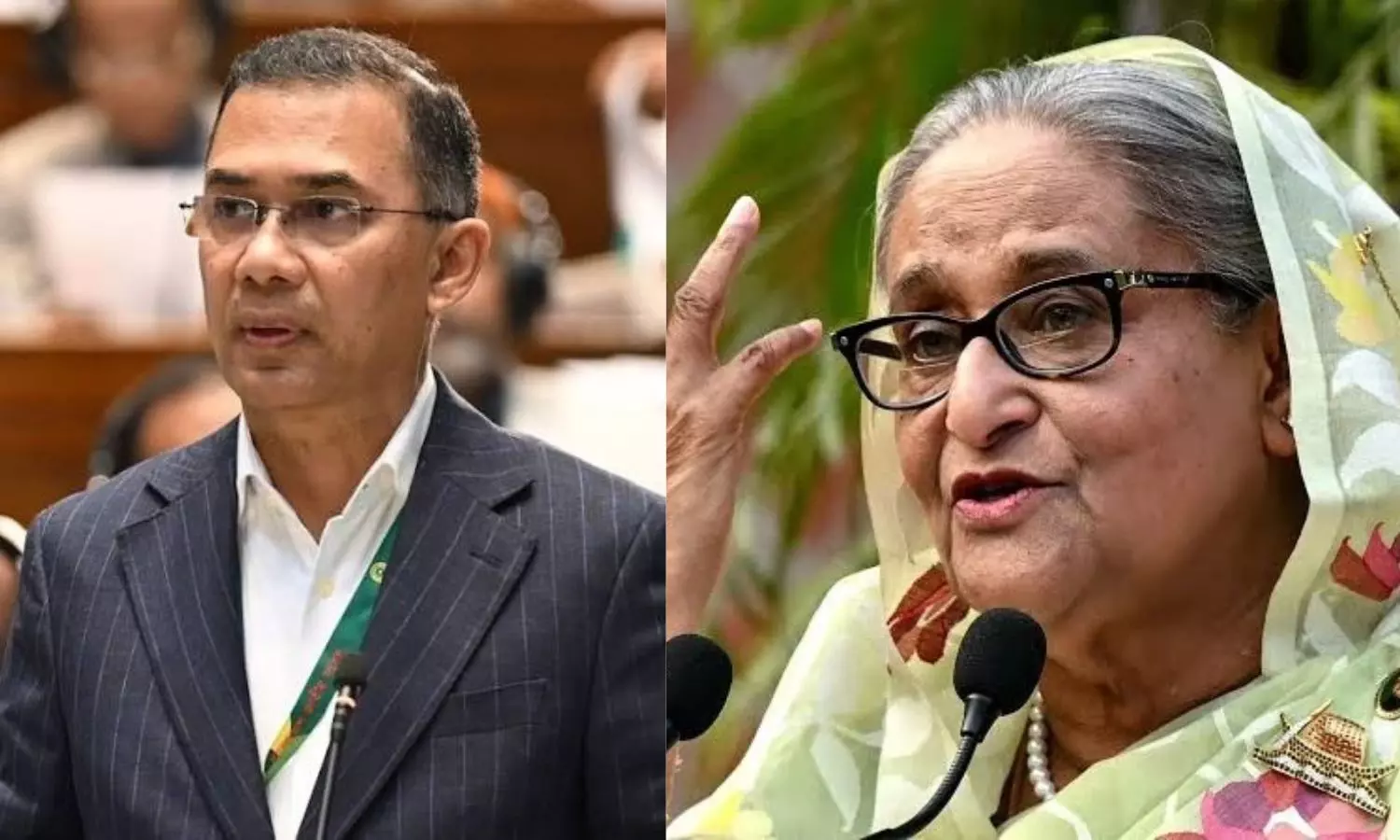
There is an ongoing war, minus the guns, fighter planes and bombs, between India and Bangladesh. Sheikh Hasina, Bangladesh’s former Prime Minister, is the target. The country’s new PM, Tarique Rahman, is the battle’s political adversary, even as New Delhi stands as Ms Hasina’s increasingly uncomfortable custodian.
Hasina fled Dhaka on August 5, 2024, aboard a military aircraft and landed in India. Since then, the 79-year-old leader has lived under heavy security at an undisclosed location, politically isolated and cut off from her former colleagues. Sources close to her say that she wants to return home. Her reported attempts to renew her passport and obtain a national identity card suggest that the desire is real. But there are questions about her safety in Bangladesh, which witnessed massive protests against Hasina that resulted in regime change.
The new Tarique Rahman government, too, wants Hasina to come back home, via an extradition as she was sentenced to death in absentia by Bangladesh’s International Crimes Tribunal. Thus, India is caught in a diplomatic triple trap — Ms Hasina’s security, Ms Hasina’s wish and Mr Rahman’s politics. According to senior diplomatic sources, New Delhi explored the possibility of relocating Ms Hasina to another country, but finding a willing destination proved difficult. Another option: India has simultaneously sent a blunt message to Bangladesh: Your nation sent Hasina to India you must take her back. Sources close to Hasina say she wants New Delhi to negotiate with Dhaka for her return with an assurance that she will not be executed.
All this is happening amidst Mr Rahman’s outreach to China, Pakistan and Turkey, which is a cause for concern in New Delhi. Pakistani military delegations held discussions with Bangladesh’s armed forces on intelligence-sharing, border security, joint exercises and training. The historical rupture of 1971 between these two nations — Bangladesh was born out of Pakistan — no longer prevents military engagement. Hence, India’s diplomatic machinery is under additional pressure.
External affairs minister S. Jaishankar and foreign secretary Vikram Misri face a tough assignment. Gujarati-turned-Bengali high commissioner Dinesh Trivedi, according to sources, is bypassing the foreign ministry, and reporting directly to the PMO. The stakes are high. This is the ghost war: no bullets, no declared enemy, but a war over influence, security and the future balance of power in South Asia.
*
The Republic of Additional Charges
The Union government’s bureaucracy is increasingly relying on additional charge arrangements to keep key offices running. Three IAS officers now have multiple responsibilities after three retirements on October 31, 2026. Vacancies at the top, at the secretary level, are being filled by giving additional charges to existing bureaucrats, rather than immediate full-time replacements.
Manoj Govil, a 1991-batch Madhya Pradesh cadre officer and secretary (coordination), Cabinet Secretariat, got additional charge of secretary, transport and logistics planning, in the same secretariat. The assignment is significant as the government recently approved the Integrated Transport and Logistics Authority to coordinate planning across transport sectors. Rajendra Kumar, a 1992-batch Tamil Nadu cadre officer and secretary, department of border management, was assigned additional charge of secretary, Inter-State Council Secretariat.
Sandeep Pondrik, a 1993-batch Bihar cadre officer and secretary, ministry of steel, got extra charge in the ministry of heavy industries. All the three orders, which were approved by the Appointments Committee of the Cabinet, state that the officers will hold the additional charges until regular appointments are made or further orders issued.
The official explanation is continuity, to ensure there is no gap after a senior officer retires. But giving portfolios to serving secretaries raises the question whether temporary arrangements will become routine. Additional charge prevents disruption but prolonged reliance blurs accountability. For a government that prizes speed and coordination, the test is whether these stopgaps remain brief — or become the norm.
*
Himachal wants few, others want more
Himachal Pradesh’s stated policy that the state cannot afford the existing administrative setup stands in sharp contrast to the expansion sought or secured by other states. HP chief minister Sukhvinder Singh Sukhu proposes cutting IAS strength from 153 to 130 and IFS strength from 118 to 83. In contrast, Gujarat secured 15 additional IAS posts in February 2026, taking its sanctioned cadre to 328, Haryana’s cadre rose from 215 to 226 in June 2026.
Comparing the Centre’s 2019 cadre figures with sanctioned strength on January 1, 2025, Uttar Pradesh increased its IAS cadre from 621 to 652; Rajasthan from 313 to 332; Maharashtra from 415 to 435; Tamil Nadu from 376 to 394; Madhya Pradesh from 439 to 459; Chhattisgarh from 193 to 202; Odisha from 237 to 248; and Jharkhand from 215 to 224.
Himachal Pradesh’s argument for a reduction is financial. Its bureaucratic establishment costs around Rs 200 crore a year. At an estimated outgo of Rs 50 lakh per officer, the reduction of 23 IAS and 35 IFS posts imply savings of Rs 29 crore a year if the posts disappear. It is a sizable amount. But one cannot argue that the states that increased the IAS strength are fiscally irresponsible. Different states have varying workloads, revenues, and needs. One can challenge a blanket assumption that a smaller IAS is the answer to minimum government. The test is about the required cadre strength, and whether savings via reduction weaken district administration or not.
The writer is a senior journalist and alumnus of the Delhi School of Economics. He is the editor of gfiles, India’s first magazine on civil services and governance. @AnilTyagilive.