Dev 360 | Budget: The Social Cost Of Fiscal Consolidation | Patralekha Chatterjee

Health and wellness centres launched under the Ayushman Bharat programme in 2018 to deliver comprehensive primary healthcare, and now renamed as Ayushman Arogya Mandir, exist
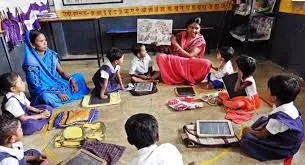
There is a huge gap between India’s headlines and its hum of life. The chasm shows up starkly during Budget season. “Fiscal consolidation” is not an abstraction -- it is the watery dal in an anganwadi, and much more.
The Union Budget for 2026-27 once again tilts the scales away from the social sector. Despite modest headline increases, actual spending continues to lag, leaving critical programmes underfunded and underutilised.
As Avani Kapur and Sharad Pandey of the Foundation for Responsive Governance highlight in their analysis of Budget 2026-27, the social sector budget as a share of India’s gross domestic product is now second lowest in over a decade, and lower even than 2014-15, when the Narendra Modi government presented its first-ever Budget. While Budget 2026-27, which was presented on February 1, shows small increases for welfare schemes, actual utilisation remains low.
For the past few days, I have been speaking to anganwadi workers in villages, grassroots researchers, medical doctors working in tribal hamlets, academics who study or have lived experience of these patterns to get a better understanding of the human cost of de-prioritisation of the social sector.
Starkly and predictably, ordinary people do not speak the language of budgets. They simply live with the consequences.
I spoke to Dr Yogesh Kalkonde, a US-trained public health researcher and practitioner working in Chhattisgarh. Dr Kalkonde designs and implements healthcare solutions for tribal and marginalised communities. In the tribal hamlets where he works, nearly 1,000 km by road from Delhi, keeping trust in the public health system is a challenge, he says. Poor tribal families prefer to go to the private sector which they believe is better even if they are not so in all instances or do not seek care. Often, they are asked to do unnecessary diagnostic tests, which are not covered by the government-supported insurance scheme PMJAY, and this means out of pocket expenses. Even in these tribal areas, out of pocket medical expenses in absolute terms remain significant, says Dr Kalkonde.
Health and wellness centres launched under the Ayushman Bharat programme in 2018 to deliver comprehensive primary healthcare, and now renamed as Ayushman Arogya Mandir, exist. The Chhattisgarh government has invested resources, hired community health officers who are meant to transform Sub-Health Centres into Ayushman Arogya Mandir (Health and Wellness Centres -- HWCs), providing comprehensive primary health care closer to communities.
Starting HWCs and recruiting CHOs are very important public health interventions, says Dr Kalkonde, but the availability of medicines and services at these centres needs to be improved. Meanwhile hypertension, diabetes and other lifestyle diseases are rising.
In Chhattisgarh’s tribal villages, the Budget is not a talking point.
People in rural areas seem to have little expectation from it. Hundreds of kilometres away, an anganwadi worker in Gonda, Uttar Pradesh, lamented the watery dal and protein-deficient food which children are served because the money is too little and does not come in time.
Child nutrition is a key building block of “Viksit Bharat”. But as Dr Dipa Sinha, development economist and public health researcher, Azim Premji University, stresses: “There is no buzz around the topic of nutrition.”
The continuing decline of social sector budgets has led to a “low-level equilibrium” in many areas, she points out. In nutrition-- a theme Dr Sinha has focused on for years -- this means that mid-day meals are of poor quality in many northern and central states, which depend more on the Centre and have scant state budgets, while they are far better in southern states that invest additional resources to provide more nourishing meals.
“It is mostly rice and watery lentils, with vegetables only occasionally. Hardly any nutrients.” The amount of money needed for a nutritious meal is not available, and the cost per unit has not been adequately revised for years. Meanwhile, food prices have gone up. Even eggs are costlier in states that do not have cultural issues serving eggs.
“The Centre does not release sanctioned amounts on time, leading to delays in paying Asha and anganwadi workers, unfilled posts, and insufficient frontline staff to provide services.” The broader trend -- the de-emphasis of the social sector in Central spending -- is not confined to health and nutrition; even education is affected. “There is huge demand for education on the ground, but access remains limited. For example, many schools do not have laboratories, and students effectively lose access to science after Class 9. This, in turn, affects their choice of subjects,” says Dr Sinha.
“The states do not always get their share of resources from the Centre in time and since transfer of such resources is not legally mandatory, they are on the backfoot,” says Dr Indranil Mukhopadhyay, a health economist and professor at School of Government and Public Policy, O.P. Jindal Global University.
“There has been persistent underutilisation of allocated funds for health. Revised estimates are less than Budget estimates. This impacts the situation on the ground. Take midday meals (MDM). Food prices have gone up but the unit cost of an MDM has hardly changed. If there is a delay in transferring money to states, procurement gets hit. There is bound to be an impact on the quality. The nurturing required in caring for children is missing. Further, there is delay in payment to Asha workers. This affects their work on the ground, many things like early detection of pregnancy. Lack of resources also leads to vacancies in key posts. This undermines the public health system, lowering the quality of care. But on the ground despite all this, we see public services being utilised. This Budget promises new institutions, tertiary hospitals but it remains to be seen whether quality will follow…” he said.
A statement by Jan Swastha Abhiyan India (JSAI) notes that in the five-year period (FY2019-20 to FY2023-24), the health ministry surrendered a total of Rs 1,32,749 crores.
On every metric, including the social sector, India remains a patchwork quilt. Better resourced and governed states deliver better outcomes, but the nation cannot advance unless its populous states and vulnerable groups do too. Fiscal policy has been steered by deficit reduction, with interest payments swallowing nearly a quarter of total Central expenditure. That leaves little room for social spending, which in 2026-27 stands at just 18% of expenditure -- barely 2.5% of GDP.
Capital expenditure is cast as the engine of growth, while the social sector is asked to bear the costs of fiscal consolidation. Yet the true test lies beyond balance sheets. The view from the ground points to an urgent need to start rigorously measuring the long-term costs of this strategy.
