Cabinet Reshuffle Faces Two More Deadlines; Which Of Them Will Hold?

In the finance slot, a civil servant or technocrat may be inducted. The move will introduce a non-political face as the head of a crucial ministry. There is a growing concern that many handle multiple portfolios
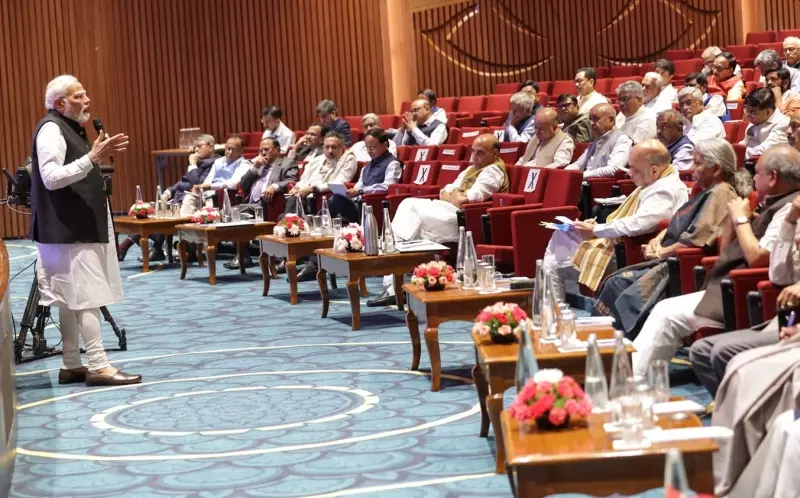
Several deadlines have come and gone including the Parliament’s Monsoon session in July, and Independence Day. The expectation is that the much-expected reshuffle of the 71-member Union Cabinet may happen either before the Shradh begins on September 26 or around Dussehra (October 20). The timing may be uncertain but there is a surety that it will happen. Three broad features, more in terms of tactics rather than strategy, will define the reshuffle. These include — a new unexpected face to handle the finance portfolio, political diversity to enhance representation within the BJP and BJP-led coalition, and trimming of the multiple posts being handled by several ministers.
There is a visible urgency. A concrete indicator is the initiative by the Prime Minister’s Office to undertake a 360-degree performance review of the Cabinet members. Stung by the Gen Z protests, there is pressure within the ruling party, and from the RSS to change things around. The Union Council of ministers comprises 30 ministers with Cabinet rank, five ministers of state with independent charge, and 36 ministers of state. The Indian Constitution caps the figure at 15 per cent of the strength of the Lok Sabha, or 81 of the existing 543 members. There is scope to add a maximum of 10 new faces.
In the finance slot, a civil servant or technocrat may be inducted. The move will introduce a non-political face as the head of a crucial ministry. There is a growing concern that many handle multiple portfolios. These include: Amit Shah (Home; cooperation); J.P. Nadda (health and family welfare; chemicals and fertilisers); Shivraj Singh Chouhan (agriculture and farmer welfare; rural development); Manohar Lal (housing and urban affairs; power); H.D. Kumaraswamy (heavy industries; steel); Lalan Singh (panchayati raj; fisheries, animal husbandry and dairying); Pralhad Joshi (education; consumer affairs, food and public distribution; new and renewable energy); Ashwini Vaishnaw (railways; information and broadcasting; and electronics and information technology); and Jyotiraditya Scindia (communications; development of the Northeastern region). A trimming is necessary.
Mohan Yadav’s survival strategy
Why does Mohan Yadav continue to survive as chief minister of Madhya Pradesh amid storms? Two factors stand out: patron Suresh Soni and a competent civil-service team.
Politicians often rise not merely through capability or electoral victories, but by serving top leadership. Geography creates opportunity. Ujjain, home to Mahakaleshwar, gave Mr Yadav such a platform. His rise involved coordinating senior RSS and BJP visits to the shrine, helping him build rapport, particularly Suresh Soni. He is widely regarded as Mr Soni’s protégé.
That protection matters amid controversy. An investigative report alleged that Mr Yadav’s extended family members and associated entities acquired 137 plots, covering 168 acres, valued around ₹45 crore, around Ujjain after December 2023. Yet he remains.
Administratively, Ashok Barnwal, the chief secretary, remains the overall boss. Under him, Mr Yadav relies on his “ratnas” in the secretariat. At the centre is Neeraj Mandloi, 1993-batch IAS and additional chief secretary to the chief minister. He took charge in August 2026, replacing Rajesh Rajora, and is regarded as Mr Yadav’s Man Friday, the gateway for decisions.
Dr Sudam Khade, 2006-batch IAS, serves as secretary to the CM, handling files, coordination and welfare programmes. Dr Ilayaraja T., 2009 batch, manages coordination and grievance. Kaushlendra Vikram Singh, 2010 batch, is seen as a fast-tracked younger bureaucrat. Chandrashekhar Walimbe, also 2010 batch, handles bureaucratic strategy, legislative documentation and workflows.
Another significant official is Anshuman Yadav, 1998-batch IPS and ADG Intelligence. He took over after A. Sai Manohar retired on August 31, 2026. Intelligence provides inputs on law and order, political agitation, communal tensions, organised crime and VVIP security. He is the fourth intelligence chief in roughly three years of the Mohan Yadav government.
RSS insiders suggest Mr Yadav’s political fate may finally be decided after the 2027 Uttar Pradesh Assembly elections.
Independent thinker or disgruntled insider?
Subhash Chandra Garg’s transformation into one of the establishment’s persistent critics has an intriguing backstory.
A 1983-batch Rajasthan cadre IAS officer, Mr Garg became finance secretary in March 2019. He was regarded as a protégé of then principal secretary to the Prime Minister, Nripendra Mishra, at the very top of government. Insiders suggested that Mr Mishra played an important role in bringing Mr Garg to the finance ministry.
It was during this period that the telecom battle was gathering momentum. According to reports circulating within government, Mr Garg had argued in the Telecom Commission, now Digital Commission, that the government should recover the principal adjusted gross revenue dues — around ₹1.11 lakh crore — from Bharti Airtel, Vodafone Idea and Tata Teleservices, while waiving interest and other penalties. The government was reportedly not convinced.
The suspicion gained fresh traction after Mr Garg’s retirement, when, following the Supreme Court’s AGR judgment, he advocated a one-time telecom settlement — recover the principal dues but waive punitive interest and penalties to prevent the sector from collapsing.
Then came the dramatic turn. On July 23, 2019, Mr Garg was abruptly shifted from finance to the relatively less prestigious power ministry. The following day, he offered to resign. The episode created considerable buzz in the bureaucracy and was seen as an unusually high-profile departure of a senior civil servant.
Now he has challenged the establishment again — this time over GDP. Questioning the reported 7.8 per cent April-June growth, Mr Garg argued that underlying growth could be closer to 2.6 per cent because earlier data had been revised downward. The government went into an overdrive to demolish the claims, and even garnered support from the World Bank to protect the sanctity of the GDP data.
But the question is no longer about economics. Is Mr Garg a dissenter who changed his mind — or an insider who, after being pushed out, began questioning the system from outside?