Bharat Bhushan | Was Yasin Malik Used And Betrayed By Indian State?

The National Investigative Agency (NIA) has appealed in the Delhi high court to convert Malik’s life sentence to the death penalty
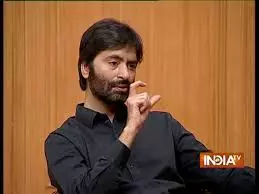
Kashmiri leader Mohammad Yasin Malik, once the toast of India’s political elite, is today a pariah facing a double life sentence for his alleged “terrorist” activities.
The National Investigative Agency (NIA) has appealed in the Delhi high court to convert Malik’s life sentence to the death penalty. Malik argued his own cases for a while in the trial court after his first lawyer died during the Covid-19 pandemic, but later refused to participate in the trial.
Embracing the inevitability of certain death, he has written his last testament — a signed and verified affidavit that has been submitted to the Delhi high court. Malik is not contesting the NIA’s appeal. He has resigned himself to death, having offered, he points out in his affidavit, his “istikhara prayer” seeking guidance from God for his decision and accepting his fate in humility.
Malik’s journey, from a militant to an interlocutor for peace, and subsequently to a “terrorist”, reflects India's strategic policy shifts, from engagement to securitisation in Jammu and Kashmir (J&K). Malik, according to his affidavit, was used as an instrument by the Indian State and then cast aside as a liability.
After he denounced armed struggle for good as the chief of J&K Liberation Front by declaring a unilateral ceasefire in 1994, successive Indian governments used Malik as a bridge with the Kashmiri separatists.
He was granted bail in several militancy related cases (now revived after 35 years), issued an Indian passport and sent as an emissary to start a dialogue both with the separatists and Pakistan. Prima facie, Malik’s 82-page affidavit shows that the charges under which he has been sentenced do not stand scrutiny. They relate to the NIA cases against him — the over three-decade-old TADA cases against him in the CBI court in Jammu are separate and ongoing. The main charges by the NIA include funding stone-pelting after the death of Burhan Wani and receiving money from Hafiz Saeed of Lashkar-e-Tayyaba.
Malik points out that he was arrested barely half an hour after Burhan Wani’s killing by the security forces. His name also does not figure in any of the 80-odd FIRs in the main and supplementary stone-pelting chargesheets. The charge was made against him after a gap of over two years, when he was arrested after the government’s abrogation of Articles 370 and 35A of the Constitution, which ended J&K’s special status. The accusations appear to be an afterthought.
Similarly, Malik’s affidavit also points out inconsistencies in the ledger details of hawala operator Zahoor Ahmad Watali used to charge him for receiving Rs 15 lakhs from Hafiz Saeed.
The ledger shows that Saeed allegedly sent the money to Watali on May 3, 2015. However, in the same ledger, Rs 15 lakhs were delivered to Malik a month earlier, on April 7, 2015, from a source now named by Malik.
Despite these anomalies in the evidence, they were not taken into account by the court. Instead, the prosecution emphasised Malik having met Hafiz Saeed, Pakistani leaders and Kashmiri militants in Pakistan; colluding with a Pakistani handler called “Pervez Ahmed”, etc. In short, what Malik claims are events and processes relating to his role as an interlocutor to start a dialogue with Pakistan and the Kashmiri militants.
Malik’s affidavit painstakingly details how in each instance cited, he was acting on the direction and advice of highly-placed officials of India’s Intelligence Bureau — all of them named in the affidavit, including the IB officer who requested him to meet Hafiz Saeed and the Pakistani leaders, The then director of IB is named as the one who created a fake email ID in the name of one “Pervez Ahmad” (described by the NIA as Malik’s Pakistani handler) to allow him to communicate with Malik on Track-II efforts for dialogue with the Kashmiri militants.
Malik’s affidavit records his meetings with the then national security adviser Brajesh Mishra, current NSA Ajit Doval (then special director of IB), the government’s interlocutors with Pakistan — eminent journalist R.K. Mishra and diplomat Satinder Lambah, home ministers Rajesh Pilot and P. Chidambaram and six Prime Ministers, including Vishwanath Pratap Singh, Inder Kumar Gujral, Atal Behari Vajpayee and Manmohan Singh, discussing with them ways and means to bring peace to Jammu and Kashmir.
The affidavit is not a plea for clemency. It is a political script, consciously crafted. Even though it may seem rambling, quoting poetry and often quite emotional, if he is executed it will earn him a place in Kashmir’s history of resistance.
By emphasising both his role as a peacemaker betrayed and his voluntary embrace of an impending death sentence, he will claim a unique position distinct from other figures of resistance before him, like Maqbool Bhat, Afzal Guru and Burhan Wani, as he had genuinely become a Gandhian, choosing the path of peace.
His affidavit is a message to three constituencies — the Kashmiri people, India and the international community.
To the Kashmiris, his affidavit presents him as a martyr for the Kashmir cause, a peacenik betrayed by India and someone who occupies the high moral ground by embracing death rather than seeking mercy.
To other Indians, he demonstrates the contradictions of their governments, and upends the narrative of the NIA to prove that if he is guilty then so are the politicians, intelligence officers and the security establishment that used him as an interlocutor.
By embracing death, he underlines the injustice of the Indian State in sending a peace-seeker to the gallows.
His message to the international community will poke holes in India’s narrative on Kashmir, highlighting India’s double standards (negotiating peace with the Naga insurgents but denying the same process to the Kashmiris) and questioning the human rights optics as the victim of a duplicitous India.
Malik’s is a classic case of a moderate militant leader being brought into the peace process tactically and then sidelined once the State becomes confident and stronger. His affidavit is a brilliant political script — if he lives, he will forever be the symbol of India’s betrayal, deterring the leaders of other insurgencies from joining any state-sponsored peace process, and if he dies, he will live as a martyr in Kashmir’s history.
The writer is a senior journalist based in New Delhi
