Bharat Bhushan | Pax Silica: Insurance At The Cost Of Strategic Autonomy

India’s enthusiasm to join Pax Silica reflects its need to strengthen the resilience of its supply chains, reduce investment risks and build capacity. India gains access to secure supply chains, strengthening its semiconductor and AI ecosystems by reducing dependence on China
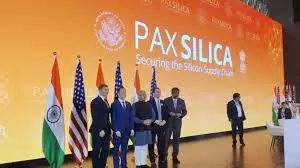
Has India finally chosen a side by signing Pax Silica, and said goodbye to “strategic autonomy” as the cornerstone of its foreign policy? Is it a signal that it is no longer “equidistant” but has tilted towards the United States?
When Pax Silica was launched in December 2025, India was not invited to be a signatory, and some strategic experts had then lamented that India would be marginalised in what could prove to be the defining technology contest of the twenty-first century. Yet now that India has joined Pax Silica as a signatory member, several questions are being raised.
India’s “strategic autonomy” will now be confined within the guardrails of the rules of the Pax Silica coalition. When Pax Silica was launched in December 2025, its nine signatory members agreed to align their tech trajectory with US standards and oversight on chip clearance, the specialised high-performance hardware and software systems to develop, train and deploy AI systems (compute infrastructure), oversight and supply chain rules. These included Australia, Greece, Israel, Japan, Qatar, South Korea, Singapore, the United Arab Emirates and the United Kingdom.
The non-signatory participants are Canada, the European Union, the Netherlands, the Organisation for Economic Cooperation and Development (OECD) and Taiwan. Non-signatory members preserve technological autonomy and avoid binding commitments to coalition-wide standards. They also retain relatively greater geopolitical manoeuvring space, balancing relations with the American-led bloc and other countries like China and Russia.
India’s enthusiasm to join Pax Silica reflects its need to strengthen the resilience of its supply chains, reduce investment risks and build capacity. India gains access to secure supply chains, strengthening its semiconductor and AI ecosystems by reducing dependence on China. Besides deepening strategic operations with the US, India’s talent pool of engineers and AI researchers can get access to global platforms and funding, leading to capacity building. Domestic manufacturing can get a potential boost as membership provides investors with rules, frameworks of protection and political backing.
As a member state of Pax Silica, American tech giants may increasingly see India as an attractive investment and manufacturing destination. And India gains geopolitical influence as it gets to influence global tech governance rules and standards. However, there may be some distinct disadvantages as well.
Signing Pax Silica is also a geopolitical signal. It places India itself firmly in a US-led technology bloc against those that the United States sees as “countries of concern”, such as China and Russia.
Pax Silica is not only a trade forum. It also involves infrastructure and policy integration among the member states [KM1] [KM2] regarding critical minerals, energy inputs, advanced manufacturing and AI testing hardware and software infrastructure. Reliance on US technology and regulatory standards can limit India’s autonomy, especially because India’s AI ecosystems are nascent and vulnerable compared to the established AI infrastructure of the developed members of Pax Silica. Providing them protection may not be possible if India has to align with US-led standards for AI-ecosystem development.
There are other concerns as well. There are apprehensions that India may lose sovereignty over its long-term plan for evolution of semiconductor technology, desired capacities, manufacturing processes and architecture – as coalition rules may override domestic priorities. This could adversely impact the government’s “India First” strategy.
In order to prevent adversarial access to advanced AI systems, Pax Silica talks of “the promotion of a shared and trusted ecosystem of AI developers and vendors”. This may put India’s AI development under external scrutiny as using “shared and trusted ecosystem” could mean that coalition partners are expected to use certified cloud and chip providers, mostly US-based or allied companies, for training, validation and deployment of new AI models.
This may limit India's ability to experiment with indigenous architecture or alternative standards. Worse, India may be reduced to a subcontracting role -- providing talent, data, and applications while the core development remains with the US.
Experts also point out that Pax Silica will also tie AI specialised hardware and software testing infrastructure to energy grid resilience, as AI models have huge energy requirements. If this leads to coalition standards demanding access to energy grid monitoring and planning, then this would provide members of Pax Silica access to India’s energy allocation priorities, planning of critical energy infrastructure and insights into India’s grid vulnerabilities such as peak loads, grid topology, and operational data. India could risk subordinating its energy planning to American supervision.
Although there is no explicit evidence as yet that Pax Silica overrides national data protection laws, this may change as it develops shared AI models or transborder data pipelines for data pooling. Questions may then arise about which laws will govern cross-border data flows.
The Digital Personal Data Protection Act 2023 (DPDP Act) protects both data processed in India as well as data processed abroad relating to goods and services offered to Indians. Therefore, even after India joining Pax Silica, the data of Indians processed abroad should normally remain under Indian jurisdiction. However, enforcement may become tricky if data is processed in coalition countries. India may need to negotiate data localisation, oversight processes and interoperability to ensure that Indian data remains under sovereign control.
Lastly, it is unclear how Pax Silica will deal with asymmetries in coalition supply chains. While India gets access to advanced semiconductor chip ecosystems, there seems to be no protection for members if their ties with the United States take a downturn. Could their access be downgraded depending on the whims of the US and its unpredictable President? India would get access in good times but if for some reason direct or indirect sanctions were imposed on India, then what would happen to supply chain access and resilience for India? After all, despite being an ally, the US threatened punitive tariffs against close allies South Korea and Japan for chip exports to China. President Trump does not lack “rationale” for threatening sanctions.
By restructuring global power in semiconductors, AI and critical infrastructure, Pax Silica is then essentially an instrument of geopolitical alignment and control. Irrespective of the verbal gymnastics of those who defend India’s joining, it will be seen as India having made a definite geopolitical choice. That could complicate India’s trade with China and its role in Global South forums, especially Brics. Pax Silica impacts both strategic autonomy as well as domestic policy autonomy. It comes with risks of both dependency and geopolitical friction.
The writer is a senior journalist based in New Delhi
