Behind The Doval Summons: Legal Battle Or Contest For Influence?

In New Delhi, there is talk of a turf battle between external affairs minister S. Jaishankar and Mr Doval. Prime Minister Narendra Modi is aware of the differences between the two
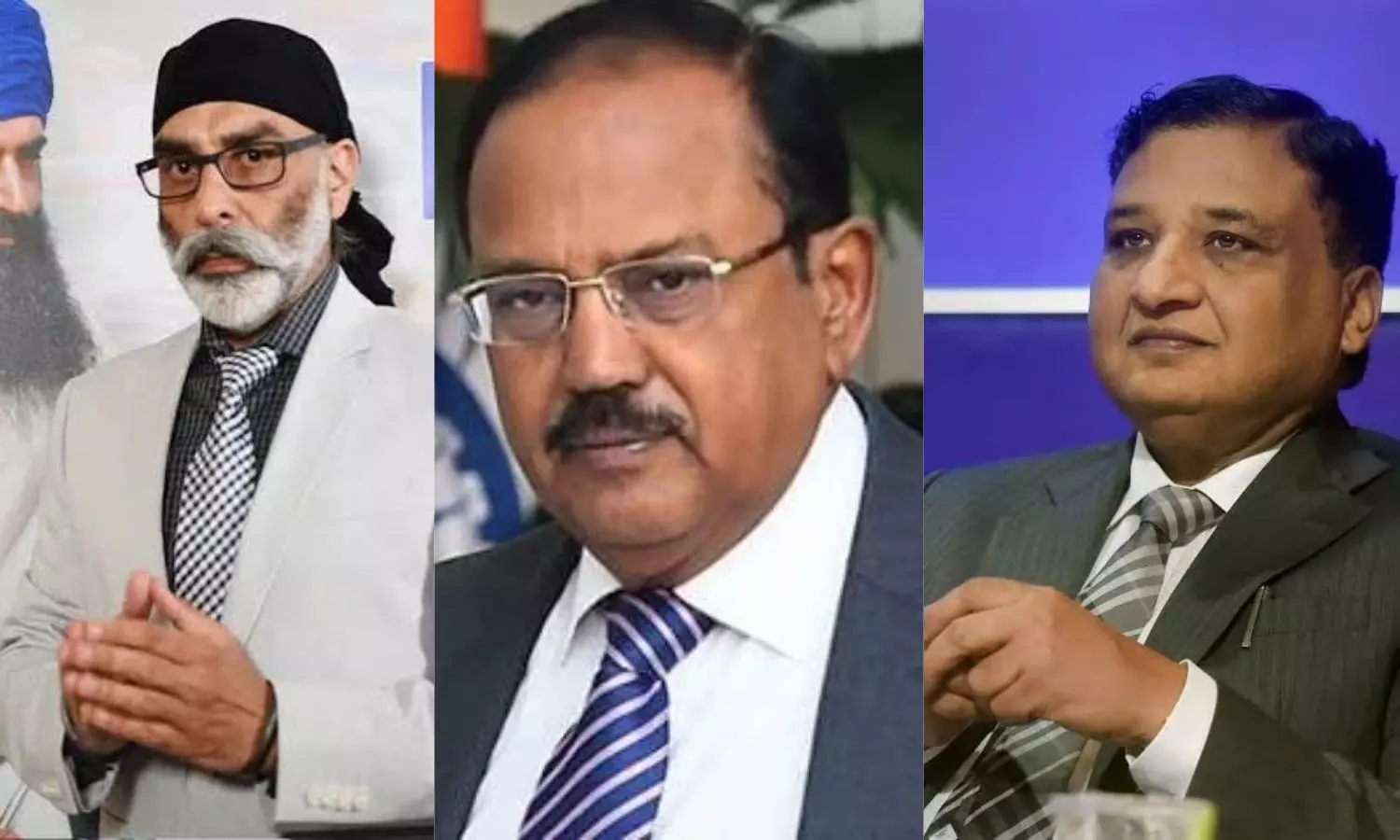
In spying and espionage, power rarely announces its arrival, or begins instantly. It accumulates over decades, via access, networks and intelligence-sharing. But when a participant becomes too influential, the adverse message can arrive from an unexpected quarter. The system is inevitably larger than an individual. It is in this context that one can view how an American courtroom has opened a gaping hole in India’s national security ecosystem. Summons issued against national security adviser Ajit Doval, and former RAW chief Samant Goel in the Gurpatwant Singh Pannun case comprise civil proceedings but the implications are wider.
In New Delhi, there is talk of a turf battle between external affairs minister S. Jaishankar and Mr Doval. Prime Minister Narendra Modi is aware of the differences between the two. Mr Jaishankar represents the country’s diplomacy and foreign policy. He enjoys a reputation among the world’s diplomats and foreign ministers. Mr Doval is central to Mr Modi’s national security strategy. In a conclave in the capital in March 2025, Mr Doval brought together US intelligence director Tulsi Gabbard, Canada intelligence chief Daniel Rogers, and the then Britain MI6 chief Richard Moore. Others included Russia SVR chief Sergei Naryshkin, Russia FSB director Alexander Bortnikov, France DGSE director Nicolas Lerner and Saudi Arabia intelligence chief Khalid bin Ali Al Humaidan. Both Mr Jaishankar and Mr Doval enjoy proximity to global and Indian oligarchs.
Enter Gurpatwant Singh Pannun, an American citizen and Khalistan separatist. He accused Mr Doval and Mr Goel of plotting his assassination in New York in 2023. The US court authorised summons on Mr Doval and RAW’s Goel through Indian channels. India rejected the allegations as fabricated and malicious. There is no evidence that Washington funded Pannun or engineered the lawsuit. But the timing has got tongues wagging. Is it only a legal battle, a diplomatic warning or a covert contest for influence? After all, sections in the US seem uncertain about the future of Indian politics.
Bureaucracy’s political compass
A crucial issue hangs over the heads of senior bureaucrats in New Delhi. Given the recent unpredictable political developments and forthcoming elections in 940 Assembly constituencies across seven states in 2027, the civil servants await further twists and turns in the changing political equations. For them, the electoral cycle is not merely a contest between political parties. It is a test of governance, administrative continuity, postings, and accountability. The five states of Uttar Pradesh, Punjab, Uttarakhand, Goa and Manipur, which are due for polls early next year, account for 690 seats. Gujarat and Himachal Pradesh, which will follow suit later, for the rest.
The Election Commission of India directed the five states to transfer election-linked officers posted either in their home districts or having completed three years in a district. Chief secretaries and DGPs must report compliance. At the Centre, the extensions of Cabinet Secretary T.V. Somanathan and Home secretary Govind Mohan by a year each reinforced continuity and diminished uncertainty at the top apart from counters related to succession and career progression of the juniors. Mr Somanathan urged senior secretaries to stop “playing safe”, delegate authority, and build trust in junior officers. He reminded them that civil servants must remain neutral, and learn administrative skills from the political leaders.
The deeper apprehension among the bureaucrats is not only about possible regime changes. It is the ambiguity about where authority will reside, whose orders will prevail, and whether recorded professional advice will protect an officer. Hence, they are watching the environment for signals, and not endorsements. In this climate, files may move cautiously, decisions climb higher and career calculations overshadow initiative. It is a test for the bureaucracy. They can take responsibility and serve the Constitution or get busy anticipating the next political cues.
Green Belts: Who guards the guardians?
Of Haryana’s 41 Indian Forest Service cadre officers, 32 were caught in a reshuffle after the felling of around 2,000 trees in the Alipur-Shikargah Reserved Forest. The recovery of 19 truckloads of timber from Punhana, which weighed 2,724 quintals, reveals the scale. The cosy security of a state posting turned into a career risk. It is unclear if the scale of the reshuffle represents an administrative exercise, or an attempt to contain a scandal that shook the forest department. Chief conservator of forests Subhash Chander Yadav, a 2010-batch forest officer, was shifted from Gurugram to headquarters and the central circle, Rohtak. His transfer came after he submitted an earlier report that flagged the irregularities. At the top of the administrative level stands Sudhir Rajpal, IAS, additional chief secretary of Haryana’s environment, forest and wildlife department. As the head, his oversight is a legitimate subject of scrutiny. The felling of the trees reportedly continued from September to early November. Who briefed Mr Rajpal? When did the state learn about the events under the cover of CAMPA plantation and ridge-making? Jhalkar Uyake (deputy conservator of forests, Faridabad), was suspended; Afzal Khan (range forest officer), Sandeep Kumar (forester), and Ankit Kumar (forest guard) were dismissed. But can the scandal take a back seat with the rolling of field-level heads? A deeper investigation into the contractor, CAMPA approvals, measurement books and payments are required. One needs to examine the role of forest minister Rao Narbir Singh. Official transfers can rearrange the chairs. They cannot bury the stumps and shenanigans.