Anil Tyagi | Can A Geriatric Admin Respond To The Needs Of Gen Y & Z?

Take the case of those saddled in the Prime Minister’s Office, with the sole intention of translating the leader’s vision into an active mission. While Prime Minister Narendra Modi is 75 years old, PMO’s principal secretary P.K. Mishra is 78, and national security adviser Ajit Doval, at 81, is an octogenarian
Recent events at Capital Jantar Mantar and Gen Z’s so-called political maturity has triggered several thought processes within the government, the BJP and among the party’s Members of Parliament. One of them relates to leadership. Of course, no one dares to question the ‘might-and-right’ of the Prime Minister. But it is the dependence on, or rather the composition of, the second layer, the so-called implementers, which is being debated. The discussions are getting louder by the day, even as the high-pitched decibel levels at Jantar Mantar are fading away.
Take the case of those saddled in the Prime Minister’s Office, with the sole intention of translating the leader’s vision into an active mission. While Prime Minister Narendra Modi is 75 years old, PMO’s principal secretary P.K. Mishra is 78, and national security adviser Ajit Doval, at 81, is an octogenarian. An ageing, if efficient, administrative group. Add to them the older loyalist cabinet ministers — external affairs minister S. Jaishankar, 71 years, petroleum minister Hardeep Singh Puri, 74, and Arjun Ram Meghwal, law and justice, 72.
For many BJP MPs, and party politicians, the ageing executive-legislative ecosystem, though visionary, may be outdated. With a majority of voters in the next national elections expected to be Gen Z and millennials (Gen Y), this circle of governance may not be able to feel the “pulse of the nation”. If the upper echelons of governance comprise elderly civil servants, technocrats, and ministers, who help the Prime Minister shape decisions, there may be a disconnect. The electoral and political fissures and cracks were visible after the events at Jantar Mantar last month.
BJP MPs are concerned about the information disruptions within the government. The Bhupender Yadav episode is symbolic. After members of the personal staff, who worked with the environment minister, were removed on July 3, he reportedly told a senior BJP leader that he did not have “an iota of an idea” about it. This begs a question — why are orders issued to MPs from the highest places, like regularly dispatching them to their respective constituencies after the end of each Parliament Session?
Shivakumar’s Super-Shifts
Most new chief ministers either opt for a bureaucratic cleansing or shakeup, or continuity. There is rarely a middle ground. But D.K. Shivakumar, the chief minister of Karnataka, chose a third ‘mixed’ option since he took over on June 3, 2026. While retaining the original set-up, he focused on a new command structure within, and around, the chief minister’s office (CMO). This contrasts with his predecessor’s (Siddaramaiah) strategy, which was for status quo. Mr Shivakumar shifted Tushar Giri Nath to the CMO as additional chief secretary. He replaced Anjum Parwez, who had served with Siddaramaiah. Munish Moudgil got concurrent charge as principal secretary to the CM for programme and project implementation, a signal that the CM wants a tight monitoring of projects. CM’s six-member governance committee is headed by former chief secretary S.V. Ranganath, and comprises retired civil servants, which denotes a dependence on institutional memory and experiences.
However, chief secretary Shalini Rajneesh retained her position in Shivakumar’s regime. A 1989-batch IAS officer, she assumed the post under Siddaramaiah in August 2024 and will retire in June 2027. L.K. Atheeq, who worked with the previous CM, was appointed as financial adviser to the new CM. The picture is becoming clear. Use every positive and advantage within the state civil services to deliver results. But the test will emerge when the next chief secretary is chosen. It will truly indicate CM Shivakumar’s real gameplan.
Trivedi’s ‘Middle’ Tarique with Modi?
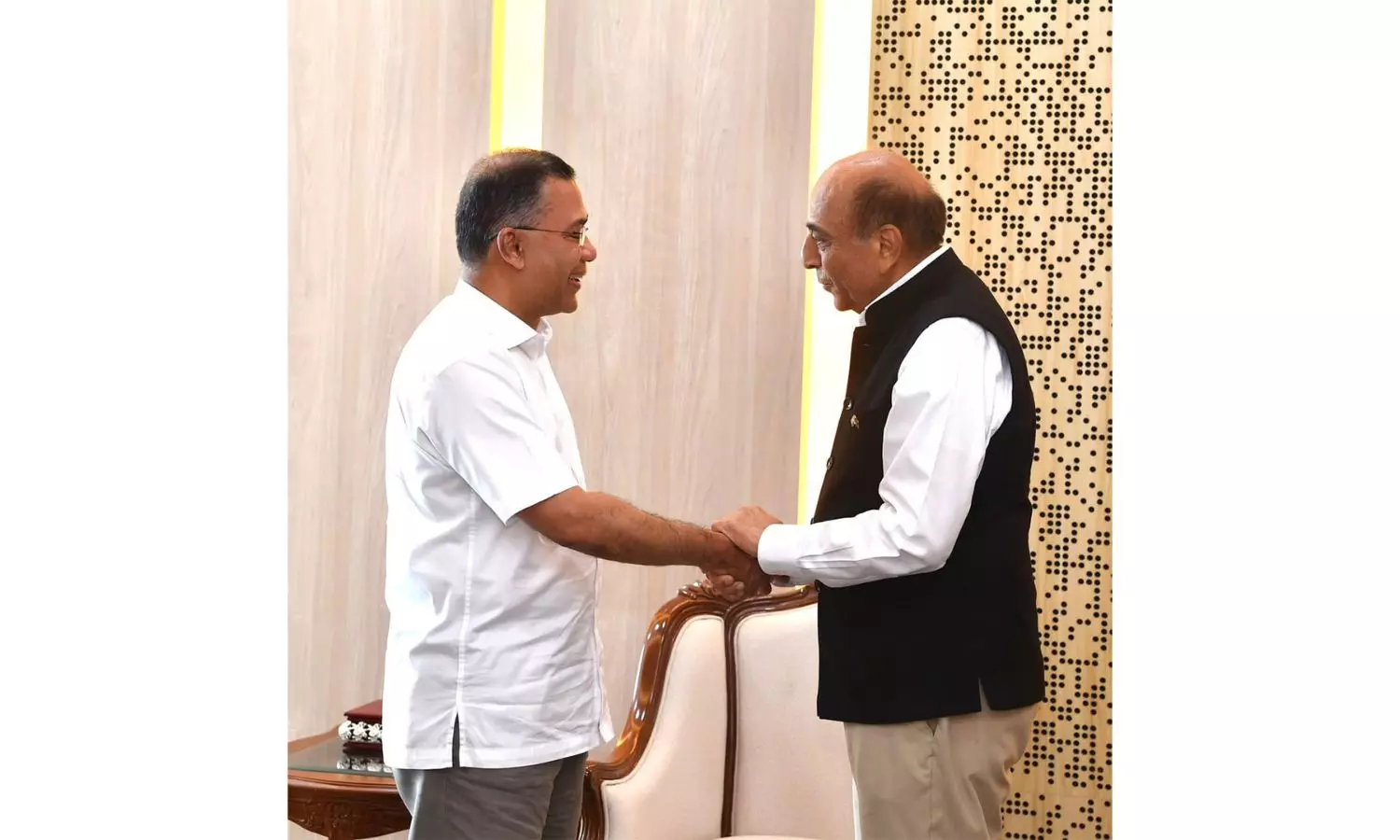
Many successes in the intriguing and mysterious world of diplomacy are related to Track-II efforts initiated by powerful Track-I actors. Hence, many eyes are fixed on Dinesh Trivedi, the newly appointed high commissioner to Bangladesh. This is especially crucial in the light of sensitive, even controversial, India-Bangladesh relations. Mr Trivedi’s aim seems to be to create a direct link between Prime Minister Narendra Modi, and Tarique Rahman, his Bangladeshi counterpart, bypassing the official, established and rooted diplomatic channels. The off-road diplomatic paths to Indian corridors of power need to be open.
One of the first clues comes from a recent high-level private meeting between Mr Trivedi and Mr Rahman in Dhaka. In an unusual turn of expected protocol, during the discussion, Mr Trivedi asked his deputy, Pawan Badhe, to leave the room. The symbolism was a powerful one. A diplomat and a head of state talked about issues that only they were privy to. More importantly, Mr Badhe is known to be a key cog within the official wheel of the Indian external affairs ministry.
Obviously, the exclusion from the meeting had the tongues wagging. Questions were raised. Has Mr Trivedi decided to run a semi-official, but parallel channel? Some sections within the external affairs ministry are uncomfortable. Mr Trivedi’s prominence, and proximity to the PM irks them. They fear that the ministry is being sidetracked. The situation seems a bit volatile because Mr Trivedi is an experienced but controversial politician with Bengal roots. Being a politician, his modus operandi is distinctly different from those of career diplomats. Given that the pathway to better relations with the neighbour passes through three locations, Mr Tarique’s in Dhaka, MEA’s on Raisina Hill, and Mr Modi’s at 7, Lok Kalyan Marg, the chatter is about the exclusion of the ‘Middle’. It is more intriguing to observe after Tarique Rahman officially cancelled his visit.
The writer is a senior journalist and alumnus of the Delhi School of Economics. He is the editor of gfiles, India’s first magazine on civil services and governance. @AnilTyagilive.