Anil Tyagi | 2 Top Leaders Decide Fate Of Thousands Of Civil Servants

Prior to 2014, the establishment officer (EO), ex-officio secretary to the ACC in the department of personnel and training (DoPT), who served ex-officio as the secretary to the ACC, prepared a list of vacancies that were pinpointed by the various Central ministries. The official panel of candidates was forwarded to the ACC for final approvals. The ACC either held in-person meetings in the Prime Minister’s Office in South Block or discussed the issues on phone. Once the committee approved the appointments, the EO’s office issued the requisite orders
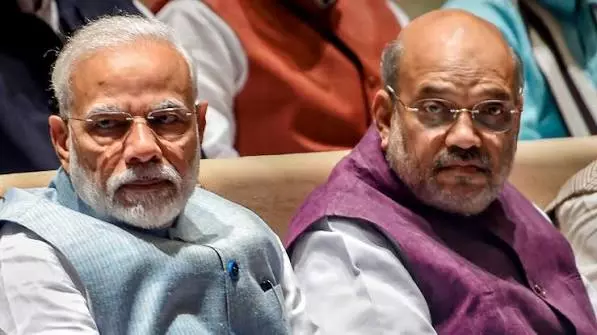
The fate of thousands of civil servants, including 5,577 IAS officers, 4,594 IPS and those from nearly 60 Central services and PSUs are in the hands of a single two-member committee, Appointments Committee of the Cabinet (ACC).
The ACC now comprises two senior-most politicians from the administration, Prime Minister Narendra Modi and home minister Amit Shah. They are inevitably the most powerful decision-makers today. But what is significant, and crucial, is the subtle yet critical change in the composition of the ACC.
Earlier, it had three members: the Prime Minister, home minister, and the Cabinet minister of the concerned ministry. On June 19, 2014, the membership was reduced to two. Not many, including senior retired and working civil servants, know the reason(s) behind the change. There are no policy papers or minutes that explain the decision.
Prior to 2014, the establishment officer (EO), ex-officio secretary to the ACC in the department of personnel and training (DoPT), who served ex-officio as the secretary to the ACC, prepared a list of vacancies that were pinpointed by the various Central ministries. The official panel of candidates was forwarded to the ACC for final approvals. The ACC either held in-person meetings in the Prime Minister’s Office in South Block or discussed the issues on phone. Once the committee approved the appointments, the EO’s office issued the requisite orders.
Since 2015, contend sources, the role of the EO and DoPT has diminished. The relevant Central ministry or department initiates the future appointments, which is done online through the ACC Vacancy Monitoring System (AVMS). This usually happens up to two months before an actual vacancy arises. Instead of the EO’s role in forwarding the names of the potential candidates, sources contend that in most cases the names for the coveted posts are decided at the higher/highest levels. The EO’s role is largely limited to preparing the digital proposal and submitting the file electronically to the ACC for approval.
One is not sure how, when and where the two members of the ACC meet to finalise the appointments. When one looks at the official communication that announces the appointments, it typically states: “The ACC has approved the following names for the post…”
Seniority takes back seat; extension raj holds sway
The one question in the minds and lips of senior civil servants, which is being discussed in professional and social circuits is about the future of T.V. Somanathan, the current Cabinet secretary. His term expires on August 31, and the senior secretaries wish to know if it will be extended. A 1987-batch IAS officer of the Tamil Nadu cadre, Mr Somanathan took charge as Cabinet secretary on August 31, 2024, for a two-year term. Sources say that an extension may not be difficult unless Prime Minister Modi decides otherwise and has other plans.
Experience shows that in the past 12 years, during the three consecutive Modi terms, extensions of senior civil servants were more the rule than an exception. Instead of the mandatory two-year terms, the former Cabinet secretaries like B.K. Chaturvedi served for three years, K.M. Chandrashekhar for four, Ajit Kumar Seth for four, and Pradeep Kumar Sinha for 4.2 years. Mr Somanathan’s predecessor, Rajiv Gauba, a 1982-batch IAS officer of the Jharkhand cadre, held the post for five years, which made him the country’s longest-serving Cabinet secretary.
A similar pattern can be seen in the high-profile ministries. The tenure of Vikram Misri, a 1989-batch IFS officer, was extended till July 14, 2027. Praveen Sood, director of the CBI and a 1986-batch officer of the Karnataka cadre, got a second extension until May 24, 2027. Alok Sharma, DG SPG, and Alok Garg, DG Narcotics Control Bureau, received extensions. While Satish Kumar, IRMS 1986, chairman of the Railway Board, got a second extension, Gurdeep Singh, CMD, NTPC, recently received a six-month extension (up to January 2027) despite having served for 10 years.
Therein lies the paradox, and complication. Each extension of a senior bureaucrat slashes a year, or two, or more from the career calendars of those who are in the promotion queue and they wait with bated breath for the incumbent to retire. There is a growing feeling that possibly the Modi Raj has quietly shifted promotions and tenures in the civil services from a seniority-based rotating system that allows new entrants to a less flexible trust-based one.
Big Brother is watching
In Lutyens’ Delhi, everything is noticed, and little goes unobserved, monitored and documented. Spread across 28.73 sq km, the Capital’s enclave that denotes and wields power and influence has become a zone that is under constant watch and surveillance since Mr Modi became Prime Minister on May 26, 2014.
Look around and quietly observe the iconic hangouts of the rich and powerful. Senior civil servants, who once inhabited Delhi Golf Club, India Habitat Centre, IIC and Khan Market, exercise caution and have cut back on visits from these familiar haunts. Some of them merely vanished from these places.
Every meeting and appearance, even casual conversation, is measured as one is not sure about the eyes and ears that may be taking notes and keeping track. There is a reluctance to be seen in the wrong company, perceived or real. Surveillance cameras and speed-checking equipment mark the roads. Around the prominent VVIP areas in Central Delhi, large luxury vehicles with Gujarat registration plates have reportedly become common.
No one talks about these things, not even in whispers. But the message looms large and clear in the minds and hearts of the civil servants. This can take the shape of sudden transfers, delayed postings, unexplained exclusions and granted extensions. In the steel frame of governance, the sound of the footsteps reverberates through the corridors into the ears of the most powerful.
The writer is a senior journalist and alumnus of the Delhi School of Economics. He is the editor of gfiles, India’s first magazine on civil services and governance.