Abhijit Bhattacharyya | Can FTAs Spell Return of Economic Imperialism?

Trade pacts with US, EU and others spark fears over deficits and farmers
The speed of the Indian State in striking a spate of bilateral free trade agreements with several countries in recent times has been truly breathtaking. New Delhi has shown unusual alacrity to reach trade “alliances” with Australia, the UAE, Oman, Britain, the European Union and the United States to prove a point -- that India “can do”, and has “done it”. While it may still be too early to assess the real worth of these deals, one can review the features and potential as well as long-term fallout of such measures, along with the financial, economic, commercial and trade implications for India’s 1.42 billion people and its $4 trillion GDP. Many of the foreigners who now enter India with comparative ease have had a past which deserves a re-look, with or without the FTAs.
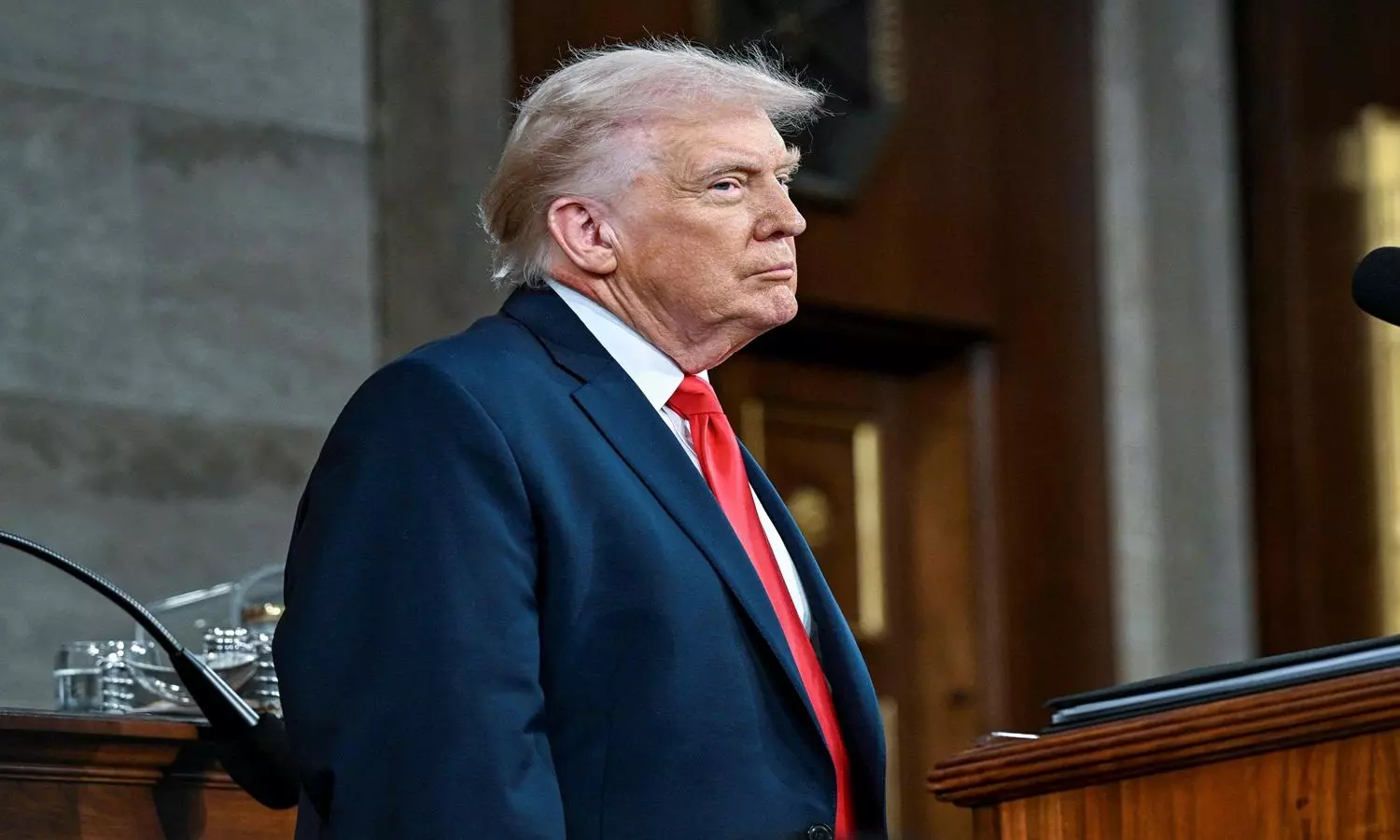
As the US Supreme Court sent shockwaves across America and the world last week by striking down the “emergency” tariffs imposed by President Donald Trump, the latter is unfazed and instantly imposed a fresh 10 per cent “global tariff” on all countries, which he raised to 15 per cent a day later. On the India trade deal, he declared: “Nothing changes. They (India) will be paying tariffs. We won’t be paying tariffs”. How gross and insulting could President Trump be towards India?
Let’s, therefore, quickly glance through the sequence of FTAs. The India-UAE agreement in February 2022 was truly unique due to the latter’s 11.5 million populace and $600 billion GDP partnership with the Indian giant. The April 2022 India-Australia agreement between a $2 trillion GDP continent of 22 million with the most populous country-continent too is replete with future possibilities.
The real test for India, however, will come over deals with the three mightiest economic powers: China, the United States and the 27-nation European Union bloc, which combined have a demography and GDP far outweighing the heft India can muster. It will be an overwhelming, almost an impossible, task for Indian system to tackle a multi-thrust from Asia, Europe and America’s total 2.21 billion demography (China 1.42 billion, EU 450 million and US 340 million) and their $75 trillion GDP (US $34 trillion, EU $22 trillion and China $21 trillion). What is even more ominous is the huge gap in per-capita income between India’s $4 trillion GDP with those of the trio of three continents.
Can India’s populace successfully tackle this unfolding scenario? Can India withstand the growing threat to its sovereignty and freedom of independent action? We are forced to consider this today as America’s President is brazenly creating fear in India’s psyche over the nation’s strategic options.
This is not to suggest that India has not made progress. However, the road to success now is more arduous and uphill due to inherent structural deficiencies which need course correction if India is to achieve its cherished goal of “prosperity to all without discrimination”.
A few basic facts must be kept in mind. Even today (2026), more than half of India’s 1.42 billion people depend on agriculture and allied activities for their livelihood. Livelihood is not profession. Livelihood is compulsion, while profession implies there is a choice or option. The 2023-2024 data shows 50 per cent of the populace contributes 19 per cent to India GDP. Clearly, agriculture is the primary source of livelihood income for half the population. Ironically, data also reveals that despite 140 million households’ main source of income being agriculture, only 30 per cent own the land they cultivate.
In comparison (based on 2025-2026 estimates), trade, commerce and allied activities employ eight per cent of the workforce in India (35-40 million people). The key point is that 92 per cent of India’s retail trade is in unorganised sector (small, local or “kirana” shops), despite the rise of e-commerce.
India’s inherent trade-commerce structure is unique in its own way, having developed over thousands of years fundamentally for a captive domestic market. The huge population was a readymade consumer base for the nation’s traders. The tradition continues. Europe’s trading companies grasped this reality too well in the past and now the entire West and China have caught on. Today’s India constitutes a gigantic market for anything and everything. The recent AI jamboree in New Delhi reflected this, such as when San Francisco-based Anthropic’s CEO Dario Amodei audaciously claimed: “India is a huge playground”. No one bothered as he also said: “We can do experiments with hundreds of millions of people”. What does it mean? Will the US company do “experiments” on millions of Indians like cats, dogs, guinea pigs? Will India’s law enforcement agencies intervene to ensure “millions of people” in India are safe once this “experiment” starts? Anthropic, incidentally, is a business partner of Infosys.
Contextually, today, thousands of farmers in Ireland, Spain and France are on streets protesting against the EU’s FTA with Argentina, Brazil, Paraguay and Uruguay because prosperous European farmers fear cheap imports from Latin America will destroy their livelihoods, which is far superior in quality to India’s 750 million-plus who depend on agriculture.
There is indeed reason for apprehension because of the sheer disparity of lives in “two India”: one, the top one per cent which hold over 40 per cent of the country’s wealth, and the rest. Can the rest of India counter the onslaught of China-EU-US trio? Today, New Delhi has a $116.12 billion deficit in trade with China, yet the Dragon is on rampage. India had a $38 billion surplus with the US, but President Trump is tearing India apart with threats of further tariffs, and of dire consequence if India imports or exports without America’s consent. The US President’s warnings and threats, from oil to defence hardware, poses a grave danger to India’s sovereign right to choose its business, industrial, commercial, financial and diplomatic partners. Thus, amid crossfire between Washington and Beijing over penetration into New Delhi’s hinterland, with Mr Trump on the rampage in a bid to trample on India’s sovereignty, entered the UK and 27-nation European Union for their own share of the Indian pie. Within this bloc are the same five nations which came to India as traders in the 17th and 18th centuries but tormented the entire land and people, inflicting unspeakable misery.
Do business and trade with foreigners by all means, but do not forget what the Portuguese, British, French, Danes and Dutch did in the past. Study history… for in history lies all the secrets of statecraft. And those who fail to learn from the past are certain to be dumped into the dustbin of history.
The writer is a former chief commissioner of customs in New Delhi and Hyderabad and an alumnus of the National Defence College, New Delhi
