Aakar Patel | Is India Paying Price Now For Playing America Against China?

On October 27, 2020, during the visit of US secretary of state Mike Pompeo, India signed the Basic Exchange and Cooperation Agreement (BECA)
In February 2018 the Trump White House drew up the “US strategic framework for the Indo-Pacific”. This paper, declassified in January 2021, says America’s intent was “to maintain US strategic primacy … while preventing China from establishing new, illiberal spheres of influence”. It says China’s rise will change the region and challenge US influence globally, and concludes that “a strong India, in cooperation with like-minded countries, would act as a counterbalance to China”. To this end, the “desired end state” the US sought was to be “India’s preferred partner on security issues”, and “the two cooperate to preserve maritime security and counter China’s influence”.
America’s objective was the creation of a Quadrilateral (“Quad”) framework that would pull in the navies of India, Japan, Australia and the US as the “principal hubs” ranged against China. This plan would make India a “major defence partner” and “a strong Indian military (would) effectively collaborate with the United States” and “prevent China’s acquisition of military and strategic capabilities”.
Why was India signing up for this? It is not clear. With no discussion in Parliament, with no interviews to the media and no press conferences, with no reference to this in his manifestos, Narendra Modi began drifting India into this strategic partnership and military alliance with the United States.
In February 2020, during Mr Trump’s visit to India and months before the Ladakh crisis began, Mr Modi committed India to the agreement against China. On October 27, 2020, during the visit of US secretary of state Mike Pompeo, India signed the Basic Exchange and Cooperation Agreement (BECA). This would help India access American intelligence to improve the accuracy of the Indian Army’s missiles and armed drones. This portended Air Force-to-Air Force cooperation. The second agreement signed was the Logistics Exchange Memorandum of Agreement (LEMOA). It allows the two nations’ militaries to replenish from each other’s bases, and access supplies, spare parts and services from each other’s land facilities, air bases and ports, which could then be reimbursed. LEMOA is for India-US Navy-to-Navy cooperation.
Signing the BECA pact in Delhi, Mr Pompeo attacked China directly: “I am glad to say that the United States and India are taking steps to strengthen cooperation against all manner of threats and not just those posed by the Chinese Communist Party.”
US defence secretary Mark Esper added: “We stand shoulder to shoulder, in support of a free and open Indo-Pacific for all, particularly in light of increasing aggression and destabilising activities by China.”
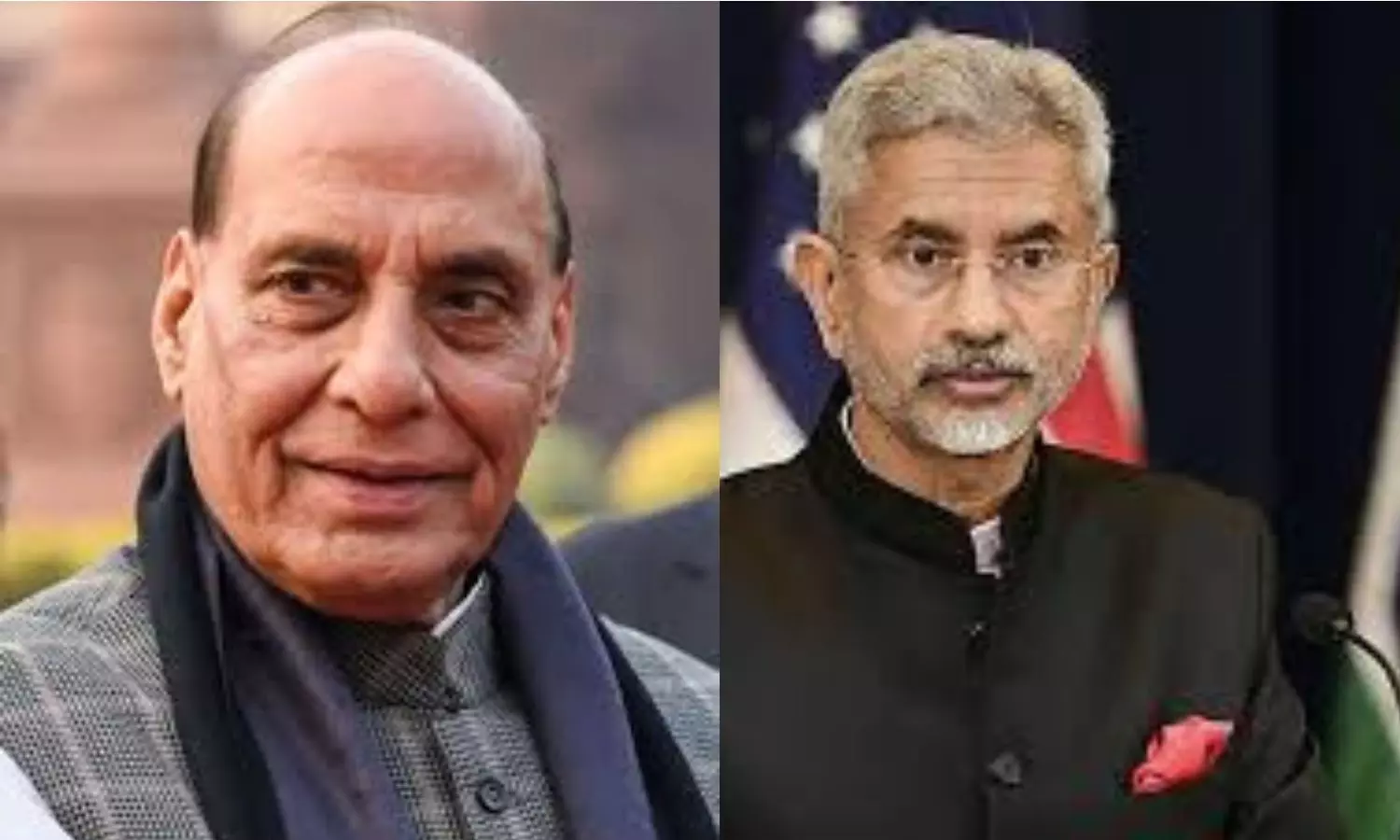
S. Jaishankar and Rajnath Singh, who were standing next to Mr Pompeo and Mr Esper, did not name China. Rajnath Singh’s prepared remarks contained this line, later deleted: “Excellencies, in the area of defence, we are challenged by reckless aggression on our northern borders.” This deletion was not given to the Indian translator in English, who read out the original text and the Americans released it.
When the paper was declassified, China said “the US side is obsessed with ganging up, forming small cliques and resorting to despicable means such as wedge-driving, which fully exposed its true face as a trouble-maker undermining regional peace, stability, solidarity and cooperation”.
India did not publicly react to the release of the US document. A third pact, signed six months after the US drew up its strategy, was the Communications Compatibility and Security Agreement (COMCASA). It allows India access to encrypted communications equipment and systems so that Indian and US military commanders, and the aircraft and ships of the two countries, can communicate through secure networks. BECA, LEMOA and COMCASA completed a troika of “foundational pacts” for deep military cooperation between the two countries. COMCASA was signed in September 2018, five months after Mr Modi travelled to Wuhan to meet Chinese President Xi Jinping. The Wuhan spirit in the agreement between Mr Modi and Mr Xi, signed on April 28, 2018, specifies that India and China would not be rivals but would cooperate with each other. They would also “push forward bilateral trade and investment”. The problem, obvious to anyone, was that, whether he fully understood it or not, Mr Modi was hunting with the hounds and running with the hares. At the same time as he was holding hands with Mr Xi, he was also winking at Mr Trump’s Indo-Pacific strategy. China’s response was to activate the Ladakh border so that India’s military focus and resources would remain on land and not the sea. Former national security adviser M.K. Narayanan, writing the same day as the casualties in Ladakh were revealed, cautioned Mr Modi, saying: “This is not the time for India to be seen as the front end of a belligerent coalition seeking to put China in its place” and that “almost all India-China border agreements are premised on the presumed neutrality of both countries”.
Mr Narayanan wrote that “as the special representative for border talks with China (2005-2010), this sentiment was an ever-present reality during all border discussions.
Why is your columnist raising issues so many years in the past? Because, as the events of this month show, they are not only relevant, they are crucial in understanding why India finds itself in the position it is in today: confused and friendless.
Essentially, India’s actions under this government have been to undo the agreements of 1993 and later, giving China space and options. And there does not seem to be much understanding about the sanctity and significance of treaties, formal and informal, that this government has signed India up for.
The writer is the chair of Amnesty International India. Twitter: @aakar_patel
