Team India sweeps Gold and multiple awards at International Linguistics Olympiad

10 Aug 2026 4:50 PM IST10 Aug 2026 4:50 PM IST
The earliest documented technical vocabulary of descriptive linguistics is attributed to ancient grammarian Panini
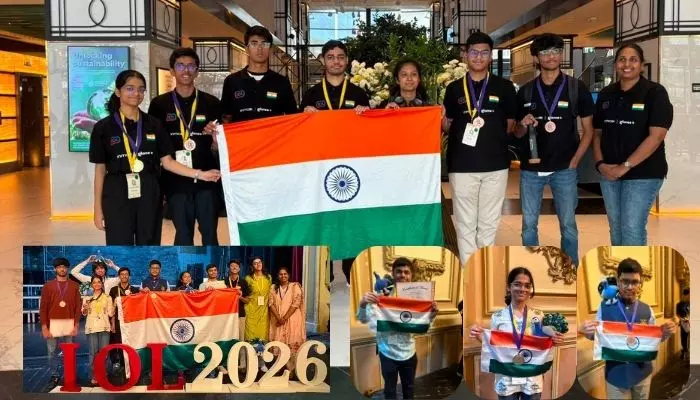
Chennai: From Panini’s ancient grammar to the frontiers of AI, language continues to inspire discovery. At IIIT Hyderabad, that legacy lives on through its mentoring of India’s Panini Linguistics Olympiad team, which has returned from Romania with Gold and multiple honours at the International Linguistics Olympiad.
The earliest documented technical vocabulary of descriptive linguistics is attributed to ancient grammarian Panini. Ashtadhyayi, his foundational Sanskrit grammar text, written between the 4th and 5th century BCE records 4,000 precise, rule-based aphorisms (sutras) to form perfect words and syntax, from roots and suffixes. The vedic scholar was transforming linguistic units into valid sentences, long before western science discovered that language is deconstructed into phonemes and morphemes.
Fast forward to the present, where IOL, the highest ranked international linguistics competition for pre-university students, is firing the lexical imagination of young minds from 40+ countries.
PLO alchemizing Gold and medal winners
Indian contingent has consistently won medals in the Best Solution, Best Team, and Best Student categories at every IOL since 2009. IIIT-H took over mentoring the Panini Linguistics Olympiad in 2015 and has continued to build upon the strong foundation established by the PLO community. This year’s winners were Gold medallist Shrilakshmi Venkatraman, Bronze winners Aarav Anil Rao, Nishanth Shankar Lakshmanan and Advay Misra, with Soham Amit Pednekar receiving an Honourable Mention.
The annual flagship event of LTRC is tasked with creating future linguistic world champions at junior (Grades 6-8) and senior (Grades 9 -12) school levels. The mentor Institution works with the brightest student talent nationwide, on language data to solve challenging puzzles that test cross-disciplinary logical reasoning, pattern recognition, and computational thinking.
LTRC builds globgal champions and India’s future technocrats
Unlike mathematics or physics Olympiads, IOL problems do not require prior linguistics knowledge. The ability to find patterns in unfamiliar languages and pure reasoning is rewarded here. The challenging national-level linguistics competition is organised under the aegis of the International Linguistics Olympiad (IOL). While the overarching sentiment is fun and puzzles, the mandate is to foster problem solving, computational thinking and appreciation for linguistic diversity.
How it all began
India’s journey at the International Linguistics Olympiad (IOL) began in 2009, when an ad hoc team lead by Zarana Sarda took part in IOL 2009 in Wroclaw, Poland. The team comprising of Aakansha Sarda, Sagar Sarda and Niyati Dave saw sweet success when Aakansha secured India’s first international win. Their participation in the 2009 and 2010 sparked the idea for the national Linguistics Olympiad (PLO) by Zarana Sarda. Between 2013-2015, the Department of Linguistics, University of Mumbai got involved and with the backing of Microsoft Research India, they helped to strengthen, broaden the outreach and institutionalize Olympiad activities.
IIIT Hyderabad hosts Panini Linguistics Olympiad
Since its debut in 2009, India has participated in seventeen Olympiads, fielding 104 participants across 25 teams. When Prof. Dipti Misra attended the 2014-2015 workshop at Bangalore, it set the stage for the next avatar. It has been a rich haul for the Indian contingent, that has earned 37 medals (six gold, nine silver, and twenty-two bronze), one bronze team trophy, nine Best Solution awards, nineteen Honourable Mentions and one Team Contest Honorable Mention. It has produced nine Repeat Medalists inducted into the IOL Hall of Fame. Today, PLO continues to inspire school students across India, fostering curiosity about language and linguistics while preparing the next generation of Olympians.
Over the years, PLO partners have included Microsoft Research Labs who funded the team for several years and academic collaborators – IIT Delhi and University of Mumbai. They are actively supported by regional centers at IIIT Hyderabad, IITs (Bombay, Delhi, Madras Patna and Indore), IISc Bengaluru, Jadavpur University, Rajagiri SET at Kochi, Krishna Public School, Raipur, DDU Nadiad, Deccan College at Pune and SNLTR Kolkata. PLO 2026 was sponsored by InMobi-Glance, Haldiram and an anonymous benefactor.
( Source : Deccan Chronicle )

Next Story