China Objects To Kiren Rijiju’s Remarks On Dalai Lama Reincarnation

India believes in freedom of religion for all and the Indian government does not take any position or speak on matters concerning beliefs and practices of faith and religion: The Ministry of External Affairs (MEA)
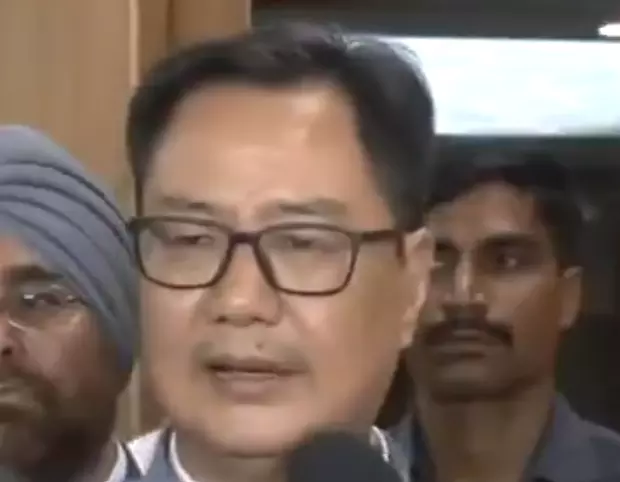
NEW DELHI: China has objected to Minority Affairs Minister Mr Kiren Rijiju's remarks that the incarnation of the Dalai Lama should follow his own wishes, urging India to act cautiously on Tibet-related issues to avoid its impact on the improvement of bilateral relations. China also said India should be clear of the anti-China separatist nature of the 14th Dalai Lama and honour its commitments on Xizang (Tibet) related issues. The Chinese Foreign Office spokesperson on Friday said India should exercise caution in its words and actions, stop interfering in China's internal affairs with Xizang related issues and avoid impact on the improvement and development of the China-India relationship.
While Mr Rijiju reiterated that all the devotees and followers of the Dalai Lama want that the Tibetan spiritual leader himself should decide on his successor, the minister at the same time clarified that his comments were neither on behalf of the Indian government nor in response to the statement made by China on Thursday insisting the Dalai Lama should be chosen through draw of lots from Golden Urn, and later approved by the Chinese government. Mr Rijiju on Friday said he is a devotee of the Dalai Lama and like all his followers he too wants his successor to be chosen by the Dalai Lama himself.
"I do not want to react to China's statement. I speak as a devotee, I have faith in the Dalai Lama, those who follow the Dalai Lama wish that he decides his successor. There is no need for any confusion on the Dalai Lama issue. All the people across the world who follow Buddhism as their religion and follow the Dalai Lama think that he should choose his successor on his own. There is no need for me or the Government to say anything. Who would be the next Dalai Lama, it will be decided by him," Mr Rijiju said.
The Ministry of External Affairs (MEA) on Friday said India believes in freedom of religion for all and the Indian government does not take any position or speak on matters concerning beliefs and practices of faith and religion.
India’s reaction came in response to the statement made by the Dalai Lama on Wednesday about his reincarnation and China’s response to it. China has not only rejected the process of appointing the next Dalai Lama but also said the reincarnation must be approved by the Chinese government.
“We have seen reports relating to the statement made by His Holiness the Dalai Lama about the continuation of the Dalai Lama institution. The Government of India does not take any position or speak on matters concerning beliefs and practices of faith and religion. Government has always upheld freedom of religion for all in India and will continue to do so,” MEA Spokesperson Randhir Jaiswal said.
Interestingly, while news agency PTI quoted the Chinese Foreign Ministry spokesperson Mao Ning saying India should exercise caution in its words and actions, stop interfering in China's internal affairs with Xizang related issues and avoid impact on the improvement and development of the China-India relationship, the strong worded the statement related to Mr Rijiju or the Indian government were neither uploaded in the video or written format on the Chinese Foreign office website and its social media handles.
In her statement, available on X, Mao did reiterate China's stand that the reincarnation of the Dalai Lama and the Panchen Lama, the second-high priest of Tibetan Buddhism, has to comply with rigorous religious rituals and historical conventions in line with domestic search, lots drawn from a 'golden urn' and the central government's approval.
“The practice of Living Buddha reincarnation is a unique succession method of Tibetan Buddhism. The reincarnation of Dalai Lama and Panchen Lama follows rigorous religious rituals and historical conventions. The principle of search and identification in China is drawing of lots and central government approval must be followed. The 14th Dalai Lama was himself enthroned after such a process and with the approval of the central government of China. The reincarnation of the Dalai Lama must follow the same set of principles, religious rituals and historical conventions as well as Chinese laws and regulations,” Mao said.
In Delhi, Chinese ambassador to India Mr Xu Feihong said the reincarnation of Living Buddhas follows a fully developed set of established rituals, and has never been decided by a single individual including the 14th Dalai Lama himself. “Over centuries of practice in the reincarnation and succession of Living Buddhas, particularly in the search for and identification of reincarnated soul boys, a rigorous and strictly regulated system of rituals and procedures has been established. These include divination, sacred lake observation, discreet visits, identification of the late Living Buddha's personal belongings, Golden Urn lottery, enthronement, and formal approval through conferment by the central government,” wrote the ambassador in a post on X.
Rijiju and his cabinet colleague Rajiv Ranjan Singh will represent the Indian government at the Dalai Lama's 90th birthday celebrations in Dharamshala on July 6. The minister said that the birthday event is a religious function and has nothing to do with politics.
Meanwhile, the Tibetan religious leaders during a meeting in McLeodganj (Dharamshala) at the residence of Dalai Lama on Friday gave their support to their spiritual leader’s recent statement on continuing the institution of his reincarnation and the process of picking next Dalai Lama. “Reincarnation is a religious matter. China is using this for political ends, which we will not accept,” the Tibetan religious leaders said in a resolution. “Everyone attending the meeting accepts His Holiness decision,” the resolution added.
Addressing the gathering of the religious leaders, the Dalai Lama said, “So many years have passed since we came into exile and Tibetans have been incomparably strong. Although we are living in exile, we have really done well to preserve our religion and culture under my leadership…With regard to the Tibetan Buddhist tradition, there are scriptural and experiential aspects. You, my Dharma brothers and sisters, Lamas and monastics, have a responsibility to preserve it. Please continue to do your best.”
