Sardar Patel believed that one should not waste time writing history but we should work hard to create history: Modi
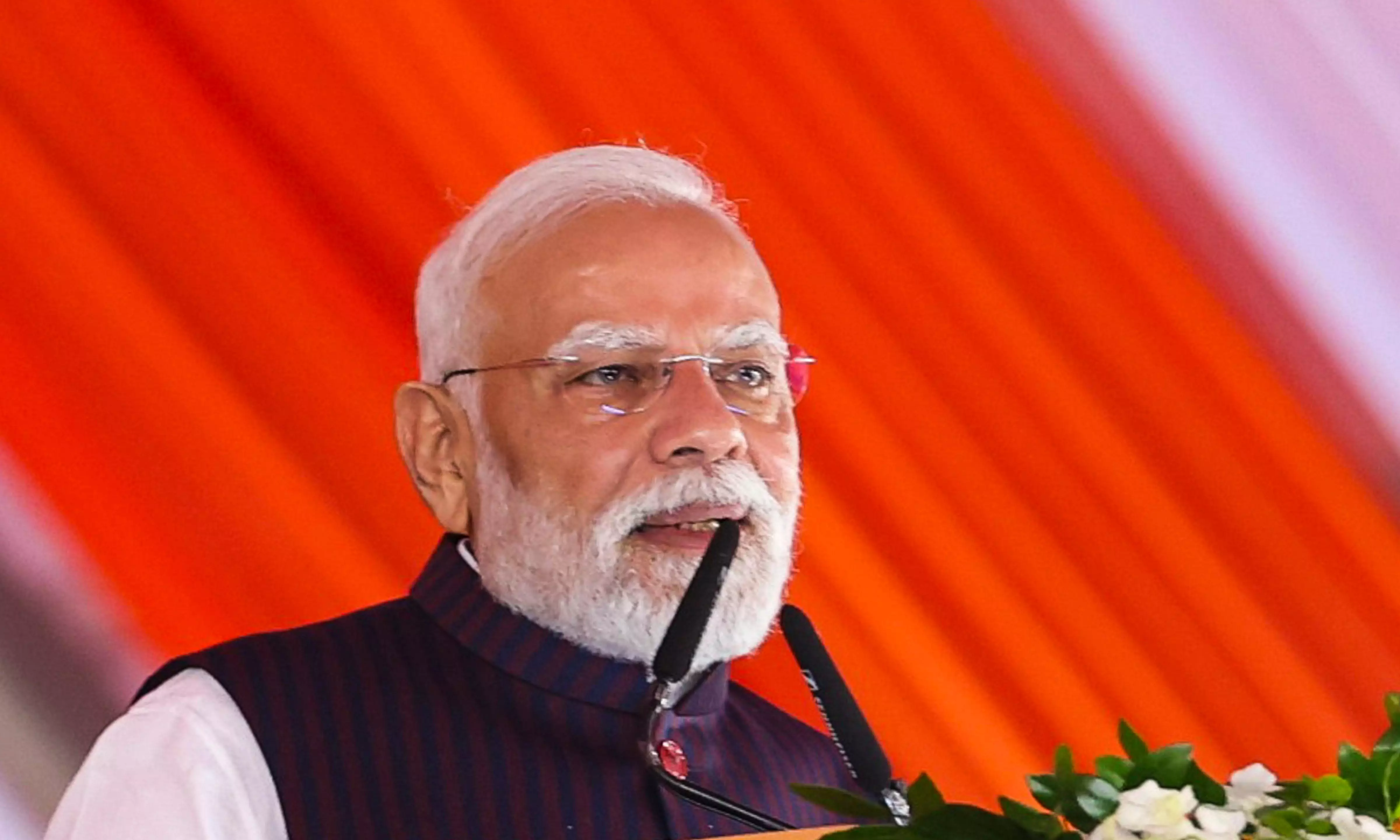
Ekta Nagar: Prime Minister Narendra Modi on Friday launched a sharp attack on the country's first PM Jawaharlal Nehru, claiming he prevented Sardar Vallabhbhai Patel from fully integrating Kashmir into the Indian Union. Speaking at an event to mark Sardar Patel's 150th birth anniversary in Kevadia, Mr Modi said infiltrators pose a "big threat to unity and integrity" of the country.
Recalling how Sardar Patel accomplished the seemingly impossible task of integrating over 550 princely states after independence, the Prime Minister said that the idea of "Ek Bharat, Shreshtha Bharat" was paramount for him.“Every action which weakens the unity of the nation must be avoided by every citizen,” he emphasised, calling it the need of the hour and the core message of Ekta Diwas for every Indian.
Pointing out that Sardar Patel placed the sovereignty of the nation above all else, the Prime Minister regretted that in the years following Sardar Patel’s demise, successive governments did not demonstrate the same seriousness towards national sovereignty.
Addressing a gathering after the Rashtriya Ekta Diwas parade, Mr Modi pointed to the mistakes made in Kashmir, the challenges in the Northeast, and the spread of Naxal-Maoist terrorism across the country as direct threats to India’s sovereignty. He said instead of following Sardar Patel’s policies, the governments of that era chose a spineless approach, the consequences of which were borne by the nation in the form of violence and bloodshed.
Pointing out that many in today’s younger generation may not be aware that Sardar Patel wished for the complete integration of Kashmir, just as he had successfully merged other princely states, Mr Modi stated and alleged that Jawaharlal Nehru did not allow this wish to be fulfilled.
Mr Modi further noted that Kashmir was divided by a separate constitution and a separate emblem. “The mistake committed by the then ruling party on Kashmir engulfed the nation in turmoil for decades. Due to their weak policies, a part of Kashmir fell under Pakistan’s illegal occupation, and Pakistan further fueled terrorism,” he remarked.
The Prime Minister emphasised that both Kashmir and the nation paid a heavy price for these missteps. Yet, he said, the then government continued to bow before terrorism.
Criticising the Opposition party for forgetting Sardar Patel’s vision, Mr Modi said that their party did not and emphasised that after 2014, the nation once again witnessed a steely resolve inspired by Sardar Patel.
The Prime Minister mentioned that today, Kashmir has broken free from the shackles of Article 370 and is fully integrated into the mainstream. He further noted that even Pakistan and the masterminds of terrorism have now realised the true strength of India.
Referring to Operation Sindoor, Mr Modi said that the entire world has seen that if anyone dares to challenge India, the country responds by striking within enemy territory. He asserted that India’s response is always stronger and decisive. “This is a message to the enemies of India—‘this is the India of the Iron Man, Sardar Patel, and it will never compromise on its security and honour’,” he said.
“In the domain of national security, India’s greatest achievement in the past 11 years has been breaking the backbone of Naxal-Maoist terrorism,” the Prime Minister exclaimed and recalled that prior to 2014, the situation in the country was such that Naxal-Maoist groups operated their own rule from within the heart of India.
Mr Modi further mentioned that in these areas, the Constitution of India did not apply, and police and administrative systems were unable to function. He highlighted that Naxals openly issued diktats, obstructed road construction, and bombed schools, colleges and hospitals, while the administration appeared helpless before them.
“Post 2014, our government launched a decisive offensive against Naxal-Maoist terrorism,” Mr Modi stated, emphasising that even the supporters of Naxals residing in urban areas—urban Naxals—were sidelined. He added that the ideological battle was won and direct confrontation was undertaken in Naxal strongholds, adding that the results are now visible to the entire nation.
The Prime Minister said that prior to 2014, around 125 districts in the country were affected by Maoist terrorism, and today, this number has reduced to just 11, with only three districts facing severe Naxal influence. He assured the nation that the government will not stop until India is completely free from Naxal-Maoist threats.
Underlining that today, the unity and internal security of the nation face a grave threat from infiltrators, Mr Modi said that for decades, foreign infiltrators have entered the country, seized resources meant for citizens, disrupted demographic balance, and jeopardised national unity. He criticised previous governments for turning a blind eye to this serious issue and accused them of compromising national security for vote-bank politics.
Mr Modi affirmed that for the first time, the country has resolved to fight this major threat decisively. He recalled announcing the "Demography Mission" from the Red Fort to address this challenge and expressed concern that even now, when the issue is being raised seriously, some individuals are prioritising personal interests over national welfare.
The Prime Minister warned that if the security and identity of the nation are endangered, every citizen will be at risk. Therefore, on Rashtriya Ekta Diwas, he called upon the nation to reaffirm its resolve to remove every infiltrator residing in India.
Underlining that in a democracy, national unity also means respecting the diversity of thought, Mr Modi emphasised that while differences of opinion are acceptable in a democracy, personal discord should not exist.
Expressing concern that after Independence, those entrusted with the responsibility of leading the nation attempted to undermine the spirit of "We the People", Mr Modi remarked that individuals and organisations with differing ideologies were discredited and political untouchability was institutionalised.
Mr Modi pointed out how the previous governments treated Sardar Patel and his legacy and similarly marginalised Baba Saheb Ambedkar during his lifetime and even after his passing.
The Prime Minister said that the previous governments adopted the same approach towards leaders like Ram Manohar Lohia and Jayaprakash Narayan.
Mentioning that this year marks 100 years of the RSS, Mr Modi highlighted the various attacks and conspiracies faced by the organisation and said there was a deliberate attempt to isolate every individual and idea outside one party and one family.

