Ruckus Erupts in J&K House Over U.S.–Israel Strikes on Iran

When the Assembly reassembled, National Conference MLA Tanvir Sadiq pressed the Leader of the House to issue a formal statement condemning the ongoing war on Iran. This sparked a series of brief but impassioned interventions from MLAs on both sides of the aisle, some supporting the call and others opposing it
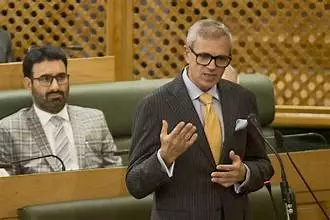
SRINAGAR: The Jammu and Kashmir Assembly descended into disorder on Friday as the second leg of the budget session reconvened after a five‑week recess. The moment proceedings began, members of the National Conference, CPI(M), Congress, PDP and several Independents rose with slogans expressing solidarity with Iran, while BJP legislators countered with demands for the establishment of a National Law University in Jammu. The uproar quickly overwhelmed the session, prompting Speaker Abdul Rahim Rather to adjourn the House for thirty minutes.
When the Assembly reassembled, National Conference MLA Tanvir Sadiq pressed the Leader of the House to issue a formal statement condemning the ongoing war on Iran. This sparked a series of brief but impassioned interventions from MLAs on both sides of the aisle, some supporting the call and others opposing it.
Chief Minister Omar Abdullah initially noted that the House was clearly divided on the matter and suggested that a structured discussion might be more appropriate than a unilateral statement. He asked the Speaker to determine the best way forward.
After listening to viewpoints from multiple members, Speaker Rather urged the Chief Minister to make a statement nonetheless, pointing out that the country’s Parliament had also addressed the issue. Abdullah then delivered a strongly worded condemnation of the conflict, describing it as an “unjust and illegal war” imposed on Iran. He said no level of denunciation could adequately capture the scale of human suffering, including the killing of Iran’s Supreme Leader Ayatollah Syed Ali Khamenie, his relatives, and close associates. He highlighted the bombing of a school that resulted in the deaths of numerous female students, calling it one of the most horrifying incidents in recent memory.
Abdullah questioned the shifting justifications offered by the United States, noting that American statements veered from regime change to security concerns to oil prices, suggesting even Washington lacked clarity about the purpose of the conflict. Responding to BJP members who argued that the Assembly should not debate issues unrelated to the region, he countered that the war had direct consequences for Jammu and Kashmir. He pointed to the large number of Indian citizens living in Iran, the long queues at petrol pumps, and the emotional distress felt by people across the region.
While acknowledging that the Assembly could not end the war by itself, Abdullah reminded members that the Central government frequently emphasises its strong diplomatic ties with countries across the world. India, he said, has historically maintained close relations with Iran as well as with the United States, Israel, and Iran’s neighbouring states. Given this, he argued, there should be no objection to the Assembly collectively urging Prime Minister Narendra Modi to use his office and personal diplomatic relationships to help bring the conflict to an end. Such an appeal, he said, would be aimed at alleviating the suffering of the Iranian people and enabling Iran to re-engage peacefully with the international community.
Taking a sharp swipe at the chief minister, PDP president Mehbooba Mufti wrote on ‘X’ that it was “deeply disheartening” that J&K’s leader — “the only Muslim chief minister of India’s only Muslim‑majority state” — took an entire month to issue an unequivocal condemnation of Israel’s attack on Iran.
The former chief minister noted that even the Punjab Assembly “acted swiftly,” becoming the first legislature in the country to pass a resolution condemning the strike and expressing solidarity with Iran.
“Yet the J&K government showed no such urgency or genuine concern,” she added, accusing it of restricting itself to “rhetoric and speeches instead of taking a clear and principled stand.”
The Assembly, meanwhile, witnessed uproarious scenes as BJP legislators staged a protest demanding the establishment of a National Law University (NLU) in Jammu. Raising slogans and holding placards, the BJP MLAs pressed the government to clarify the proposed location of the university, arguing that Jammu had long been deprived of premier educational institutions. Their protest briefly disrupted proceedings as the House attempted to take up its scheduled business.
The second leg of the Budget Session opened in winter capital Jammu under this cloud of protests, with opposition parties expected to intensify pressure on the government over unfulfilled poll promises, alleged regional disparities, and the long‑pending demand for restoration of statehood.
Amid the political back‑and‑forth, former minister and J&K People’s Conference chairman Sajjad Gani Lone also took to ‘X’, recalling that in October last year, Chief Minister Abdullah had assured the Assembly that the National Law University would begin functioning from Ompora in Kashmir Valley’s Budgam district, in 2026.
“Why has no notification been issued yet to establish the Law University in Ompora, Budgam, as required under Section 3 of J&K’s NLU Act?” he asked.
Lone pointed out that the authority to establish the university lies solely with the J&K government. He further noted that if the administration intends to participate in the Common Law Admission Test (CLAT) — conducted by a consortium of more than 20 law universities across India — then starting classes in 2026 would be impossible, as this year’s examination has already concluded.
