Omar Abdullah Urges EC to Delay Nationwide Electoral Roll Revision, Rejects BJP Pact Claims

He cited the 2022 delimitation exercise in J&K, alleging it was designed to favour one political party (BJP) through the strategic division and creation of new seats
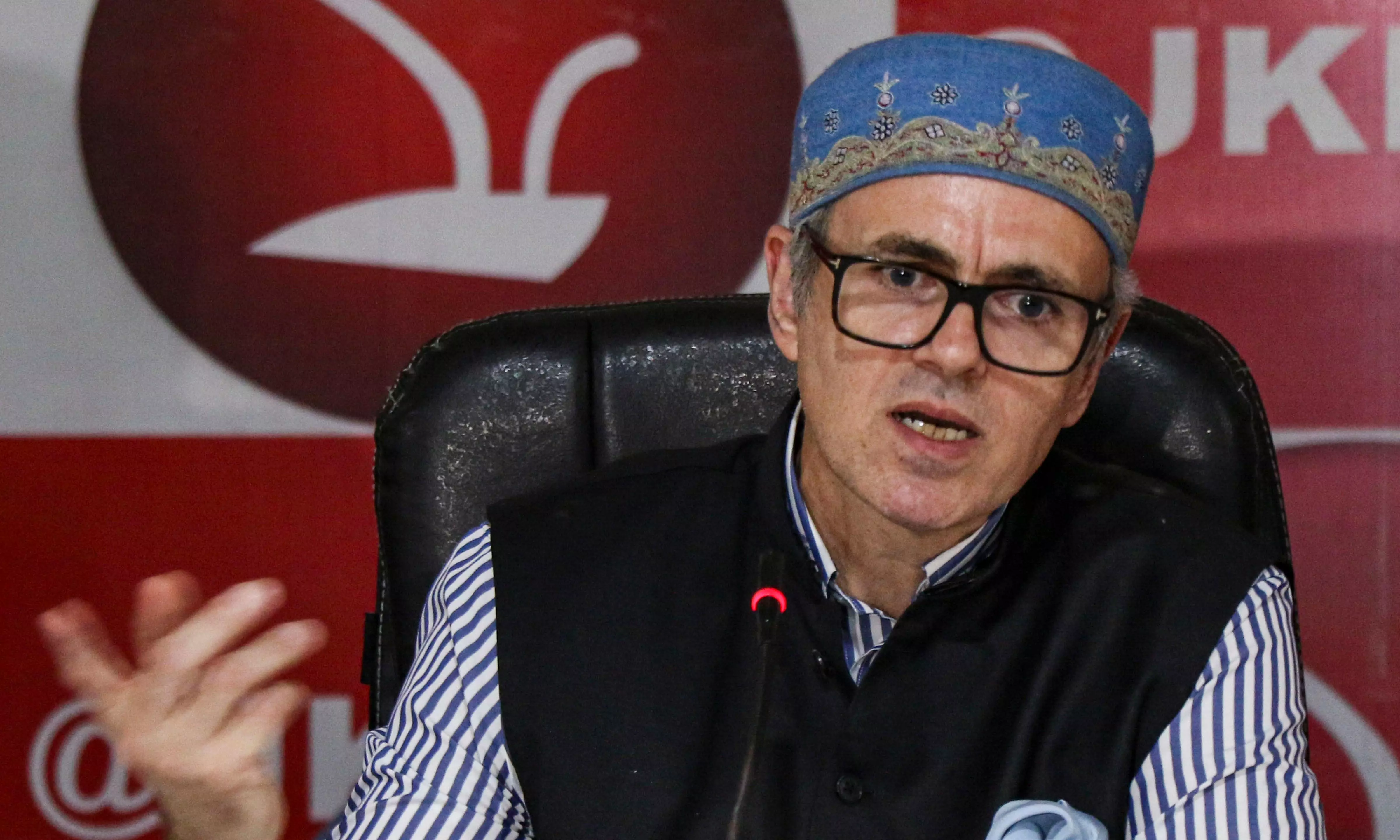
SRINAGAR: Jammu and Kashmir Chief Minister Omar Abdullah on Monday cautioned the Election Commission of India (ECI) against hastily implementing a nationwide Special Intensive Revision (SIR) of electoral rolls, urging the poll body to wait until the Bihar assembly elections conclude.
Speaking to the media in his Assembly office here after the House was adjourned, Abdullah expressed concerns about the timing and potential political motives behind the SIR, especially given apprehensions surrounding its implementation in Bihar. “The Election Commission should avoid rushing into a nationwide SIR,” he said, emphasising that premature action could raise doubts about the ECI’s independence. “It might appear as if the ECI is acting under pressure from a particular political party, a perception we’ve seen before,” he added.
He cited the 2022 delimitation exercise in J&K, alleging it was designed to favour one political party (BJP) through the strategic division and creation of new seats. “The EC must avoid repeating such mistakes,” he warned. Abdullah’s remarks come as officials indicated that the ECI might announce a pan-India SIR on Monday evening to update the voters’ list.
The Chief Minister questioned the immediate benefits of the exercise, stating, “Let the Bihar elections conclude, and then we can assess whether the SIR was beneficial. Only then should it be rolled out nationwide.”
Referring to the allegations and speculation about an understanding between his National Conference (NC) and the Bharatiya Janata Party (BJP) in the recent Rajya Sabha elections for four seats in J&K, Abdullah categorically denied any collusion. The NC secured three seats, while the BJP won one in the polls held last week. “The National Conference is the only party in Jammu and Kashmir that directly challenges the BJP,” he asserted. “We don’t engage in secret pacts. If we were to align, we would do so openly, as I did when I joined the NDA during the Vajpayee government—whether that was right or wrong is another matter,” he added.
The Chief Minister dismissed J&K People’s Conference leader and MLA Sajad Gani Lone’s claim that the Rajya Sabha polls were a “fixed match.” He challenged Lone’s credibility, noting that he (Lone) abstained from voting. “If he was against match-fixing, he should have used his vote,” Abdullah said.
He also pointed out that the BJP had 28 votes of its own and needed only one or two more to win a seat, but surprisingly it gained four additional votes, suggesting possible inducements. “Those who sold their conscience will have to answer to Allah or Bhagwan,” he remarked, adding that three MLAs deliberately wasted their votes. The Chief Minister called for transparency, urging that the names of MLAs who cross-voted or invalidated their votes be made public.
Abdullah also addressed media narratives, noting that some outlets had predicted the Rajya Sabha poll outcomes before voting began. “Were you part of the match-fixing?” he quipped, emphasising that the NC fought the election despite challenges, particularly after Lone’s abstention eased the BJP’s path to victory.
On governance, Abdullah stressed his intent to maintain cordial relations with the central government to ensure effective administration in J&K. However, he clarified a firm distinction between government-to-government ties and political alliances, stating, “There is no relation between the NC and the BJP, nor will there be in the future.”
Earlier during the Assembly session, the continued detention of Aam Aadmi Party (AAP) MLA Mehraj Malik was passionately brought to the forefront by multiple members. Among them, opposition People’s Democratic Party (PDP) legislator Waheed Ur Rehman Parra issued a stark warning, emphasising that if the House remained silent on the issue, the detention of its members under the stringent Public Safety Act (PSA) risked becoming a normalised practice. He underscored that this matter transcended divisions of religion, region, or political affiliation, stating, “This is not about Hindu or Muslim, Jammu or Kashmir, or one party versus another. At stake is the very sanctity of this House and the integrity of its elected representatives,” he said.
