NC’s Planned Statehood Protest in Delhi Draws Support, Sparks Dissent, and Deepens Political Fault Lines

Kharge and Rahul Gandhi Expected to Join NC Protest; Mehbooba Mufti Declines Over Absence of Article 370 Demand
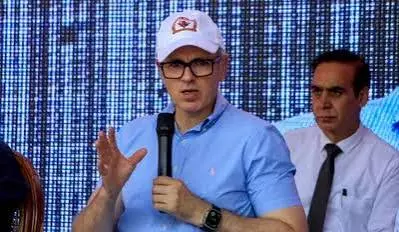
SRINAGAR: With just two days remaining before the National Conference (NC) is scheduled to hold its protest in New Delhi demanding the restoration of Jammu and Kashmir’s statehood, uncertainty continues to loom over whether authorities will grant permission for the demonstration at Jantar Mantar.
Despite the lack of official clearance, party insiders say the Congress has signalled senior figures Mallikarjun Kharge and Rahul Gandhi to join the protest. It remains unclear whether Sonia Gandhi, who has also been invited by NC President Farooq Abdullah, will participate. The CPI(M) has also announced its decision to join the protest. Its key J&K face Mohammad Yousuf Tarigami is leaving for Delhi to participate, and party sources say that some of the organisation’s national‑level leaders may also attend the demonstration.
The planned protest is scheduled to take place on the opening day of the Monsoon Session of Parliament, aligning the NC’s demonstration with a moment of heightened national political attention.
Earlier this week, NC Vice President and J&K Chief Minister Omar Abdullah reaffirmed that the party would proceed with its plan regardless of permission. He stated that NC leaders, MLAs, and MPs would travel to Delhi on July 19 and 20, while the Abdullahs themselves would arrive by Saturday evening. The Chief Minister criticised the delay in granting approval, noting that other organisations had received clearance within 24 hours. The NC sources pointed specifically to Panun Kashmir, an organisation representing displaced Kashmiri Pandits, which has been authorised to hold its protest at Jantar Mantar on July 20—the same date sought by the NC. Panun Kashmir even advanced its event, a move NC leaders interpret as part of a broader effort to overshadow their rally and dilute its political impact.
Meanwhile, Peoples Democratic Party (PDP) president and former chief minister Mehbooba Mufti has declined the NC’s invitation. In a detailed letter to Farooq Abdullah, she argued that restricting the political campaign to the demand for statehood alone would fail to address the deeper constitutional issues stemming from the August 5, 2019 decision that revoked J&K’s special status. She warned that narrowing the movement to statehood risks sidelining the demand for restoring Article 370 and other constitutional safeguards, potentially legitimising the post‑2019 changes.
Mufti reminded the NC leadership that both parties had pledged in their 2024 Assembly election manifestos to work toward restoring Article 370, reflecting the public’s expectation of a united regional front. She expressed concern that the broader political struggle had been reduced to a single‑point campaign for statehood, diverting attention from the larger constitutional rights that were “snatched away” from the people of J&K.
Her letter also criticised the Omar Abdullah‑led government for remaining silent on key issues, including the dismissal of government employees, actions against Jamaat‑e‑Islami affiliated institutions, preventive detentions, restrictions on publications, and environmental concerns. Drawing parallels with Ladakh’s united push for constitutional safeguards, she said her earlier call for a similar joint platform in J&K had gone unanswered. Mufti urged the NC leadership to convene an all‑party meeting involving regional parties and civil society to craft a common roadmap for addressing J&K’s political and constitutional challenges. She also called for the release of political prisoners and the lifting of restrictions on socio‑political organisations, insisting these issues must be part of any meaningful dialogue.
Concluding her letter, Mufti cautioned that reducing the people’s aspirations to statehood alone would ignore the wider constitutional concerns linked to Article 370. While extending her best wishes for the NC’s protest, she reiterated the PDP’s decision not to participate.
Adding to the political friction, Peoples Conference president and former minister Sajad Lone criticised the NC’s planned protest, calling it an attempt to “bury Article 370” and create confusion by projecting the statehood issue on national politics. Lone argued that if the NC were serious about restoring statehood, the Omar Abdullah government should convene an emergency session of the J&K Legislative Assembly and pass a resolution before approaching the Prime Minister and Home Minister as an all‑party delegation. He reaffirmed his party’s position that the pre‑August 5, 2019 status, including Article 370, Article 35A, and full statehood, remains paramount, with Article 370 being the most critical.
While several regional parties have agreed to participate in the protest, the BJP has dismissed it outright, accusing the Chief Minister and the NC of attempting to divert public attention from pressing governance issues by staging a statehood‑related demonstration in New Delhi.
Across the political spectrum, the NC’s upcoming protest has become a focal point for competing visions of J&K’s future—uniting some, dividing others, and underscoring the unresolved constitutional questions that continue to shape the region’s political landscape.
