Ladakh’s Democratic Push Intensifies as Leh Talks Fail to Make Headway

KDA leader Asgar Ali Karbalai said the MHA delegation attempted to steer the conversation toward developmental matters, but LAB and KDA firmly insisted that the dialogue remain anchored to the commitments recorded in the Minutes of the May 22 meeting
SRINAGAR: The latest round of discussions in Leh between Ladakh’s two principal representative bodies—the Leh Apex Body (LAB) and the Kargil Democratic Alliance (KDA)—and senior officials of the Ministry of Home Affairs (MHA), including Ladakh Chief Secretary Ashish Kundra, ended without any substantive breakthrough.
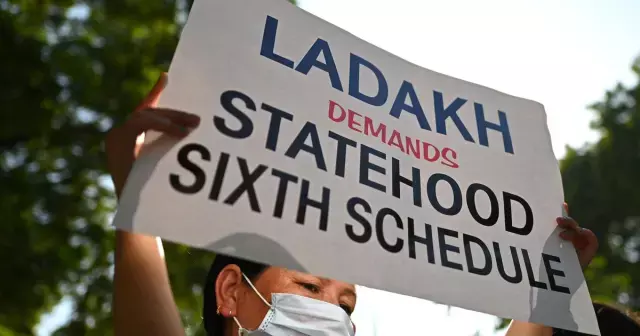
Despite nearly two hours of dialogue, Wednesday's meeting failed to advance the commitments recorded during the crucial May 22 talks in New Delhi—particularly the proposal for a Union Territory–level elected body with legislative, executive, and financial powers. This lack of progress has sharpened concerns among Ladakh’s representative groups, who have, once again, warned that prolonged delays could force them to revive their agitation for full statehood and Sixth Schedule status demands.
Against this backdrop of stalled negotiations, LAB and KDA used the Leh meeting to present a comprehensive charter of non‑negotiable demands, reaffirming their insistence on a constitutionally empowered democratic framework for Ladakh. The meeting, attended by senior leaders including Chering Dorjay Lakruk, Sonam Wangchuk, Dorje Stanzin, Asgar Ali Karbalai, and Sajjad Kargili, continued the ongoing dialogue that began in May.
In recent months, senior MHA officials—such as Additional Secretary (Home) Prashant Lokhande—have also visited Leh, signalling a shift toward region‑centric consultations rather than Delhi‑based negotiations.
KDA leader Asgar Ali Karbalai said the MHA delegation attempted to steer the conversation toward developmental matters, but LAB and KDA firmly insisted that the dialogue remain anchored to the commitments recorded in the Minutes of the May 22 meeting. He noted that both organisations unequivocally reiterated that the proposed UT‑level elected body must possess legislative, executive, and financial powers, backed by strong constitutional safeguards for Ladakh.
Karbalai stressed that any dilution or deviation from the May 22 understanding would leave LAB and KDA with no option but to revert to their earlier demands for Statehood and inclusion under the Sixth Schedule. He further cautioned that continued delays or evasive tactics by the Centre could trigger mass‑level agitation across Ladakh, as public patience is wearing thin.
LAB and KDA emphasised that Ladakh requires a sui generis democratic model, tailored to its unique geography, cultural identity, and administrative needs. While acknowledging that Ladakh currently lacks the revenue base for immediate statehood, they argued that a constitutionally empowered democratic system can and must be established without delay. Their charter, described as the most coordinated and detailed since Ladakh became a Union Territory in August 2019, outlined several core demands.
Foremost among these is the creation of a fully empowered Ladakh Legislative Assembly, headed by a Chief Minister and supported by a council of nine ministers. Members must be elected from properly delimited constituencies, and the Assembly’s powers should draw from the State List and Concurrent List under Article 246, supplemented by relevant provisions of the Union Territories Act, 1963. To avoid administrative conflicts seen in other UTs, the Lieutenant Governor must act on the aid and advice of the elected government.
The second major demand is financial autonomy, including constitutionally protected control over taxation, budgeting, appropriation, expenditure, borrowing, and public funds. Ladakh must have its own Consolidated Fund and Contingency Fund, with procedures adapted from Articles 198–209 to ensure strong legislative oversight.
Third, LAB and KDA called for a constitutionally empowered legislature with clearly defined territorial representation and legislative, executive, and financial powers. They stressed the need for constitutional safeguards similar to those under Articles 371A (Nagaland), 371F (Sikkim), and 371G (Mizoram) to protect Ladakh’s cultural heritage, fragile ecology, and demographic balance.
Fourth, they demanded that Home Affairs, Public Order, and Police fall substantially under the control of the elected government and the Ladakh Legislative Assembly. This draws upon constitutional principles in Articles 162, 163, and 166(3), and references governance models from Puducherry and the erstwhile UT of Mizoram, where elected governments exercised greater authority over policing.
Fifth, they sought the establishment of a Ladakh Public Service Commission, along with separate Ladakh Administrative and Police Services and Ladakh‑specific cadres. This would require amendments to Section 93(2) of the J&K Reorganisation Act, 2019, and Article 315, ensuring that Ladakh’s public services are constitutionally anchored and aligned with the proposed UT‑level legislature.
Alongside the main charter, LAB and KDA submitted a resolution demanding the unconditional withdrawal of all cases related to the September 24, 2025 incidents in Leh, and dignified compensation for those killed or injured. They stressed that Ladakhis must not be left in prolonged administrative uncertainty and that the Centre must honour commitments made during earlier rounds of dialogue.
With the Leh talks failing to produce any headway, the MHA delegation assured LAB and KDA that the next meeting would be held in New Delhi during the first week of September—either under the High Powered Committee headed by MoS Home Nityanand Rai or its Sub‑Committee. LAB and KDA have made it clear that the May 22 commitments must remain the foundation of all future negotiations, and that any deviation could trigger mass‑level agitation across Ladakh.
As the region prepares for the September meeting, Ladakh’s representative bodies “remain united in their demand for democratic restoration, constitutional safeguards, and a governance model that reflects the aspirations of its people", said Sajjad Kargili co-chairman KDA.
