Not Just Dog Bites, People Dying of Accidents Caused by Strays: SC

7 Jan 2026 4:33 PM IST7 Jan 2026 4:33 PM IST
Recurrence of dog bite incidents within institutional areas, including sports complexes, reflected not only administrative apathy but also a "systemic failure" to secure these premises from preventable hazards: SC
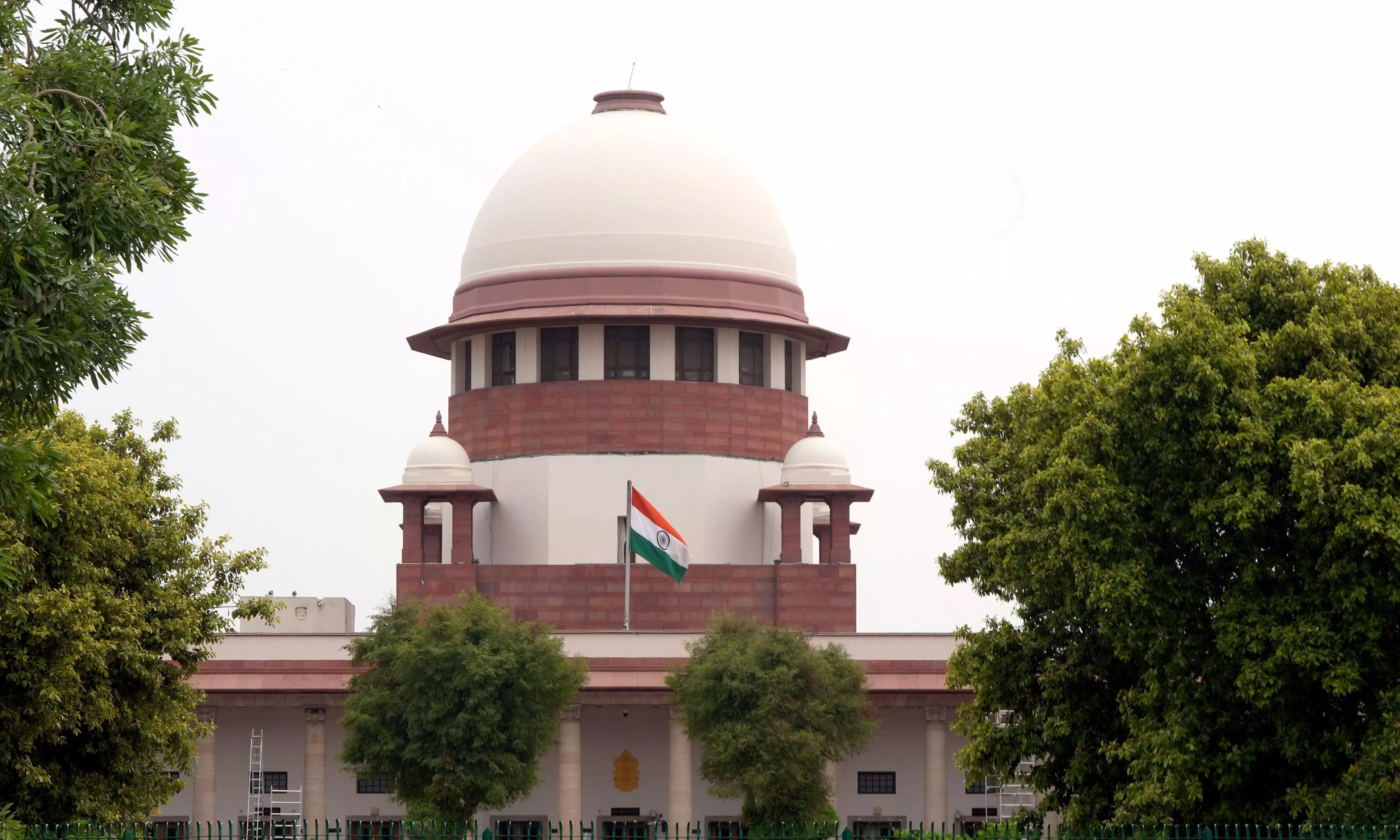
Supreme Court (File Photo)
New Delhi: Flagging that it is impossible to predict an animal’s behaviour or know whether a dog is “in a mood to bite”, the Supreme Court on Wednesday expressed serious concern over the failure of civic bodies to comply with rules and court directions, noting that people were dying not only due to dog bites but also in road accidents caused by stray animals.
A three-judge Bench comprising Justices Vikram Nath, Sandeep Mehta and N.V. Anjaria observed that roads must be kept free of stray animals. “It is not only dog bites but also roaming stray animals that are proving dangerous and causing accidents. No one knows which dog is in what mood in the morning. Civic bodies must strictly implement rules, guidelines and directions,” the Bench said.
The apex court was hearing pleas seeking modification of its earlier orders, filed by dog lovers as well as those demanding stricter enforcement. The hearing was taken up after lawyers and animal activists contended that they were not heard before the court passed its order on November 7.
Justice Mehta pointed out that two Rajasthan High Court judges had met with accidents in the past 20 days due to stray animals, with one of them still suffering from spinal injuries. “It is a serious issue,” he remarked.
Senior advocate Kapil Sibal, appearing for petitioners seeking modification of the earlier order, argued that capturing all dogs was not the solution and called for adoption of a scientific approach accepted worldwide. He suggested implementing the CSVR (Capture, Sterilise, Vaccinate and Release) model to manage stray dog populations and reduce human-animal conflict.
“Prevention is always better than cure,” Justice Nath said, adding that the court had merely directed the removal of stray dogs from institutional areas and had not interfered with existing rules or regulations.
The court clarified that it was only seeking strict enforcement of existing rules, guidelines, modules and standard operating procedures by states and civic bodies. “Some states have not responded to our orders or complied with them. We will be very harsh with those states,” the Bench warned.
When counsels pointed out continuing dog attacks, the court acknowledged that both children and adults were being bitten and losing their lives.
Amicus curiae Gaurav Agarwal informed the court that the National Highways Authority of India had prepared an SOP and identified about 1,400 km of vulnerable highway stretches, but said implementation would require cooperation from state governments. The Bench suggested fencing highways and expressways to prevent stray animals from entering roadways.
Justice Nath noted that States such as Madhya Pradesh, Uttar Pradesh, Karnataka and Punjab were yet to file compliance affidavits, while some affidavits submitted were “disappointing”, and said the court would deal with them.
Kapil Sibal said the response to the stray dog issue should reflect a mature and responsible society, stressing that the matter was not adversarial. “If one tiger becomes a man-eater, we do not kill all tigers,” he said, cautioning that housing rabid and non-rabid dogs together would only spread disease.
In a lighter vein, the Bench remarked that “the only thing missing is counselling the dogs so that they don’t bite when released back”.
Earlier, on November 7, the Supreme Court had directed the immediate relocation of stray dogs from institutional areas such as educational institutions, hospitals and railway stations to designated shelters after sterilisation and vaccination, citing an alarming rise in dog bite incidents.
( Source : Deccan Chronicle )

Next Story