VANETs are expected to power future transport ecosystems, enabling cars to warn each other about sudden braking, road hazards, or traffic bottlenecks
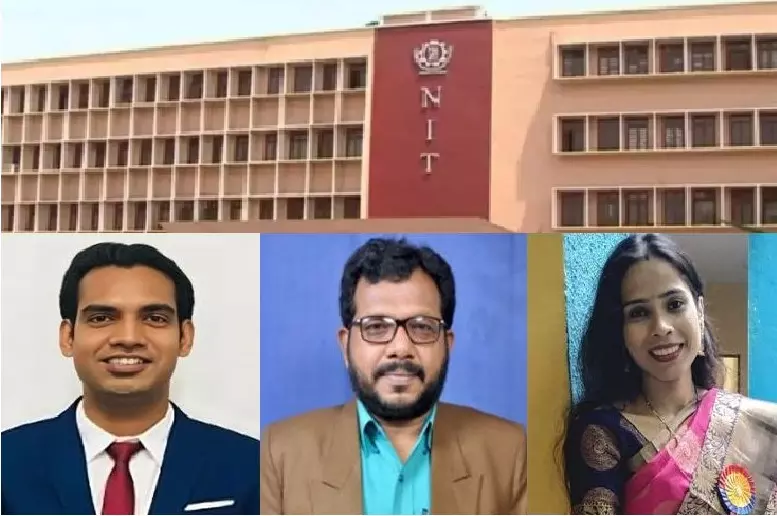
Rourkela: Researchers at the National Institute of Technology (NIT) Rourkela have secured a patent for a new artificial intelligence (AI) model designed to make roads safer by enabling more efficient communication between vehicles.
The patent, titled “Adaptive Contention Window Optimisation in VANETs using Multi-Agent Deep Reinforcement Learning for Enhanced Performance Model,” has been filed by Dr. Arun Kumar, Assistant Professor; Prof. Bibhudatta Sahoo, Professor; and Dr. Lopamudra Hota, research graduate, Department of Computer Science & Engineering, NIT Rourkela. Their work addresses a key challenge in Vehicular Ad-Hoc Networks (VANETs), which allow vehicles in close proximity to exchange information in real time.
VANETs are expected to power future transport ecosystems, enabling cars to warn each other about sudden braking, road hazards, or traffic bottlenecks. However, simultaneous message transmissions by multiple vehicles often lead to congestion, delays, or signal loss—undermining reliability.
The NIT Rourkela team’s solution uses multi-agent deep reinforcement learning to help vehicles “learn” to sequence their messages based on urgency. This adaptive adjustment ensures time-critical alerts are transmitted first, reducing delays and improving reliability, especially in high-traffic scenarios.
Dr. Arun Kumar said: “In 2023, India reported nearly 4,80,000 road accidents and around 172,000 deaths, many of which could be prevented through modern technologies. Our work is a step toward building safer roads and smarter cities. We envision a near future where autonomous vehicles become a reality in India, and this patent is a small step in that direction—driving the spirit of Innovate in India and Make in India.”
The model has diverse applications, including electronic brake lights, vehicle platooning, navigation systems, emergency response alerts, electronic toll collection, and on-road commercial services, positioning it as a backbone for future smart city mobility systems.
Prof. Bibhudatta Sahoo added: “This patent represents a practical step towards preparing India’s road ecosystem for vehicle-to-vehicle communication. By addressing congestion in VANETs and offering a model for coordinated interaction, we are laying the groundwork for safer, smarter, and more efficient traffic management. We invite researchers across institutions to collaborate with our lab at NIT Rourkela to further advance this vision.”
With India rapidly embracing digital infrastructure and smart transport initiatives, the patented model positions NIT Rourkela at the forefront of road safety and autonomous mobility research.