LS passes Waqf Bill after 12-hour debate

Defending the bill amid the Opposition's attack, Union home minister Amit Shah, while making an intervention, made it clear that whether people like it or not, a law that is passed by the Parliament has to be accepted by all.
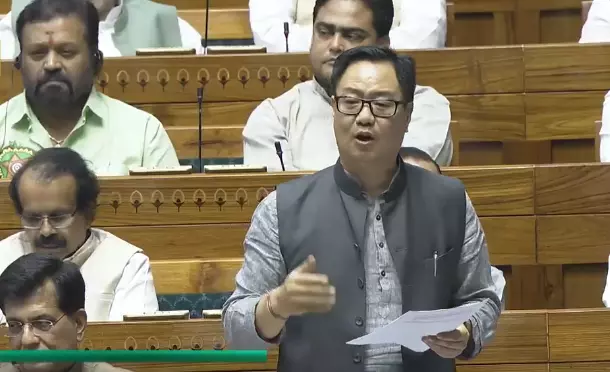
New Delhi: After an intense discussion stretched over 12 hours, the Lok Sabha on Thursday passed the contentious Waqf (Amendment) Bill 2025. The House also passed The Mussalman Waqf (Repeal) Bill 2024. Both the bills will now go to the Rajya Sabha for debate and passage and are likely to be tabled on Thursday.
Terming it a historic day which will go a long way in restructuring Waqf Board functioning and protecting the lands of the people, Union minority affairs minister Kiren Rijiju said the law deals with the management of Waqf properties and does not interfere in the religion of Muslims.
Caught in a quagmire, the NDA allies like the TDP and the JD(U), which have a substantial Muslim population in the states that they govern, while justifying the Waqf bill, tried to explain what all welfare work their parties and leaders have done for the minorities.
Defending the bill amid the Opposition's attack, Union home minister Amit Shah, while making an intervention, made it clear that whether people like it or not, a law that is passed by the Parliament has to be accepted by all.
“Who are you trying to threaten? This is the law passed by Parliament and it is binding for all. Everyone has to accept it,” said Mr Shah while responding to a statement by an MP who said the minorities will not accept this law.
The discussion that stretched over 12 hours saw intense debate and fiery speeches from members of both the Treasury and the Opposition benches, sprinkled with wit and humour at times. The banter between Mr Shah and SP chief Akhilesh Yadav during the Waqf bill debate is a case in point.
On the serious side, as the Opposition dissected the bill, Mr Rijiju and Mr Shah tried to allay fear among Muslims and remove “misconceptions” that the law interferes with their religion. Mr Rijiju said the Opposition was engaged in fear-mongering like it did when Article 370 was abrogated or the CAA law and the Triple Talaq laws were enacted.
Mr Shah accused the Congress-led Opposition of spreading misconceptions, fear-mongering about the law for their votebank and appeasement politics. He clarified that the bill will not be implemented with retrospective effect; rather, it will apply only to future Waqf properties and functioning.
"You (the Opposition) will break this country... Through this House, I would like to tell Muslims of the country that not even one non-Muslim would come into your Waqf. This Act has no such provision. But what would the Waqf Board and Waqf council do? To catch the people selling off Waqf properties and drive them out, to catch those who lease off their properties for 100 years in the name of Waqf. The income of Waqf is dropping, the income with which we have to do development for minorities and push them forward; that money is being stolen. Waqf Board and council will catch that," said Mr Shah.
The Union home minister underlined that non-Muslims in Waqf councils and boards are meant only for ensuring administration of properties and there was no provision to include any non-Muslim person among those who run religious institutions.
Attacking the Congress, Mr Shah said that had the Waqf law not been amended in 2013, this bill would not have been needed.
“Everything was going well. But there were elections in 2014 and overnight in 2013, the Waqf Act was turned extreme for appeasement. As a result, the Congress government handed over 123 VVIP properties in Lutyens Delhi to Waqf when elections were just around the corner, just 25 days away,” alleged Mr Shah and lauded Mr Rijiju for saving the Parliament and surrounding areas from going to Waqf by bringing the Waqf amendment bill.
Sharing details of the bill, Mr Rijiju said it seeks to improve the functioning of Waqf properties, address complexities, ensure transparency and introduce technology-driven management. He added Waqf is controlling the third largest pool of properties in the country after railways and defence.
Initiating the discussion, Congress MP Gaurav Gogoi termed the bill an attack on the basic structure of the Constitution with an aim to dilute its provisions, defame minorities, disenfranchise them and divide the Indian society.
Questioning the necessity of amendments, Mr Gogoi argued that the bill had not been adequately discussed with minority representatives and was pushed through by the BJP in JPC without taking any suggestions of the Opposition into consideration.
Countering him, BJP MP Ravi Shankar Prasad reminded him of the Shah Bano case, saying the Congress has over the years only paid lip service to the cause of minorities but did nothing to empower them, accusing the party of undermining legal reforms for political gains.
Accusing the BJP of using the amendment for polarisation to manage its “diminishing” votebank, the Samajwadi Party chief said this will prove to be the "Waterloo" for the saffron party.
The Waqf (Amendment) Bill aims to strengthen Waqf tribunals through a structured selection process and setting a time frame for faster dispute resolution.
Waqf institutions earning over `1 lakh will need to undergo audits by state-sponsored auditors and a centralised portal will automate Waqf property management, improving efficiency and transparency.
Restoring pre-2013 rules, the bill also proposes that practising Muslims (for at least five years) can dedicate their property to Waqf. Besides, women must receive their inheritance before the Waqf declaration, with special provisions for widows, divorced women and orphans.
The bill also proposes that an officer above the rank of collector will investigate government properties claimed as Waqf. In case of disputes, the senior government official will have the final say on whether a property belongs to Waqf or the government.
The bill also proposes that non-Muslim members will be included in the central and state Waqf boards for inclusivity.
