Thiksey Monastery Leads Major Plantation Drive to Green Ladakh

More than 5,000 saplings of species such as willow, poplar, robinia, Russian olive, cherry, apple, apricot, pear, black currant, chinar and Kashmiri juniper were planted as part of the initiative, reflecting a broad and carefully chosen mix suited to local environmental conditions
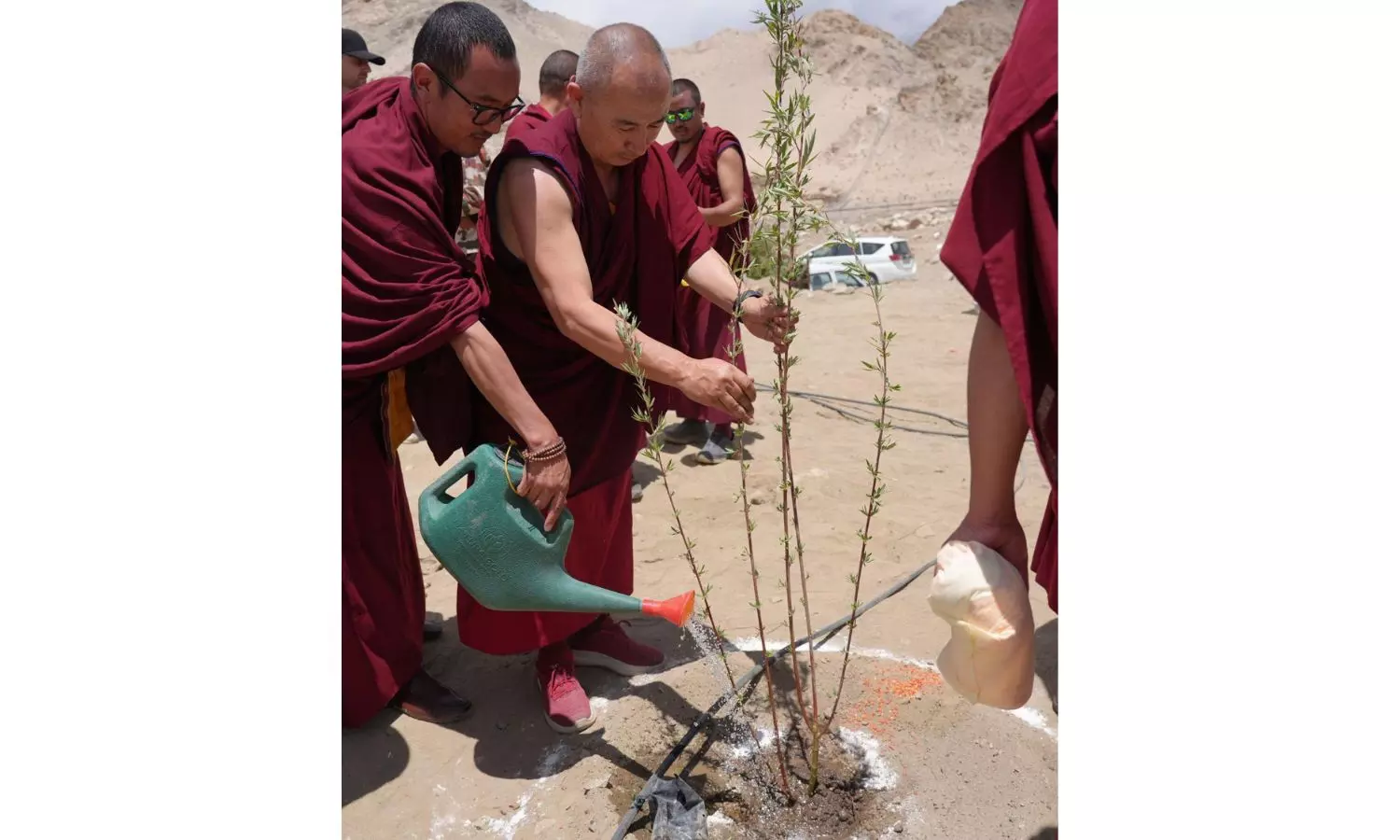
SRINAGAR: In a significant step towards enhancing Ladakh’s fragile ecosystem, Thiksey Monastery has provided 7.5 hectares of land for a large-scale plantation drive aimed at increasing the region’s green cover.
More than 5,000 saplings of species such as willow, poplar, robinia, Russian olive, cherry, apple, apricot, pear, black currant, chinar and Kashmiri juniper were planted as part of the initiative, reflecting a broad and carefully chosen mix suited to local environmental conditions.
The plantation campaign was launched on World Environment Day 2026 under the Indus River Green Corridor Initiative on land donated by the monastery. Organised in line with the year’s theme, “Inspired by Nature. For Climate. For Our Future.”, the programme highlighted the growing emphasis on ecological restoration in the cold desert region.
A large number of participants, including ITBP personnel, NCC cadets, monks of Thiksey Monastery, and students from Druk Padma Karpo School and Mahabodhi Residential School, joined the effort, underscoring the strong community dimension of the campaign.
Beyond the main plantation effort, the programme also introduced a high-altitude experimental plantation plot to study how selected tropical and subtropical species respond to Ladakh’s extreme climatic conditions. Spread over a small but strategically important area, the experimental plot includes species such as juniper, Russian olive, black currant, grapes, tea plants, papaya and other fruit-bearing varieties. Ten asafoetida, or hing, plants have also been introduced on a pilot basis to assess their suitability for cultivation in the region.
The experiment is expected to generate valuable insights into plant survival, growth patterns and long-term climate adaptation strategies for high-altitude agriculture and horticulture, officials said.
Speaking on the occasion, Lieutenant Governor Vinai Kumar Saxena praised Thiksey Monastery for its contribution to environmental conservation and said that such sustained plantation efforts would enrich biodiversity, improve ecological stability and help create a greener and more sustainable corridor along the Indus River. He also pointed to the economic promise of asafoetida cultivation in Ladakh, noting that the crop is well suited to the region’s cold desert conditions, requires relatively little water and could offer farmers a viable additional source of income if the pilot project proves successful.
Thiksey Monastery, also known as Thiksey Gompa, is a prominent Buddhist monastery belonging to the Gelug tradition of Tibetan Buddhism. Perched dramatically on a hilltop in the village of Thiksey, it lies about 19 kilometres east of Leh. Renowned for its striking architectural resemblance to the Potala Palace in Lhasa, Tibet, Thiksey is considered the largest monastery in central Ladakh, and is one of the region’s most iconic spiritual and cultural landmarks.
The plantation drive forms part of a wider transformation underway in Ladakh, where sustained efforts are being made to reverse land degradation, combat climate change and expand green cover in one of the country’s most ecologically sensitive regions. Through afforestation campaigns, riverbank stabilisation projects and community-led ecological restoration, the Union Territory is gradually reshaping its landscape. In that context, the initiative at Thiksey stands out not only as an environmental intervention but also as a symbol of how religious institutions, local communities and public agencies can work together to build a greener future for Ladakh.
