Srinagar Court Issues NBW Against Farooq Abdullah in JKCA Case

According to court records, the case concerns alleged financial mismanagement within the JKCA, widely known as the JKCA scam. The CBI has already filed a chargesheet against several accused, including Abdullah, under Sections 120‑B, 406 and 409 of J&K’s erstwhile Ranbir Penal Code (RPC)
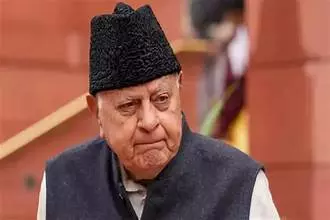
SRINAGAR: A court in Srinagar on Thursday issued a non‑bailable warrant (NBW) against former Chief Minister Farooq Abdullah after rejecting an exemption application filed on his behalf in the long‑running Jammu and Kashmir Cricket Association (JKCA) financial irregularities case investigated by the Central Bureau of Investigation (CBI).
The order came from the Court of the Chief Judicial Magistrate (CJM), Srinagar, during a hearing scheduled for the framing of charges.
According to court records, the case concerns alleged financial mismanagement within the JKCA, widely known as the JKCA scam. The CBI has already filed a chargesheet against several accused, including Abdullah, under Sections 120‑B, 406 and 409 of J&K’s erstwhile Ranbir Penal Code (RPC).
During Thursday’s proceedings, Abdullah—who was in Jammu after surviving an assassination attempt the previous night—did not appear before the court. His counsel sought exemption from personal appearance, but the CJM rejected the plea. The court noted that even after being offered the option of joining the hearing virtually, the counsel declined, stating that Abdullah could neither appear physically nor through video conferencing. The court then directed issuance of the NBW and listed the matter for further proceedings on March 30.
This development follows the court’s earlier order dated March 2, in which it held that prima facie offences under the cited RPC sections were made out against Abdullah and others, directing that charges be framed. The court had fixed March 12 for framing of charges and recording statements of approvers.
However, the court dismissed an application filed by the Enforcement Directorate (ED) seeking to introduce additional charges—specifically Sections 411 and 424 of the RPC in the case. In its order, the court made it clear that the ED had no locus standi to request the addition of charges in a matter that is being investigated and prosecuted exclusively by the CBI. Since the CBI is the primary agency handling the case, the court held that the ED could not intervene in the framing of charges or attempt to expand the scope of the prosecution.
The court further underlined that the ED cannot presume the existence of a predicate offence, which is a mandatory legal foundation for initiating money‑laundering proceedings. Because the CBI’s chargesheet does not establish such an offence under the relevant provisions, the ED’s attempt to rely on it was deemed legally unsustainable. The order noted that the agency appeared to be acting on assumptions rather than on the findings of the primary investigating authority.
In addition, the court described the ED’s application as vague and procedurally flawed, pointing out that it cited provisions from laws that have already been repealed, including sections of the Indian Penal Code that no longer apply in J&K following the erstwhile state’s legal restructuring. This lack of clarity and reliance on outdated statutes further weakened the ED’s plea, leading the court to reject it in its entirety.
In August 2014, the Jammu, Kashmir and Ladakh High Court provided significant relief to Abdullah by quashing the ED chargesheets filed in the money‑laundering case linked to the alleged ₹113‑crore JKCA scam. Justice Sanjeev Kumar ruled that no predicate offence existed, rendering the ED’s chargesheet and supplementary chargesheet unsustainable.
The ED had earlier alleged that JKCA received ₹109.78 crore from the BCCI between 2005 and 2011 and claimed that Abdullah, then JKCA president, misused his position by making illegal appointments and enabling the diversion of funds. The agency stated that over ₹45 crore was siphoned off, including ₹25 crore withdrawn in cash without justification. Assets worth ₹21.55 crore belonging to Abdullah and others were attached, and a charge sheet was filed in 2022.
Those named in the ED chargesheet, including Abdullah, challenged the agency’s jurisdiction before the High Court, leading to the quashing of the proceedings.
The CBI had filed its own chargesheet in July 2018, alleging that large sums were transferred from JKCA accounts to those of office bearers and unrelated individuals. Charges were framed under Sections 406, 168 and 120‑B of the RPC, relating to breach of trust, fraud and criminal conspiracy. Before the CBI took over, the case was handled by a Special Investigation Team (SIT) of the J&K Police, but the High Court transferred the probe in 2015 citing lack of progress and credibility.
Abdullah, removed as JKCA president in July 2015, has consistently denied involvement, arguing in a detailed response to the High Court that his name was being dragged into the case to tarnish his political image.
