Police Raid Publishers as J&K Book Row Deepens

The FIR relates to ‘Personalities and Legends of Jammu and Kashmir’, authored by Hilal Ahmad and Santosh Meena and published by Jammu-based Oberoi Book Service, and ‘Great Personalities of Jammu and Kashmir’, authored by Dr Sushant Giri and published by Delhi-based Anurag Prakashan
SRINAGAR: The controversy over two school-library books accused of glorifying Kashmiri separatist figures has escalated, with the counter-intelligence wing of the Jammu and Kashmir Police registering an FIR and raiding publishing houses linked to the titles.
The case has been filed under provisions of the Bharatiya Nyaya Sanhita and the Unlawful Activities (Prevention) Act. Police said physical documents and digital evidence were seized during searches, though no arrests have been made so far.
The FIR relates to ‘Personalities and Legends of Jammu and Kashmir’, authored by Hilal Ahmad and Santosh Meena and published by Jammu-based Oberoi Book Service, and ‘Great Personalities of Jammu and Kashmir’, authored by Dr Sushant Giri and published by Delhi-based Anurag Prakashan.
Officials said 123 copies of one book were supplied to schools in Jammu, Ramban and Udhampur, while 128 copies of the other reached schools in Jammu and Baramulla under the Samagra Shiksha programme.
The police action came a day after the administration banned both books, blacklisted their authors and publishers, suspended eight School Education Department officials, removed a contractual employee and ordered a time-bound high-level inquiry.
The School Education Department said the books were withdrawn after being found to contain “highly inappropriate content”. The department said it had approved 463 books from 364 publishers this year and that only two titles were found objectionable.
The government accused those involved in the approval process of “serious negligence”, “dereliction of duty” and failure to conduct proper due diligence, saying the material had the potential to create a law-and-order situation.
Eight officials, including a Library Coordinator, Assistant Coordinator, Principal, four Lecturers and an Academic Officer, have been placed under suspension. Sheikh Suheel Ahmad, a contractual Computer Assistant associated with Samagra Shiksha, have been disengaged.
Ashwani Kumar, IAS, Financial Commissioner (Additional Chief Secretary), Power Development Department, has been appointed Inquiry Officer, while Rohit Sharma, JKAS, Additional Secretary in the General Administration Department, will serve as Presenting Officer. The inquiry has been asked to submit its report within 30 days.
The controversy erupted after the BJP and Jammu and Kashmir Peoples’ Forum alleged that the books projected separatist leaders and figures linked to militancy in a favourable light. Leader of Opposition Sunil Sharma claimed one book used objectionable references, including terms such as “India-occupied Kashmir”, and praised figures including Jammu Kashmir National Liberation Front (JKNLF) co-founder Muhammad Maqbool Bhat, who was hanged in Delhi’s Tihar Jail on February 11, 1984, after being convicted in the murder of intelligence official Amar Chand during militant activities in the Valley in the 1960s.
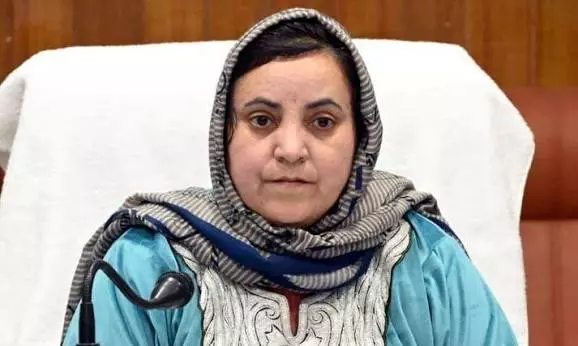
Chief Minister Omar Abdullah has said he has neither seen nor read the books. Education Minister Sakina Itoo, however, condemned the episode as a “deliberate attempt” to influence young minds and sought the immediate removal of officials who approved the titles. She said she had directed the School Education Department to act against those responsible for including inappropriate and separatist-linked content in school library books.
The latest action comes amid a wider crackdown on publications in J&K. Last year, the administration ordered the forfeiture of 25 books by authors, academics, journalists and historians, citing concerns over radicalisation, secessionist narratives and alleged glorification of terrorism. Police later searched bookshops across the Kashmir Valley to stop circulation of the banned titles.
The move drew criticism from civil society groups, journalists, writers and political leaders, who called it an attack on free expression and academic freedom. Critics said many of the works were scholarly studies, memoirs and historical analyses that should be debated, not banned, while supporters argued that material glorifying militancy or promoting separatism could not be treated as neutral scholarship.
