It was not immediately clear about the charges pressed against Wangchuk
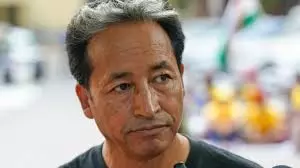
Srinagar: The Leh police arrested climate activist Sonam Wangchuk on Friday, just days after Ladakh’s capital was engulfed in turmoil as protests demanding statehood and inclusion under the Sixth Schedule of the Constitution escalated into violence, resulting in four civilian deaths and over 80 injuries, with nearly half being police personnel.
Wangchuk was arrested under the National Security Act (NSA). On Thursday, he had anticipated detention under the Public Safety Act (PSA), a stringent 1978 J&K law allowing preventive detention without trial for up to two years for activities threatening public order or state security.
Instead, the NSA, enacted in 1980, was used, permitting detention without trial for up to 12 months to prevent threats to national security or public order. The invocation of the NSA is allegedly based on claims that Wangchuk’s actions undermined ongoing government negotiations with Ladakhi representatives. Sources indicate that Wangchuk may be flown out of Leh and detained at a location outside the UT.
Wangchuk’s arrest, just hours before his scheduled 2.30 pm press conference, has intensified tensions in Leh, which has been under curfew since Wednesday evening. Wangchuk was reportedly detained by a police team led by Ladakh DGP S.D. Singh Jamwal at his village near Leh. Following his arrest, Internet services were suspended in Leh.
Kargil observed a shutdown in solidarity with Leh, though no major incidents were reported on Friday. The security forces, including the CRPF, continue patrolling in the twin towns, with locals complaining that they are facing shortages of essentials like food and milk.
Wangchuk, a 59-year-old self-described “engineer-turned-education reformer”, with nearly 4 lakh followers on X, has led a non-violent campaign for Ladakh’s autonomy for the past several years. The Union territory of Ladakh was formed from Jammu and Kashmir after the state lost its special status and was divided into two Union territories on August 5, 2019. Ironically, Wangchuk had initially supported the Centre’s decision, describing Ladakh’s creation as a Union territory as freedom from Kashmiri domination.
The movement, spearheaded by the Leh Apex Body (LAB) and Kargil Democratic Alliance (KDA), representing a broad coalition of political, religious and social groups of Ladakh’s twin regions, seeks statehood, tribal safeguards under the Sixth Schedule, separate Lok Sabha seats for Leh and Kargil, and a Public Service Commission to address youth unemployment.
A peaceful sit-in in Leh on Wednesday turned violent, with clashes involving arson, vandalism of government buildings, and a BJP office, prompting the police to use teargas and impose a curfew.
The Union home ministry said the mob violence was "guided by the provocative statements" of Wangchuk, who continued the strike despite calls to end it. It claimed Wangchuk “misled the people” with references to “Arab Spring-style protests” and “Gen-Z protests in Nepal”, inciting a mob to leave the hunger-strike venue and attack public and political offices. It also accused “certain politically motivated individuals” of being unhappy with the progress in ongoing talks between Ladakhi groups and the MHA’s high-powered committee. The BJP publicly accused the Congress of inciting the violence.
Wangchuk refuted the allegations, asserting he urged peace and ended his 15-day hunger-strike to de-escalate tensions.
The CBI is also probing his outfits, including the Students’ Educational and Cultural Movement of Ladakh (SECMOL), for alleged Foreign Contribution (Regulation) Act violations.
On Thursday, the MHA cancelled the FCRA license of Wangchuk's flagship NGO, Students’ Educational and Cultural Movement of Ladakh, with immediate effect. SECMOL, which runs solar-powered schools and eco-innovations like artificial “Ice Stupas” for water conservation, was accused of misusing foreign funds of Rs 4.93 lakhs from Swedish group Framtidsjorden for youth programmes on climate and migration, depositing local contributions (Rs 54,600) into the FCRA account instead of a domestic one and contraventions of FCRA Sections 8, 12, 17, 18 and 19, including “inappropriate” foreign contributions.
Wangchuk, a 2018 Ramon Magsaysay Award recipient for his eco-innovations like “Ice Stupas”, called the timing of the probe suspicious and described his arrest as a “witch-hunt” to deflect from Ladakh’s core issues, warning it could fuel further protests.
On Thursday, a high-level MHA team arrived in Leh to review the situation, and held meetings with lieutenant-governor Kavinder Gupta and leaders of the Ladakh and Kargil groups.
A preparatory meeting with the MHA is set for September 27 or 28 in New Delhi, followed by talks on October 6 to address the four-point agenda.
Calling Wangchuk’s arrest “unfortunate”, Jammu and Kashmir Chief Minister Omar Abdullah stated that it was anticipated, as the Central government had been targeting him since Thursday. He remarked: “The Central government made promises to the people of Ladakh, similar to those given to Jammu and Kashmir, but it remains unclear why it continues to renege on these commitments.”
Meanwhile, amid escalating tensions, Kargil town and nearby areas are under curfew-like restrictions as a precautionary step following Wangchuk’s detention. On Friday afternoon, the Kargil district administration imposed prohibitory orders under Section 163 of the Indian Civil Security Code 2023, banning large gatherings and public rallies.
Announced via loudspeakers, the orders prohibit the assembly of five or more people until further notice. The Kargil police station SHO confirmed: “The prohibitory orders will remain in effect until further notice, and no one will be allowed to disrupt peace.” Heavy police and paramilitary deployment across the district will prevent unrest and enforce compliance, officials said.

