India, Mangolia to Boost Military Ties

The meeting, held at Hyderabad House, reflected warmth and camaraderie as both leaders shook hands and interacted before the ceremonial planting
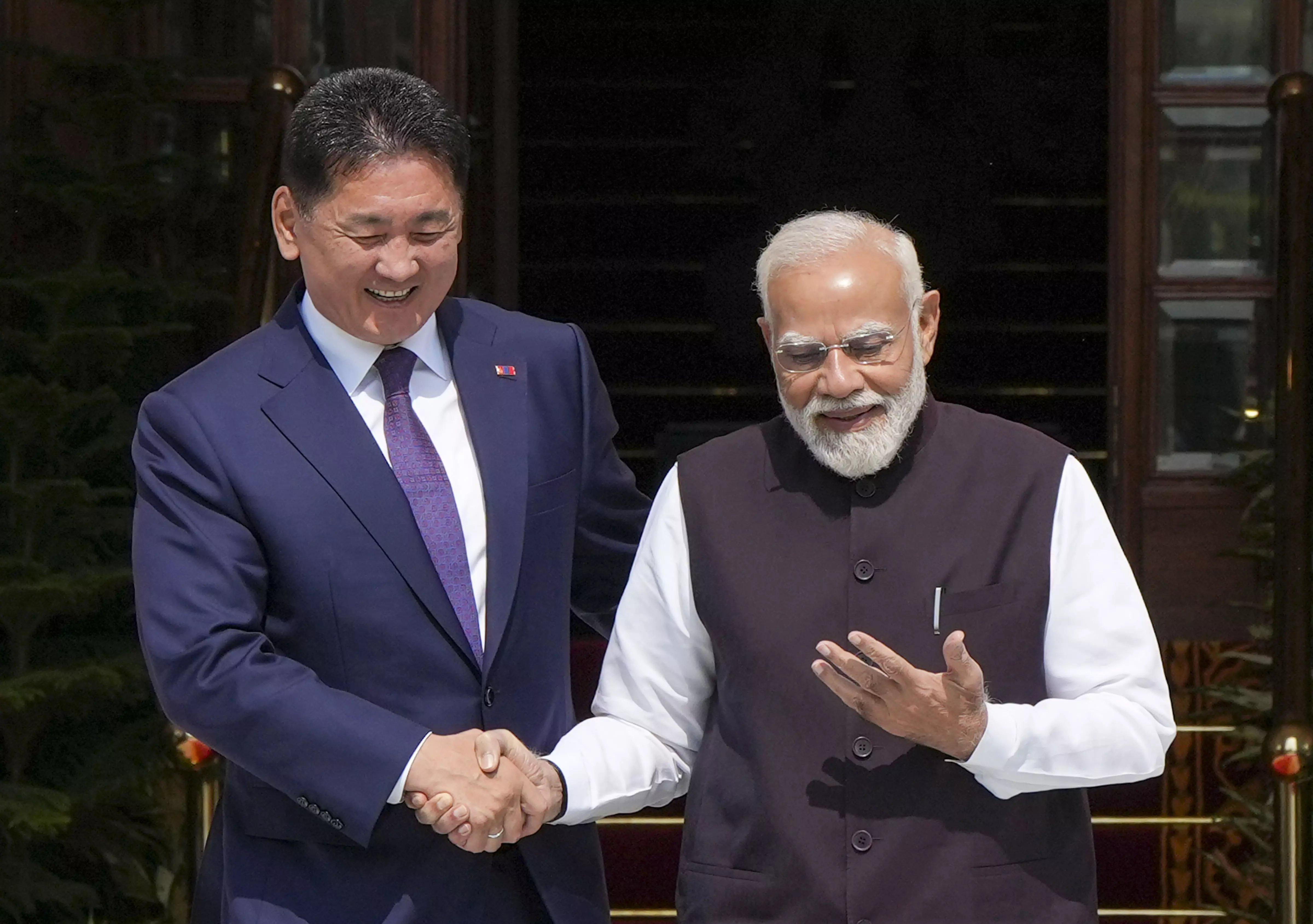
New Delhi: After holding wide-ranging talks with Mongolian President Khurelsukh Ukhnaa here on Tuesday, Prime Minister Narendra Modi announced that India would launch a capacity-building programme for the Central Asian nation's border security forces and strengthen defence cooperation with the landlocked nation. Modi said India and Mongolia stand as close partners in international fora, “supporting a free, open, inclusive, and rules-based Indo-Pacific”.
India and Mongolia inked 10 pacts, including in geology and mineral resources, and one on Indian development grant assistance for quick impact development projects. Pacts were also signed in other sectors, including digital humanitarian aid, immigration matters, cultural exchange and cooperatives. The two nations inked an MoU between the Ladakh Autonomous Hill Development Council and Mongolia’s Arkhangai Province that “will give a fresh boost to cultural ties”. Mongolia has inked the framework agreement for the International Solar Alliance (ISA).
In a special media briefing later, ministry of external affairs secretary (east) P. Kumaran said that on defence cooperation, the Mongolian side was interested in the usage of drones to strengthen security and “wants more support in terms of training” from India. He added that India provides some (defence) equipment to Mongolia and also provides training in cyber security measures to Mongolian armed forces.
The foreign ministry spokesperson pointed out that, at Mongolia’s request, India has appointed a defence attaché at its embassy in the Mongolian capital, Ulan Bator.
After the talks, the Prime Minister said India has been a "steadfast and reliable" partner in Mongolia's development story and pointed out that the oil refinery project, being built with India's $1.7 billion line of credit, will strengthen the Central Asian nation's energy security.
Modi referred to Mongolia as India’s spiritual sibling bound by the common bonds of Buddhism and said that the engagement between the two countries is more than just a diplomatic relationship. He announced free e-visas for Mongolian citizens wanting to visit India.
On his part, the Mongolian President hailed India's leading role in the clean energy sector and specifically referred to the New Delhi-led International Solar Alliance.
The Mongolian President also thanked India for its development assistance and the construction of the oil refinery, which he said will provide economic and energy security for his country. He said Indian development projects will empower local communities and MSMEs in his country.
Ukhnaa also acknowledged India as a leader in the field of energy transition. He also suggested that India help develop the Mongolian high-quality cashmere wool industry. He also mooted a boost to tourism and said a Mongolian air carrier is willing to start chartered flights to New Delhi and Amritsar.
In his media statement, speaking about cooperation in skill development, the Prime Minister said, “Through the Atal Bihari Vajpayee Centre of Excellence for IT and the India-Mongolia Friendship School, the aspirations of Mongolia’s youth are reaching new heights. These projects are a testament to the depth of our friendship.”
Stating that India will continue these efforts, keeping the needs of the people of Mongolia at the forefront, Modi said, “I am happy that our private sector is also exploring new possibilities of cooperation in areas such as energy, critical minerals, rare earths, digital, mining, agriculture, dairy, and cooperatives.”
The Prime Minister announced that next year, the holy relics of two great disciples of Lord Buddha—Sariputra and Maudgalyayana—will be sent from India to Mongolia.
Modi said: “The depth and scope of our partnership is reflected in our people-to-people ties. Both our countries share the age-old bond of Buddhism, which is why we are also called spiritual siblings… We have decided to soon launch a project to digitise one million ancient manuscripts. Nalanda University has played a vital role in Buddhism in Mongolia, and today we have agreed to strengthen this historic connection by linking Nalanda with Gandan Monastery.”
In a special media briefing later, ministry of external affairs secretary (east) P. Kumaran said that on defence cooperation, the Mongolian side was interested in the usage of drones to strengthen security and “wants more support in terms of training” from India. He added that India provides some (defence) equipment to Mongolia and also provides training in cyber security measures to Mongolian armed forces.
The foreign ministry spokesperson pointed out that, at Mongolia’s request, India has appointed a defence attaché at its embassy in the Mongolian capital, Ulan Bator.
