Ladakh Tensions May Escalate As Leh Apex Body Withdraws From Talks With Centre

Four people were killed and scores of others were injured in clashes between protesters and security personnel, while over 50 people were taken into custody for their alleged involvement in rioting. Activist Wangchuk, the main face of the agitation, was also detained under the stringent NSA
Srinagar: In a significant development that could further escalate the political tensions in the strategically sensitive region of Ladakh, the Leh Apex Body (LAB) announced on Monday its decision to withdraw from scheduled talks with the Central government, set for October 6 in New Delhi.
The talks were intended to address critical demands from Ladakh, including statehood, inclusion under the Sixth Schedule of the Indian Constitution, job reservations for locals, and the allocation of separate parliamentary seats for Leh and Kargil.
A preparatory meeting between the ministry of home affairs' high-powered committee (HPC) and representatives of the LAB and Kargil Democratic Alliance (KDA), intended to lay the groundwork for the formal talks on October 6, was planned for September 29. The delay in initiating these talks was being attributed to the need to complete the funerals of victims of the police firings that occurred in Leh on September 24.
Hours after the LAB pulled out from talks with the Centre, the ministry of home affairs expressed its willingness to engage in constructive and outcome-focused discussions with Ladakh groups to resolve issues amicably.
The government issued a statement affirming its openness to dialogue with the LAB and KDA at any time.
A statement issued in New Delhi said: “The government has always been open for dialogues on Ladakh matters with the Leh Apex Body and Kargil Democratic Alliance at any time. We would continue to welcome the discussion with ABL and KDA through the HPC on Ladakh or any such platform.”
The statement added, “The dialogue mechanism established with the LAB and KDA through the high-powered committee on Ladakh has yielded good results to date in the form of increased reservations for the Scheduled Tribes of Ladakh, providing women reservations in LAHDCs (Ladakh Autonomous Hill Development Councils — Leh and Kargil) and protection to local languages. The process of recruitment for 1,800 posts in government has already commenced in the UT of Ladakh. We are confident that continuous dialogue would yield the desired results in the near future.”
The LAB cited the arrest of climate activist and a key member of the leading advocacy group Sonam Wangchuk under the National Security Act (NSA), allegations of "anti-national" labelling against protesters, "indiscriminate" firing by security forces, and an atmosphere of fear, grief, and anger as factors making "meaningful dialogue" impossible.
The LAB's decision to pull out of the talks follows recent violent clashes in Leh, which resulted in the deaths of four persons and injuries to over 80 others, half of whom were police personnel. During a press conference, LAB chairman Thupstan Chhewang announced that the body had unanimously resolved to refrain from engaging in discussions until specific conditions are met.
These conditions include the establishment of a judicial inquiry into the September 24 violence and the withdrawal of legal cases against those arrested during and after the incidents.
Mr Chhewang emphasised that restoring peace and normalcy in the region is a prerequisite for any dialogue. He urged the MHA, the Union territory administration, and district authorities to take immediate steps to address the prevailing situation, stating, "The terror and grief among the people must be addressed. Only after that can talks be considered." The LAB also demanded the release of all individuals detained in connection with the September 24 incident, including Mr Wangchuk.
The KDA has expressed its support for the LAB's decision to withdraw from the talks. KDA member Sajjad Kargili called for the immediate and unconditional release of Mr Wangchuk, who has been transferred to a jail in Jodhpur, along with other detained youth leaders.
The last rites for Rinchen Dadul, a 20-year-old local youth, and Tsewang Tharchin, a 46-year-old former Army veteran who served in the Ladakh Scouts from 1996 to 2021 and fought in the 1999 Kargil War against Pakistan — the remaining two victims of the September 24 police firing — were conducted in Leh on Monday amid heightened security and ongoing curfew restrictions.
This marked the completion of the cremations of all four deceased persons, following the funerals of Jigmet Dorjay, another local youth, and Stanzin Namgyal, an activist, on September 28. The ceremonies took place under stringent controls to prevent gatherings, with participation restricted to immediate family members and media access heavily curtailed.
The cremations of the slain individuals, particularly that of war veteran Tharchin, have intensified calls for a judicial probe into the police firing.
Despite widespread anger over the deaths, no new incidents of violence were reported since the night of September 24, largely due to the heavy security presence and curfew. The LAB and KDA, leading the movement for statehood and other demands, reaffirmed their commitment to non-violent protests and urged locals to avoid provocations while honouring the "martyrs".
Lieutenant-governor Kavinder Gupta, who has been holding daily security review meetings with top security and civil administration officials since the turmoil erupted in Leh last Wednesday, emphasised the critical importance of maintaining law and order.
In an official statement, Mr Gupta issued a stern warning to anti-social and disruptive elements, asserting that strict action would be taken against anyone attempting to incite violence or create unrest. At the same time, he reassured the people of Ladakh of the administration's unwavering commitment to safeguarding their rights, aspirations, and cultural identity. He appealed to citizens to remain calm, cooperate with authorities, and uphold Ladakh's long-standing traditions of peace, brotherhood, and mutual respect. "Ladakh belongs to its people, and the government stands firmly with the locals in ensuring their safety, security, and prosperity. Together, we will not allow any divisive force to derail the peace and development of this region," he asserted.
On Monday, he chaired another high-level meeting with senior officials, including the General Officer Commanding-in-Chief of the Northern Command, Lt. Gen. Pratik Sharma, to assess the situation.
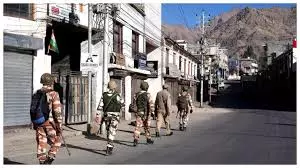
On Monday, Leh remained under a tense but peaceful atmosphere as the town continued to grapple with the aftermath of the violent protests on September 24. A strict curfew, imposed following the clashes, remained in effect, casting a sombre mood over the region. However, a limited relaxation of the curfew was permitted for two hours starting at 1 pm in the old city area, allowing residents to procure essential items such as food and medicine.
Meanwhile, Leh’s markets remained largely deserted, with shops and businesses either closed or operating minimally during curfew relaxations.
Both the old town and newer areas of Leh saw a significant presence of Ladakh Police, Indo-Tibetan Border Police (ITBP), and Central Reserve Police Force (CRPF) personnel enforcing restrictions. Barbed wire barriers and checkpoints limited movement, particularly around sensitive locations such as Martyrs Park, where the cremations of the two remaining victims took place. Internet services, including mobile data and broadband, remained suspended in Leh and surrounding areas as authorities aimed to prevent the spread of inflammatory content.
