Mehbooba Mufti Objects to Repurposing of Cross‑LoC Trade Centre as Tourist Facility

Since the 2019 shutdown, the Salamabad complex — once echoing with the movement of goods and the roar of the Jhelum nearby — deteriorated into disuse. Rust overtook cargo halls, machinery broke down, and signs like “P.O.K. Drivers’ Rest Room” faded under dust
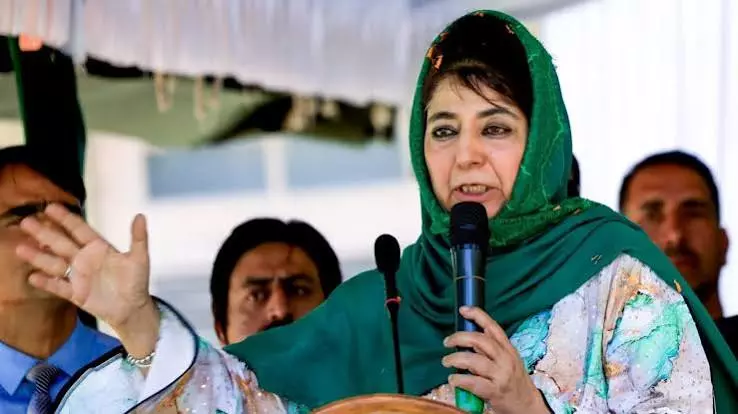
SRINAGAR: Former Jammu and Kashmir chief minister and PDP president Mehbooba Mufti has voiced strong disappointment over the conversion of the Salamabad Cross‑LoC Trade Facilitation Centre in Uri, Baramulla, into an ordinary tourist facility. She argued that the centre was never meant to be a sightseeing stop but a humanitarian and political bridge — a space created to reconnect divided families, deepen people‑to‑people contact, and heal the wounds of separation across the Line of Control (LoC).
The Salamabad centre, located about 100 km north of Srinagar, was established in October 2008 as one of two official points for cross‑LoC trade, the other being Chakan da Bagh in Poonch. Both were part of a series of India–Pakistan confidence‑building measures (CBMs) that followed the launch of the Srinagar–Muzaffarabad bus service in 2005, which allowed divided families to meet after decades. The trade operated on a duty‑free, cashless barter system, with 21 mutually agreed commodities — including apples, dry fruits, carpets, and textiles — exchanged without banking channels.
For years, Salamabad bustled with trucks, traders, and cross‑border drivers. But the facility fell silent in April 2019, when the Narendra Modi government suspended cross‑LoC trade indefinitely, citing security concerns. The Ministry of Home Affairs stated that the routes were being misused for smuggling narcotics, weapons, and fake currency, and that several trading firms were allegedly linked to banned militant organisations. Pakistan condemned the suspension as a unilateral move that undermined CBMs and accused India of politicising humanitarian and economic linkages.
Since the 2019 shutdown, the Salamabad complex — once echoing with the movement of goods and the roar of the Jhelum nearby — deteriorated into disuse. Rust overtook cargo halls, machinery broke down, and signs like “P.O.K. Drivers’ Rest Room” faded under dust. Earlier this month, the J&K government formally handed over the centre to the Tourism Department, which is now repurposing it for border tourism, complete with accommodation rooms, a cafeteria, a park, and LoC viewpoints. Officials describe this as a way to generate local employment and bring Uri onto the tourism map.
Mufti, however, sees the conversion as a symbolic erasure of a vital peace‑building institution. She recalled that the centre “was built to bridge divided families, revive trade and heal wounds,” recalling how PDP workers lost their lives during the Muzaffarabad Chalo rally that demanded opening the LoC routes. She urged Chief Minister Omar Abdullah to take up the matter with the Government of India and push for restoring the centre’s original purpose. “Kashmir needs more bridges to the outside world, not the shutting of those that connect us,” she wrote.
