Modi's remarks come amid chaos over the Trump administration doubling the tariff imposition to 50 per cent on goods from India
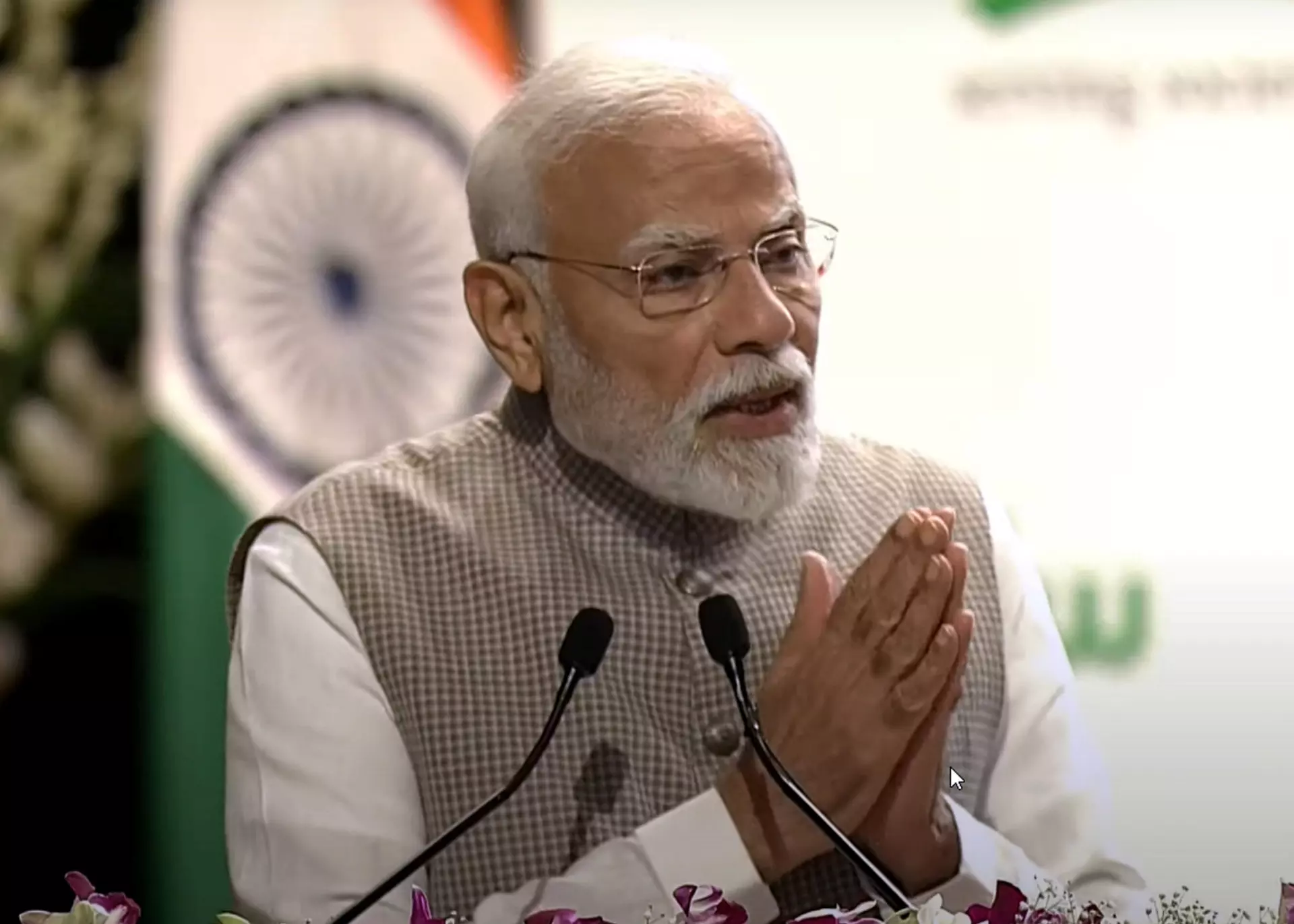
New Delhi: "Bharat will never compromise on the interest of farmers," asserted Prime Minister Narendra Modi on Thursday, amid US President Donald Trump increasing tariff to 50 per cent. The Prime Minister said that for the BJP-led NDA government at the Centre, the welfare of farmers was of the highest priority and that he was prepared to pay a heavy personal price for it if necessary.
Speaking after inaugurating the M.S. Swaminathan Centenary International Conference at the Indian Agricultural Research Institute (ICAR), Pusa, here, the Prime Minister said: “Bharat will never compromise on the interests of its farmers, livestock rearers and fishermen. I am fully aware that I may have to pay a very heavy price personally, but I am prepared for it."
"For the farmers of my country, for the fishermen of my country, for the livestock rearers of my country, Bharat stands ready today for the fishermen and dairy farmers. We are continuously working towards increasing farmers’ incomes, reducing their agricultural expenditure and creating new sources of income,” Modi said.
The Prime Minister’s statement came a day after the US President ratcheted up tariffs on Indian goods to 50 per cent and on a day the initial 25 per cent tariffs announced by the US on Indian imports came into effect. The two nations continue to discuss a bilateral trade deal, which has been stuck over the US demand for greater access to India's agricultural and dairy market.
The US wants reduced tariffs on products like corn, soybeans, apples, almonds and ethanol, as well as increased access for US dairy products. New Delhi is resisting these demands, as these will have a direct bearing on farmers.
The Prime Minister noted that the Centre regarded the strength of farmers as the foundation of the nation's progress. “That is why the policies framed in recent years have not merely extended assistance but have also sought to build trust among farmers,” he said.
Modi mentioned that the direct financial support provided through the PM-Kisan Samman Nidhi had empowered small farmers with self-confidence and the PM Fasal Bima Yojana has given them protection from risk.
“Issues related to irrigation have been addressed through the PM Krishi Sinchai Yojana. The creation of 10,000 FPOs has enhanced the collective strength of small farmers. Financial support to cooperatives and self-help groups has given fresh momentum to the rural economy,” Modi said.
Mentioning the e-NAM platform, Modi said that it has made it easier for farmers to sell their produce, while the PM Kisan Sampada Yojana has accelerated the development of new food processing units and storage infrastructure.
The Prime Minister said that the recently approved PM Dhan Dhanya Yojana aims to uplift 100 districts where agriculture had lagged behind. “By providing facilities and financial assistance in these districts, the government is instilling new confidence in farming,” he said.
r Modi stated that 21st-century India was fully committed to becoming a developed nation and this goal will be achieved through the contribution of every section of society and every profession.
Drawing inspiration from Dr Swaminathan, the Prime Minister stated that India’s scientists had another opportunity to create history. Highlighting that the previous generation of scientists ensured food security, he stressed that the current focus must shift towards nutritional security.
Calling for the large-scale promotion of bio-fortified and nutrition-rich crops to improve public health, Modi advocated for reducing the use of chemicals in agriculture and urged for greater promotion of natural farming, stating that more urgency and proactive efforts are required in this direction.
Sharing his association with Dr Swaminathan, the Prime Minister recalled the earlier conditions in Gujarat, where agriculture faced severe challenges due to droughts and cyclones.
Noting that during his tenure as the Chief Minister of Gujarat, work began on the "Soil Health Card" initiative, he remembered the professor showing great interest in the initiative, offering open-hearted suggestions that significantly contributed to its success.
“Professor Swaminathan led the campaign to make India self-reliant in food production,” emphasised the Prime Minister, stating that his identity extended beyond the Green Revolution.