CISF at 57: The Shield Guarding India’s Strategic Assets

Marking 57 years of dedicated service to the nation, the CISF security umbrella today extends across the nation’s most critical and vital installations
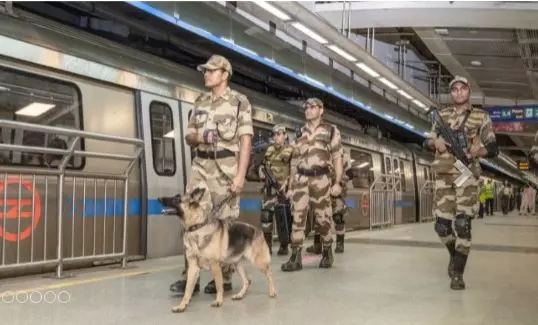
Hyderabad: The Central Industrial Security Force (CISF) has the unique distinction of providing security to key government buildings, historical monuments and other vital installations including airports and metro rail even as the force gears up to celebrate 57th Raising Day on March 6.
Marking 57 years of dedicated service to the nation, the CISF security umbrella today extends across the nation’s most critical and vital installations, including nuclear facilities, space establishments, airports, seaports, power plants, and other strategic infrastructure including the mass rapid transport system such as the Delhi metro.
In addition, the CISF is entrusted with the security of the central jail in Jammu and Kashmir and provides security cover to certain categories of VIPs.
Formed under the 50th Act of Parliament in 1968, the CISF today stands as a truly multi-faceted Central Armed Police Force. From its modest beginning with just 3,129 personnel, the force has grown into a formidable strength of 2.20 lakh personnel, deployed across almost all states of the country.
The CISF presently provides security cover to 361 critical national installations, including 70 airports. In addition, the force maintains 12 reserve battalions to respond to any security exigency and operates 08 state-of-the-art Training institutions, across the country that continuously shape and strengthen the “Force of the Future”.
Owing to its consistent professionalism, vigilance, and dedication, the CISF has now been entrusted with the security of the “Temple of Democracy” — the Parliament House of India. Through its continual efforts to safeguard the nation’s critical assets with utmost efficiency, the CISF has earned immense public trust.
Today, the force stands as one of the most visible and people-connected security agencies in the country, with extensive public interaction at airports, metro stations, and heritage sites. The daily security interactions of CISF with the public goes upto one crore.
The CISF has not only grown stronger in terms of manpower but has also evolved into a technologically advanced force. It is the only Central Armed Police Force (CAPF) that possesses a full-fledged Fire Wing, deployed across key installations and comprising highly trained professionals equipped with state-of-the-art fire-fighting and rescue equipment.
In addition to safeguarding national assets and preventing huge revenue losses through its effective security and fire-safety mechanisms, the CISF has also generated significant revenue through its specialized consultancy services. These services, available to private entities for a nominal fee, have been availed by several leading organizations such as SBI Data Centres (Mumbai, Chennai and Hyderabad), AIIMS New Delhi, IIM Indore and Shri Kashi Vishwanath Temple (Varanasi) among others.
The CISF, the “Shield of Security”, also holds the distinction of having the largest number of women personnel among the Central Armed Police Forces, reflecting its commitment to gender equality and inclusivity.
As the sentinel of the nation’s critical infrastructure, the CISF continues to enhance its professional capabilities and technological edge, staying steadfast to its motto — “Protection and Security.”
On January 29 1964, there was a major fire at the Heavy Engineering Corporation plant at Ranchi which resulted in colossal loss of properties. A commission headed by Justice B. Mukherjee in his report had cited sabotage as the cause of fire and recommended in the report for a disciplined and uniformed force to be assigned the responsibility of providing fire and security coverage to the Public Sector Undertakings (PSUs).
The first fire wing unit with strength of 53 personnel was inducted at FACT Cochin on 16th April, 1970. The Central government in January 1991 approved the recruitment rules for various posts of fire service cadre in CISF and accordingly the fire service cadre started functioning in CISF on January 12, 1991.
At present 115 PSUs and government establishments spread in the entire length and breadth of the country are provided with the fire safety coverage by CISF fire wing.
It is managed by professionally trained personnel with science and engineering background. providing fire prevention and fire protection to the highly sensitive, vulnerable and hazardous units like Petro-Chemical Complex, Oil Refinery, Steel Plants, Chemical & Fertilizer Plants, Port Trusts, Nuclear and Space Organizations, Power Plants, Defence installations, Parliament House Complex and establishments of the Finance Ministry.
The wing is providing fire safety coverage to 115 different installations all over the country. The CISF has a Fire Service Training Institute (FSTI) which was established in 1987 at Deoli, Rajasthan. Later on, FSTI was shifted to CISF NISA Campus Hakimpet in 1999. It has training facilities ranging from the basic physical exercise ground, black top for drill purposes, swimming pool, library, industrial fire tower for simulation exercise, drill tower for rescue drill, BA Gallery for simulator exercise, Model Fire Station, MT Section, CSSR, ASAR, USAR props area, Model Room and Laboratory to a state of the art technical centre with specialized training equipment with simulators.
The highly specialized training of the fire wing personnel has helped them achieve effective fire protection in a high fire risk industrial set up. The data reflects the immense contribution of the CISF fire wing. The CISF saved Rs.145.36 crore in 2025 attending 2,578 fire calls. In all, the CISF attended 32,705 fires and saved property worth Rs.3036.06 crore up to September 25, 2025 from 2016.