Yasin Malik Named Mastermind In 1990 Nurse Sarla Bhat's Murder Case

State Investigation Agency (SIA) on Monday filed an over 700-page chargesheet naming banned JKLF chief Yasin Malik as the key accused in the kidnapping and brutal killing of young Kashmiri Pandit nurse Sarla Bhat by terrorists in April 1990.
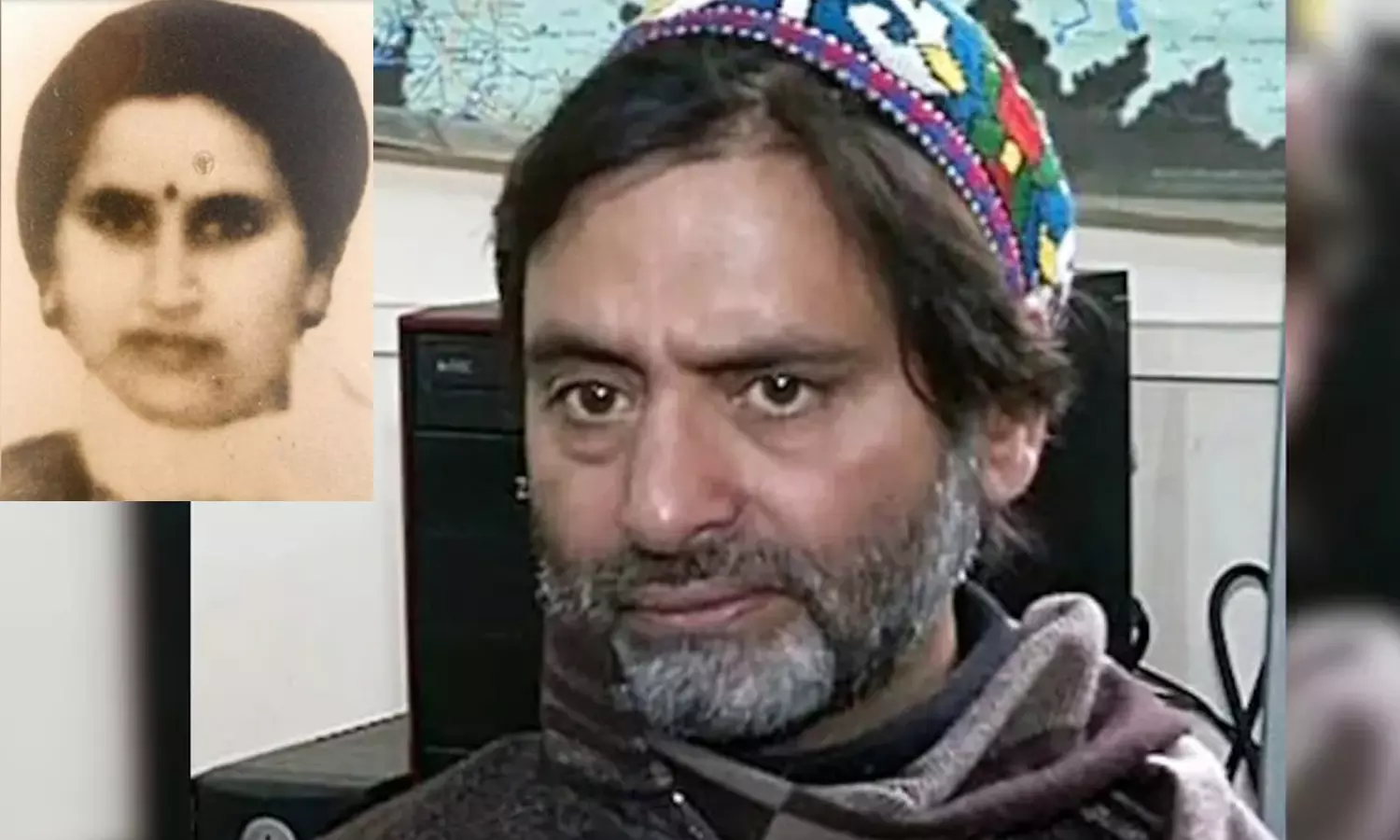
SRINAGAR: In what the concerned authorities termed as a major breakthrough in one of Kashmir’s most painful and long-pending cases from the early years of militancy, the State Investigation Agency (SIA) has filed an extensive 737-page chargesheet before a Special Court in Srinagar in connection with the abduction and killing of Sarla Bhat, a young nurse at the city's Sher-i-Kashmir Institute of Medical Sciences (SKIMS).
"The development marks a significant step toward accountability nearly 35 years after the crime that shocked the Valley," said an official.
Bhat, a 27-year-old Kashmiri Pandit, was abducted on April 18, 1990, from near her hostel and was found dead the following day in Srinagar’s Malla Bagh area. Her body bore multiple bullet injuries, reportedly along with indications of torture and sexual assault. A note left with her remains labelled her a “police informant,” a claim that investigators now say was baseless and used merely as a pretext for her targeted killing.
At the centre of the chargesheet is former Jammu Kashmir Liberation Front (JKLF) chief Muhammad Yasin Malik, who has been named as one of the accused in the case. Malik is already serving life imprisonment in a separate case related to terror funding and money laundering, in which the National Investigation Agency (NIA) has sought the death penalty.
The SIA’s chargesheet now places him among those allegedly involved in the conspiracy, abduction, and subsequent murder of Bhat—bringing renewed attention to his alleged role in militancy-era violence.
Alongside Malik, the chargesheet names Khurshid Ahmad Chalkoo, Abdul Hamid Sheikh, Muhammad Yousuf Sofi alias Idrees, and Ghulam Muhammad Taploo as co-accused. Of these, three—Sheikh, Sofi, and Taploo—have since died, while Chalkoo is believed to have fled to Pakistan-occupied Jammu and Kashmir (PoJK), with proclamation proceedings already initiated against him.
The case, originally registered as FIR No. 56/1990 at Srinagar's Nigeen Police Station, remained unresolved for decades "due to a climate of fear, instability, and reluctance among witnesses to come forward during that period". It was only after the investigation was formally transferred to the SIA on March 18, 2024, that a fresh and detailed probe was launched. Investigators revisited the case using a combination of eyewitness testimonies, protected witness accounts, forensic and ballistic reports, medical records, documentary evidence, and electronic material.
Importantly, officials had recently indicated that modern forensic advancements—especially DNA analysis and forensic genetic genealogy—could play a pivotal role in strengthening the case. If preserved biological samples such as blood, hair, or skin cells from the crime scene are available, they may provide crucial evidence linking suspects to the crime, offering hope of scientific corroboration in a case long dependent on human testimony.
The chargesheet invokes multiple serious offences under the Ranbir Penal Code (RPC) of the erstwhile state of J&K—including kidnapping, wrongful restraint, murder, destruction of evidence, and criminal conspiracy—along with provisions of the Terrorist and Disruptive Activities (Prevention) Act (TADA) and the Indian Arms Act.
According to the SIA, the killing was not an isolated act but part of a broader strategy aimed at spreading fear and enabling the displacement of the Kashmiri Pandit community during the turbulent early 1990s.
The reopening of the Sarla Bhat case is part of a wider initiative by the J&K administration under Lieutenant Governor Manoj Sinha to revisit what have been described as “deliberately buried” militancy-era cases. In July last year, Sinha directed officials to prioritise unresolved killings, file fresh FIRs where needed, provide jobs to victims' next-of-kin, and reclaim seized properties. Special cells were set up to support terror-affected families, which, officials claimed, reflected a commitment to accountability after years of perceived inaction.
A 2008 J&K Police report recorded 209 Kashmiri Pandit killings since 1989, with 109 in 1990 alone, and chargesheets filed in only a fraction of cases. Pandit groups assert higher figures, viewing Bhat's murder as emblematic of the targetted violence that displaced over tens of thousands of community members. For many, the Sarla Bhat case symbolises the broader pain and unresolved trauma of that era.
The SIA has emphasised that the filing of this chargesheet demonstrates a clear commitment to pursuing justice irrespective of the time elapsed. By reconstructing events through painstaking investigation and bringing forward allegations against individuals—including high-profile figures like Malik—the agency has signaled that terror-related crimes remain subject to the full process of law, even decades later, officials said.
This development not only reopens a deeply tragic chapter in Kashmir’s history but also raises the prospect of long-awaited answers for victims’ families and the broader community that continues to seek justice, said a Kashmiri activist.
