Lavrov Accuses US Of Trying To Prevent India From Buying Russian Oil

Russia's Foreign Minister Sergey Lavrov also accused the US of using "unfair methods" to suppress competitors by imposing sanctions on Russian oil companies.
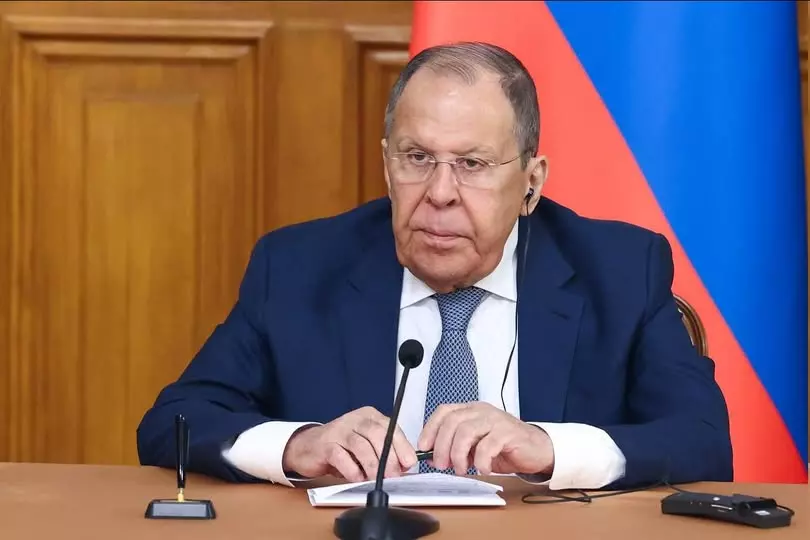
Moscow : Russia has accused the US of attempting to prevent India and other countries from buying Russian oil, saying Washington is using a wide range of "coercive" measures, including tariffs, sanctions and direct prohibitions, to fulfil its objective of global economic dominance. Foreign Minister Sergey Lavrov also accused the US of using "unfair methods" to suppress competitors by imposing sanctions on Russian oil companies.
"(The US) is attempting to control our trade, investment cooperation, and military-technical ties with major strategic partners, such as India and other BRICS members," Lavrov said in an interview with TV BRICS on Monday.
He said that the West is reluctant to relinquish its formerly dominant positions. "With the arrival of the (US President Donald) Trump administration, this struggle to suppress competitors became particularly pronounced and open," he said.
Lavrov said that Russia accepted America's proposal on Ukraine during the Alaska talks between President Vladimir Putin and his US counterpart Trump last year.
"We were told that the Ukrainian issue must be resolved. In Anchorage, we accepted the United States' proposal. To put it straightforwardly, they proposed, and we agreed - the problem should be solved," he said.
"Having accepted their proposals, we essentially fulfilled the task of resolving the Ukrainian issue and moving toward comprehensive, broad, mutually beneficial cooperation," he added.
"In practice, however, the opposite occurs: new sanctions are imposed, attacks on tankers are staged in international waters in violation of the UN Convention on the Law of the Sea, and India and other partners are discouraged from purchasing affordable Russian energy, while Europe has long prohibited such purchases, forcing them to buy American liquefied natural gas at significantly higher prices. Thus, in the economic sphere, the US has effectively declared a goal of economic domination," he said.
Lavrov said that the US aims to control all energy supply routes for all leading countries across continents, including in Europe, where they monitor the Nord Stream pipelines, the Ukrainian gas transport system, and the TurkStream pipeline.
"I am highlighting this to emphasise that the US' objective is global economic dominance, implemented through a wide range of coercive measures inconsistent with fair competition, including tariffs, sanctions, direct prohibitions, and even restrictions on communication for some partners. We must take all this into account," Lavrov said.
"While remaining open, just like India, China, Indonesia and Brazil, to cooperation with all countries, including a major power such as the US, we are in a situation where the Americans themselves are creating artificial obstacles along the way," he said.
Trump, while announcing a trade deal with New Delhi last week, claimed India agreed not to procure crude oil from Russia.
In an executive order, Trump rolled back an additional 25 per cent tariff on India that he imposed in August last for India's procurement of crude oil from Russia.
In the order, the US said it would monitor whether India resumed Russian oil purchases directly or indirectly, and that would determine whether a 25 per cent tariff would again be re-imposed.
On Monday, Foreign Secretary Vikram Misri said India will maintain multiple sources for crude oil purchases and diversify them to ensure stability in the supply chain, with national interests remaining the "guiding factor" for the procurement.
Lavrov also said that Russia will actively support India's chairmanship of BRICS with its current agenda, which is "modern, highly-relevant" with an emphasis on counter-terrorism and energy security.
India formally assumed on January 1, 2026, the chairmanship of BRICS, a 10-member bloc comprising Brazil, Russia, India, China and South Africa, along with five new members.
