India placed better compared to Asian peers on reciprocal tariffs

Notwithstanding India’s engagement with the US on a bilateral trade treaty, the latter has imposed a 27 per cent tariff on Indian imports. The US is using reciprocal tariff as a weapon to force its trading partners to negotiate on their duties
Chennai: Despite a 27 per cent reciprocal tariff by the US, India is in a better position compared to its Asian peers like China, Vietnam, Bangladesh, Cambodia and Thailand in some of the large US-focused sectors. While pharmaceuticals are exempted from tariffs, textiles have a better opportunity. Gems and jewellery, marine products and carpets will be hit badly, and the slump in demand in the US due to the increased tariffs and inflation will affect all the trading partners.
Notwithstanding India’s engagement with the US on a bilateral trade treaty, the latter has imposed a 27 per cent tariff on Indian imports. The US is using reciprocal tariff as a weapon to force its trading partners to negotiate on their duties.
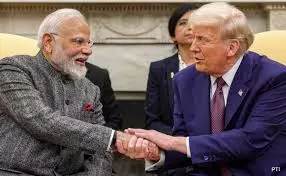
Recalling Indian Prime Minister Narendra Modi’s US visit, US President Donald Trump said: "The Prime Minister just left. He's a great friend of mine, but I said, 'You're a friend of mine, but you're not treating us right'.
According to him the US has levied a “discounted tariff” on India. “They charge us 52 per cent. We charge them almost nothing for years and years and decades," he added.
However, the calculation of the average tariff imposed by India on US imports itself is erroneous. While the tariffs range between zero to 125 per cent, the average tariffs would be around 7.9 per cent as the large volume goods are charged with lower duties.
“Almost 60 per cent of the goods imported from the US carry less than 5 per cent duty. In terms of import volumes, petroleum products, waste and scrap metal and coal are the largest categories and the duties on these categories are lower,” said Ajay Srivastava, founder, GTRI.
While this “discounted tariff” of 27 per cent is higher compared to the European Union at 20 per cent, UK at 10 per cent and Mexico and Canada, which have been exempted. These countries were also in the US list of “Dirty 15” along with India and China.
However, India fares better against its Asian peers. China with 54 per cent tariff, Vietnam 46 per cent, Bangladesh 37 per cent, Thailand 36 per cent and Cambodia 49 per cent.
“For some sectors, the tariffs are beneficial and for some they are not. In sectors like textiles, footwear, chemicals, plastics electronics, machinery and toys, India stands to have a tariff advantage and pharma will be relieved due to the exemption given to select sectors. Gems and jewellery will bear the brunt of drop in demand, and Ecuador with a 10 per cent tariff will gain in marine exports and we will lose to Turkey in carpets,” said Ajay Sahai, director general of FIEO.
Provided, Trump’s policy maintains some level of consistency, the protectionist tariff regime could act as a catalyst for India to gain from global supply chain realignments. “However, to fully leverage these opportunities, India must enhance its ease of doing business, invest in logistics and infrastructure, and maintain policy stability,” said Srivastava. Further, the tariffs will not bring in investments into the US as businesses will not make bets for a four-year term, added Sahai.
The tariffs are levied in two steps. The basic tariff of 10 per cent on almost all the trading partners will be imposed from April 5 and the additional reciprocal tariffs on countries will kick in on April 9. Industry expects that the new tariffs will be applicable for all goods entering the country from these dates. The tariffs on automobiles, announced earlier, will be applicable to all from April 3.
